Zhao Feng, Ge Yu-Zheng, Zhou Liu-Hua, Xu Lu-Wei, Xu Zheng, Ping Wen-Wen, Wang Min, Zhou Chang-Cheng, Wu Ran, Jia Rui-Peng
Department of Urology, Nanjing First Hospital, Nanjing Medical University, Nanjing, China.
Department of Rheumatology, The First Affiliated Hospital of Nanjing Medical University, Nanjing, China.
Onco Targets Ther. 2017 Nov 22;10:5551-5559. doi: 10.2147/OTT.S146479. eCollection 2017.
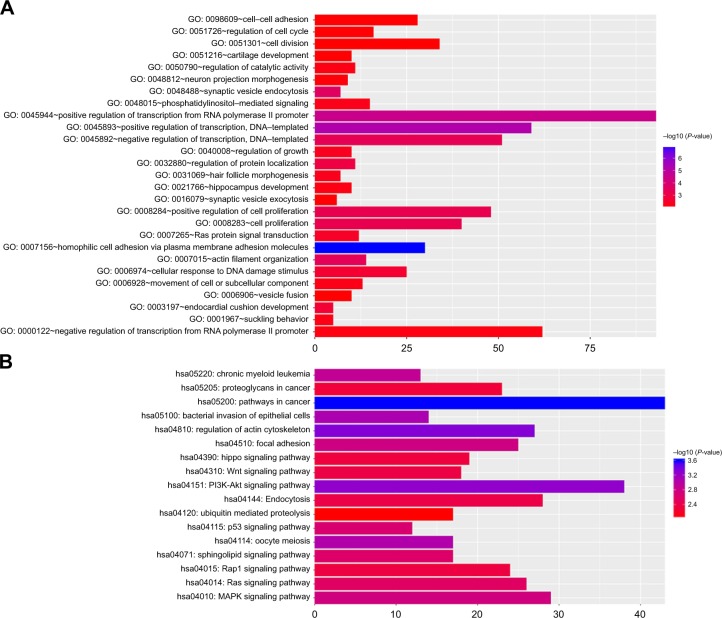
Bladder cancer (BC) is a common urinary system tumor with high aggressiveness, and it results in relatively high mortality due to a lack of precise and suitable biomarkers. In this study, we applied the weighted gene coexpression network analysis method to miRNA expression data from BC patients, and screened for network modules associated with BC progression. Hub miRNAs were selected, followed by functional enrichment analyses of their target genes for the most closely related module. These hub miRNAs were found to be involved in several functional pathways including pathway in cancer, regulation of actin cytoskeleton, PI3K-Akt signaling pathway, mitogen-activated protein kinase (MAPK) signaling pathway, Wnt signaling pathway, proteoglycans in cancer, focal adhesion and p53 signaling pathway via regulating target genes. Finally, their prognostic significance was tested using analyses of overall survival. A few novel prognostic miRNAs were identified based on expression profiles and related survival data. In conclusion, several miRNAs that were critical in BC initiation and progression have been identified in this study. These miRNAs, which may contribute to a comprehensive understanding of the pathogenesis of BC, could serve as potential biomarkers for BC prognosis or as new therapeutic targets.
膀胱癌(BC)是一种常见的具有高侵袭性的泌尿系统肿瘤,由于缺乏精确且合适的生物标志物,其导致的死亡率相对较高。在本研究中,我们将加权基因共表达网络分析方法应用于膀胱癌患者的miRNA表达数据,并筛选出与膀胱癌进展相关的网络模块。选择了枢纽miRNA,随后对其靶基因进行功能富集分析以确定最密切相关的模块。发现这些枢纽miRNA通过调控靶基因参与多种功能途径,包括癌症通路、肌动蛋白细胞骨架调控、PI3K-Akt信号通路、丝裂原活化蛋白激酶(MAPK)信号通路、Wnt信号通路、癌症中的蛋白聚糖、粘着斑和p53信号通路。最后,通过总生存分析检验了它们的预后意义。基于表达谱和相关生存数据鉴定出了一些新的预后miRNA。总之,本研究鉴定出了几种在膀胱癌起始和进展中起关键作用的miRNA。这些miRNA可能有助于全面了解膀胱癌的发病机制,可作为膀胱癌预后的潜在生物标志物或新的治疗靶点。