Kim Young Joong, Lee Eun Hye, Jun Jae Kwan, Shin Dong-Rock, Park Young Mi, Kim Hye-Won, Kim Youme, Kim Keum Won, Lim Hyo Soon, Park Jeong Seon, Kim Hye Jung, Jo Hye-Mi
Department of Radiology, Konyang University Hospital, Konyang University College of Medicine, Daejeon 35365, Korea.
Department of Radiology, Bucheon Hospital, Soonchunhyang University College of Medicine, Bucheon 14584, Korea.
Korean J Radiol. 2017 Jul-Aug;18(4):624-631. doi: 10.3348/kjr.2017.18.4.624. Epub 2017 May 19.
To analyze participant factors that affect the diagnostic performance of screening mammography.
We enrolled 128756 cases from 10 hospitals between 2005 and 2010. We analyzed recall rate, cancer detection rate (CDR) per 1000 examinations, positive predictive value (PPV), sensitivity, specificity, false positive rate (FPR), and interval cancer rate (ICR) per 1000 negative examinations according to participant factors including age, breast density, and number of visit to the same institution, and adjusted for confounding variables.
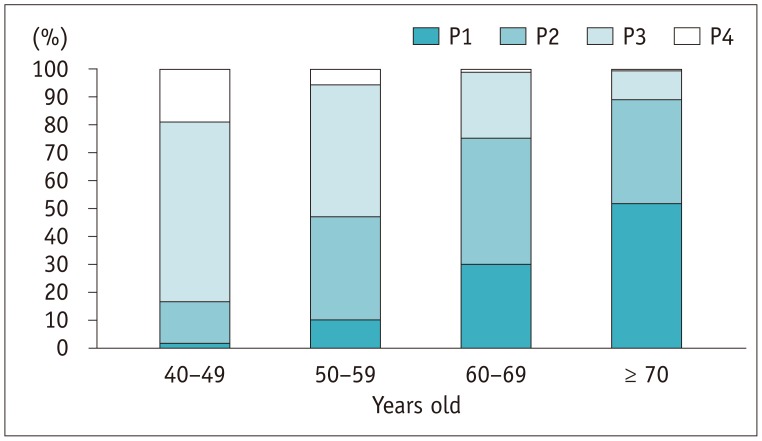
Increasing age improved recall rates (27.4% in 40's, 17.5% in 50's, 11.1% in 60's, and 8.6% in 70's), CDR (2.7, 3.2, 2.0, and 2.4), PPV (1.0, 1.8, 1.8, and 2.8%), sensitivity (81.3, 88.8, 90.3, and 94.7%), specificity (72.7, 82.7, 89.0, and 91.7%), and FPR (27.3, 17.3, 11.0, and 8.4%) ( < 0.05). Higher breast density impaired recall rates (4.0% in P1, 9.0% in P2, 28.9% in P3, and 27.8% in P4), PPV (3.3, 2.3, 1.2, and 1.3%), specificity (96.1, 91.2, 71.4, and 72.5%), and FPR (3.9, 8.9, 28.6, and 27.6%) ( < 0.001). It also increased CDR (1.3, 2.1, 3.3, and 3.6) and ICR (0.2, 0.3, 0.6, and 1.6) ( < 0.05). Successive visits to the same institution improved recall rates (20.9% for one visit, 10.7% for two visits, 7.7% for more than three visits), PPV (1.6, 2.8, and 2.7%), specificity (79.4, 89.6, and 92.5%), and FPR (20.6, 10.4, and 7.5%) ( < 0.001).
Young age and dense breasts negatively affected diagnostic performance in mammography screening, whereas successive visits to the same institution had a positive effect. Examinee education for successive visits to the same institution would improve the diagnostic performance.
分析影响乳腺钼靶筛查诊断性能的参与者因素。
2005年至2010年间,我们从10家医院招募了128756例病例。我们根据年龄、乳腺密度和到同一机构就诊次数等参与者因素,分析了召回率、每1000次检查的癌症检出率(CDR)、阳性预测值(PPV)、灵敏度、特异度、假阳性率(FPR)以及每1000次阴性检查的间期癌发生率(ICR),并对混杂变量进行了校正。
年龄增加可提高召回率(40多岁为27.4%,50多岁为17.5%,60多岁为11.1%,70多岁为8.6%)、CDR(2.7、3.2、2.0和2.4)、PPV(1.0%、1.8%、1.8%和2.8%)、灵敏度(81.3%、88.8%、90.3%和94.7%)、特异度(72.7%、82.7%、89.0%和91.7%)以及FPR(27.3%、17.3%、11.0%和8.4%)(P<0.05)。较高的乳腺密度会降低召回率(P1为4.0%,P2为9.0%,P3为28.9%,P4为27.8%)、PPV(3.3%、2.3%、1.2%和1.3%)、特异度(96.1%、91.2%、71.4%和72.5%)以及FPR(3.9%、8.9%、28.6%和27.6%)(P<0.001)。它还会增加CDR(1.3、2.1、3.3和3.6)和ICR(0.2、0.3、0.6和1.6)(P<0.05)。到同一机构多次就诊可提高召回率(就诊1次为20.9%,就诊2次为10.7%,就诊3次以上为7.7%)、PPV(1.6%、2.8%和2.7%)、特异度(79.4%、89.6%和92.5%)以及FPR(20.6%、10.4%和7.5%)(P<0.001)。
年轻和乳腺致密对乳腺钼靶筛查的诊断性能有负面影响,而到同一机构多次就诊则有积极影响。对受检者进行关于到同一机构多次就诊的教育将提高诊断性能。