Höchenberger Richard, Ohla Kathrin
Psychophysiology of Food Perception, German Institute of Human Nutrition Potsdam-RehbrueckeNuthetal, Germany.
NutriAct - Competence Cluster Nutrition Research Berlin-PotsdamNuthetal, Germany.
Front Psychol. 2017 Jun 16;8:981. doi: 10.3389/fpsyg.2017.00981. eCollection 2017.
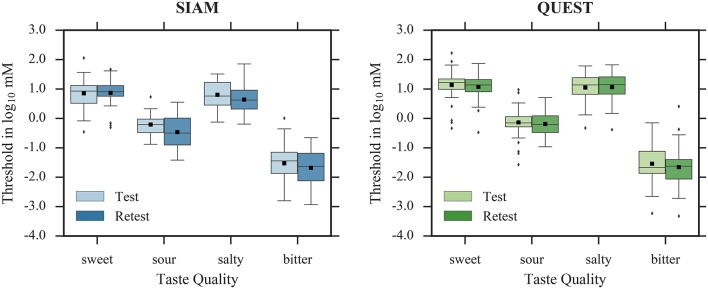
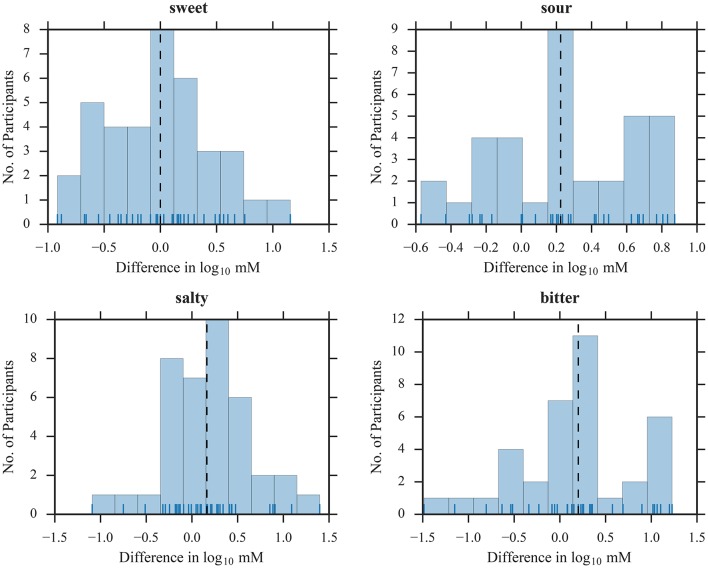
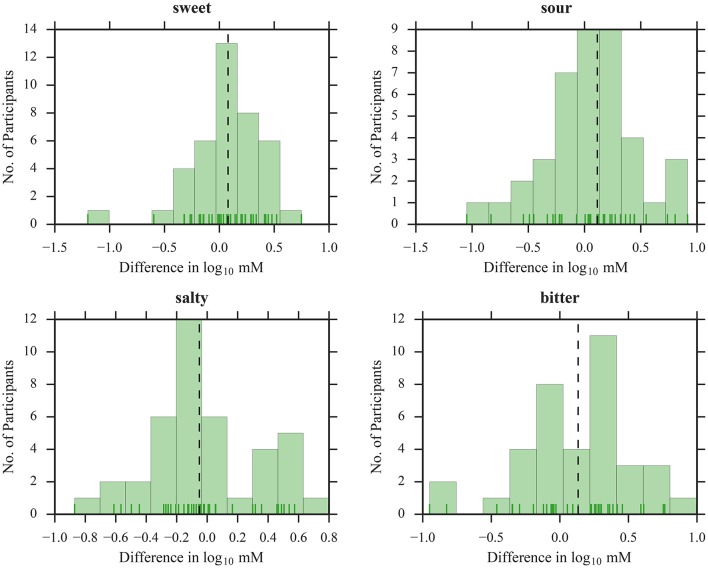
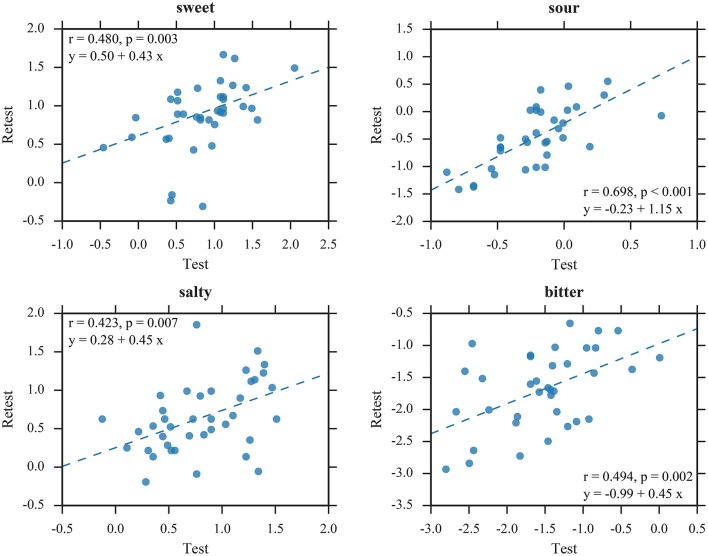
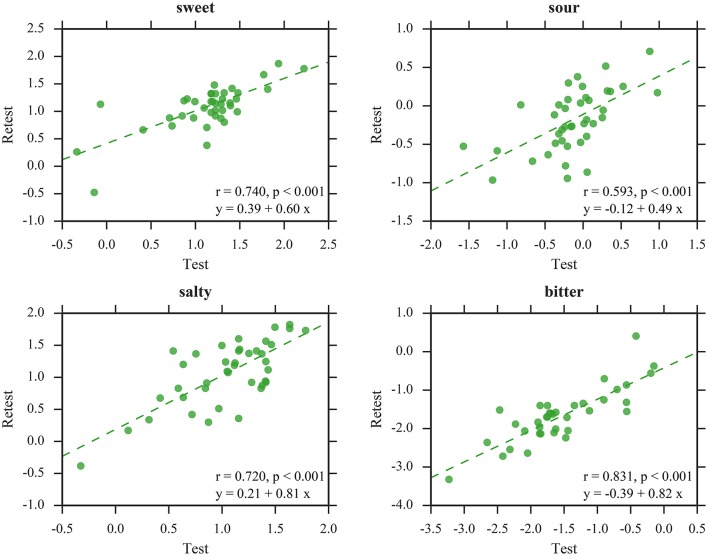
Adaptive methods provide quick and reliable estimates of sensory sensitivity. Yet, these procedures are typically developed for and applied to the non-chemical senses only, i.e., to vision, audition, and somatosensation. The relatively long inter-stimulus-intervals in gustatory studies, which are required to minimize adaptation and habituation, call for time-efficient threshold estimations. We therefore tested the suitability of two adaptive yes-no methods based on SIAM and QUEST for rapid estimation of taste sensitivity by comparing test-retest reliability for sucrose, citric acid, sodium chloride, and quinine hydrochloride thresholds. We show that taste thresholds can be obtained in a time efficient manner with both methods (within only 6.5 min on average using QUEST and ~9.5 min using SIAM). QUEST yielded higher test-retest correlations than SIAM in three of the four tastants. Either method allows for taste threshold estimation with low strain on participants, rendering them particularly advantageous for use in subjects with limited attentional or mnemonic capacities, and for time-constrained applications during cohort studies or in the testing of patients and children.
自适应方法能快速且可靠地估计感官敏感度。然而,这些程序通常仅针对非化学感官开发并应用,即视觉、听觉和躯体感觉。味觉研究中为尽量减少适应和习惯化所需的相对较长的刺激间隔,需要高效的阈值估计方法。因此,我们通过比较蔗糖、柠檬酸、氯化钠和盐酸奎宁阈值的重测信度,测试了基于SIAM和QUEST的两种自适应二选一方法用于快速估计味觉敏感度的适用性。我们发现,两种方法都能高效地获得味觉阈值(使用QUEST平均仅需6.5分钟,使用SIAM约需9.5分钟)。在四种味觉刺激物中的三种上,QUEST的重测相关性高于SIAM。这两种方法都能在参与者负担较小的情况下估计味觉阈值,使其特别适用于注意力或记忆能力有限的受试者,以及队列研究或患者及儿童测试中受时间限制的应用场景。