Wei Lei, Wu Qingping, Zhang Jumei, Guo Weipeng, Chen Moutong, Xue Liang, Wang Juan, Ma Lianying
State Key Laboratory of Applied Microbiology Southern China, Guangdong Provincial Key Laboratory of Microbial Culture Collection and Application, Guangdong Open Laboratory of Applied Microbiology, Guangdong Institute of MicrobiologyGuangzhou, China.
College of Food Science, South China Agricultural UniversityGuangzhou, China.
Front Microbiol. 2017 Jun 16;8:1109. doi: 10.3389/fmicb.2017.01109. eCollection 2017.
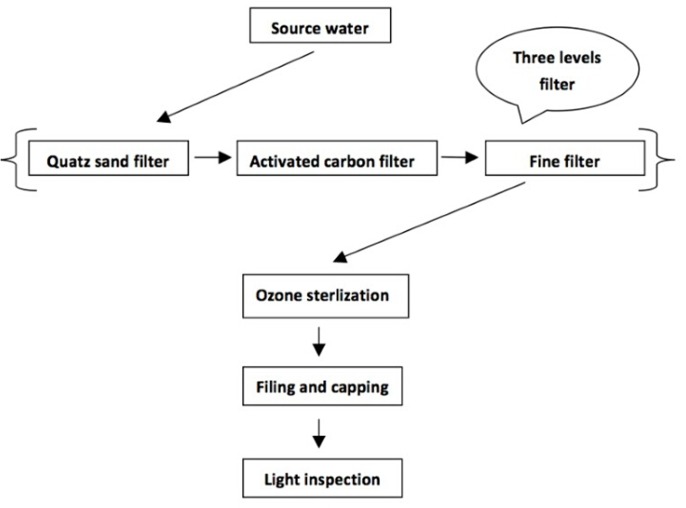
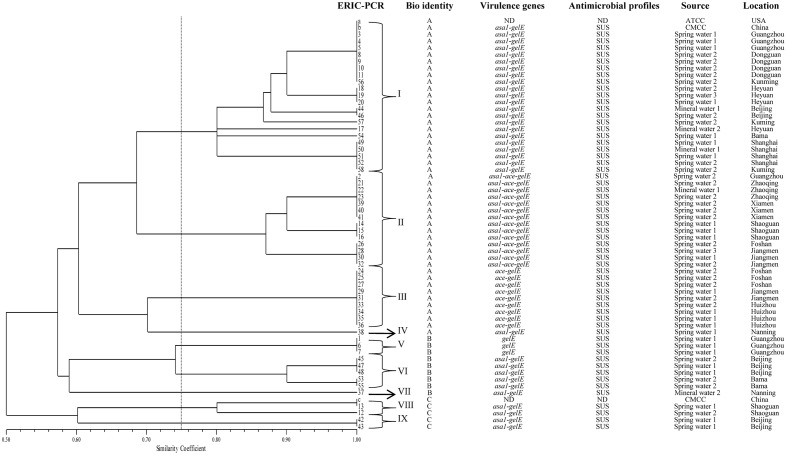
is an important opportunistic pathogen which is frequently detected in mineral water and spring water for human consumption and causes human urinary tract infections, endocarditis and neonatal sepsis. The aim of this study was to determine the prevalence, virulence genes, antimicrobial resistance and genetic diversity of from mineral water and spring water in China. Of 314 water samples collected from January 2013 to January 2014, 48 samples (15.3%) were contaminated . The highest contamination rate occurred in activated carbon filtered water of spring water (34.5%), followed by source water of spring water (32.3%) and source water of mineral water (6.4%). The virulence gene test of 58 isolates showed that the detection rates of , , , and were 79.3, 39.7, 0, 100, 0%, respectively. All 58 isolates were not resistant to 12 kinds of antibiotics (penicillin, ampicillin, linezolid, quinupristin/dalfopristin, vancomycin, gentamicin, streptomycin, ciprofloxacin, levofloxacin, norfloxacin, nitrofurantoin, and tetracycline). Enterobacterial repetitive intergenic consensus-PCR classified 58 isolates and three reference strains into nine clusters with a similarity of 75%. This study is the first to investigate the prevalence of in mineral water and spring water in China. The results of this study suggested that spring water could be potential vehicles for transmission of .
是一种重要的机会致病菌,经常在供人饮用的矿泉水和泉水中被检测到,可引起人类尿路感染、心内膜炎和新生儿败血症。本研究的目的是确定中国矿泉水和泉水中该菌的流行情况、毒力基因、抗菌药物耐药性和遗传多样性。在2013年1月至2014年1月采集的314份水样中,有48份样本(15.3%)被该菌污染。污染率最高的是泉水的活性炭过滤水(34.5%),其次是泉水的源水(32.3%)和矿泉水的源水(6.4%)。对58株该菌分离株进行的毒力基因检测表明,、、、和的检出率分别为79.3%、39.7%、0、100%、0%。所有58株该菌分离株对12种抗生素(青霉素、氨苄西林、利奈唑胺、奎奴普丁/达福普汀、万古霉素、庆大霉素、链霉素、环丙沙星、左氧氟沙星、诺氟沙星、呋喃妥因和四环素)均不耐药。肠杆菌基因间重复一致序列聚合酶链反应将58株分离株和3株参考菌株分为9个簇,相似性为75%。本研究首次调查了中国矿泉水和泉水中该菌的流行情况。本研究结果表明,泉水可能是该菌传播的潜在载体。