Mehta Varun, Gupta Ankita, Mahajan Ramit, Narang Vikram, Midha Vandana, Sood Neena, Kaur Harpreet, Kaur Kirandeep, Sood Ajit
Department of Gastroenterology, Dayanand Medical College, Ludhiana, Punjab, India.
Department of Pathology, Dayanand Medical College, Ludhiana, Punjab, India.
Endosc Int Open. 2017 Jul;5(7):E539-E546. doi: 10.1055/s-0043-100688. Epub 2017 Jun 23.
With an increasing number of ileal intubations, isolated terminal ileal ulcers (ITIU) are frequently found during colonoscopies. The present study aimed at studying the etiology and clinical significance of these ulcers in patients having gastrointestinal symptoms.
This was a prospective observational study performed on consecutive patients who underwent ileocolonoscopy for various gastrointestinal symptoms between 1 January 2014 and 31 December 2014. Clinical, endoscopic, and histological findings of patients with ITIUs were assessed to determine the etiology and they were treated accordingly. Symptom resolution was assessed within 3 - 6 months of initial diagnosis, and colonoscopy was repeated for consenting patients.
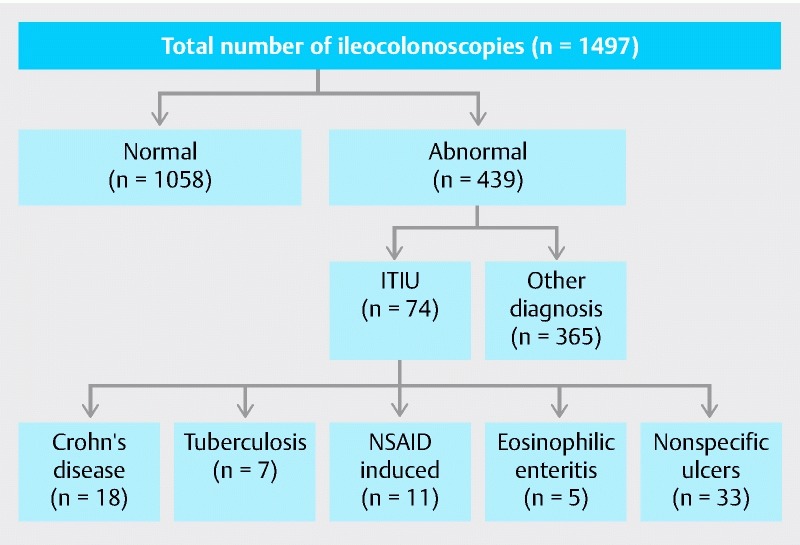
Among 74 (4.9 %) of 1497 patients who had ITIUs on ileocolonoscopy, 41 (55.4 %) had specific etiologies on initial testing. After 3 - 6 months follow-up, definitive diagnosis was ascertained in 44 (59.5 %) patients [Crohn's disease (CD): 19 (25.7 %), NSAID-induced ulcers: 11 (14.9 %), intestinal tuberculosis (ITB): 9 (12.2 %), and eosinophilic enteritis: 5 (6.8 %)], and 30 patients (40.5 %) had nonspecific ulcers. After treatment, symptomatic and endoscopic resolution were noted in 55/60 patients (91.7 %) and 28/36 patients (77.8 %), respectively. Of 5/60 patients who remained symptomatic, three were initially diagnosed with nonspecific ulcers and two with CD, and they were finally diagnosed with CD and ITB respectively, and treated accordingly.
In patients with gastrointestinal symptoms, more than half of the ITIUs have specific etiologies, and timely diagnosis and appropriate treatment can prevent serious complications. Nonspecific ulcers can be managed with symptomatic treatment, but need close monitoring and re-evaluation in the case of persistence of symptoms.
随着回肠插管数量的增加,在结肠镜检查中经常发现孤立性终末回肠溃疡(ITIU)。本研究旨在探讨这些溃疡在有胃肠道症状患者中的病因及临床意义。
这是一项前瞻性观察性研究,对2014年1月1日至2014年12月31日期间因各种胃肠道症状接受回结肠镜检查的连续患者进行研究。对ITIU患者的临床、内镜及组织学检查结果进行评估以确定病因,并相应进行治疗。在初次诊断后的3至6个月内评估症状缓解情况,对同意的患者重复进行结肠镜检查。
在1497例行回结肠镜检查的患者中,74例(4.9%)有ITIU,其中41例(55.4%)在初次检查时有特定病因。经过3至6个月的随访,44例(59.5%)患者确诊[克罗恩病(CD):19例(25.7%),非甾体抗炎药引起的溃疡:11例(14.9%),肠结核(ITB):9例(12.2%),嗜酸性肠炎:5例(6.8%)],30例(40.5%)患者为非特异性溃疡。治疗后,60例患者中有55例(91.7%)症状缓解,36例患者中有28例(77.8%)内镜检查结果改善。60例仍有症状的患者中,5例最初诊断为非特异性溃疡,2例诊断为CD,最终分别确诊为CD和ITB,并相应进行了治疗。
在有胃肠道症状的患者中,超过一半的ITIU有特定病因,及时诊断和适当治疗可预防严重并发症。非特异性溃疡可采用对症治疗,但如果症状持续则需要密切监测和重新评估。