Park Min-Jung, Han Ho Jae, Kim Dong-Il
Department of Molecular and Integrative Physiology, University of Michigan Medical School, Ann Arbor, MI 48109, USA.
Department of Veterinary Physiology, College of Veterinary Medicine, Research Institute for Veterinary Science, Seoul National University, Seoul 08826, Korea.
Int J Mol Sci. 2017 Jul 3;18(7):1421. doi: 10.3390/ijms18071421.
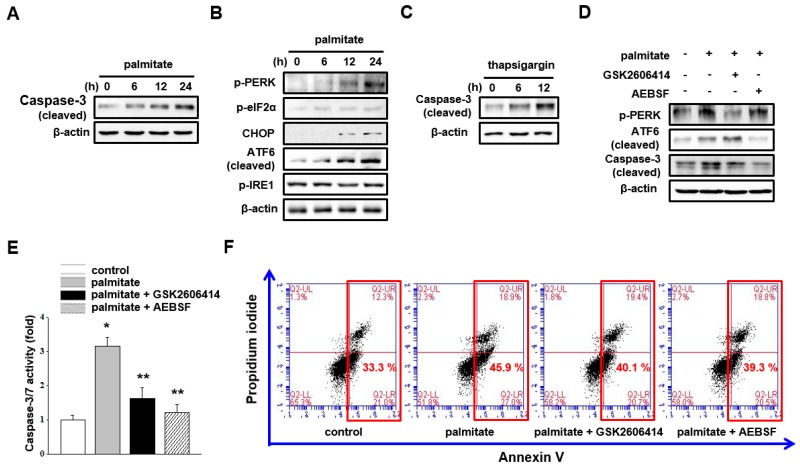
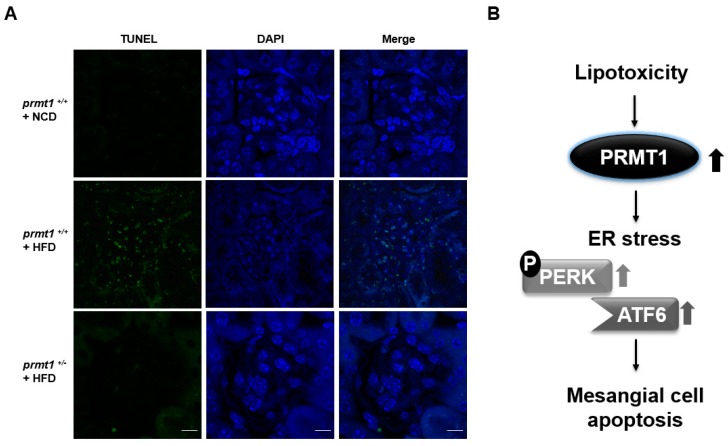
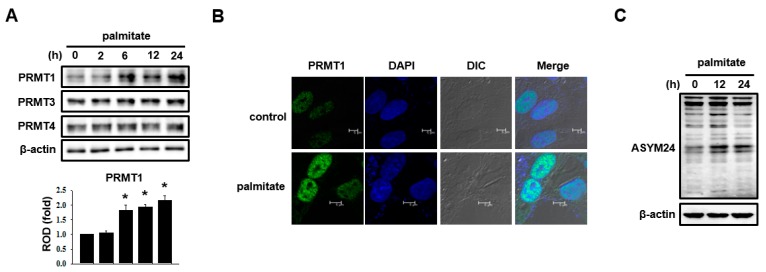
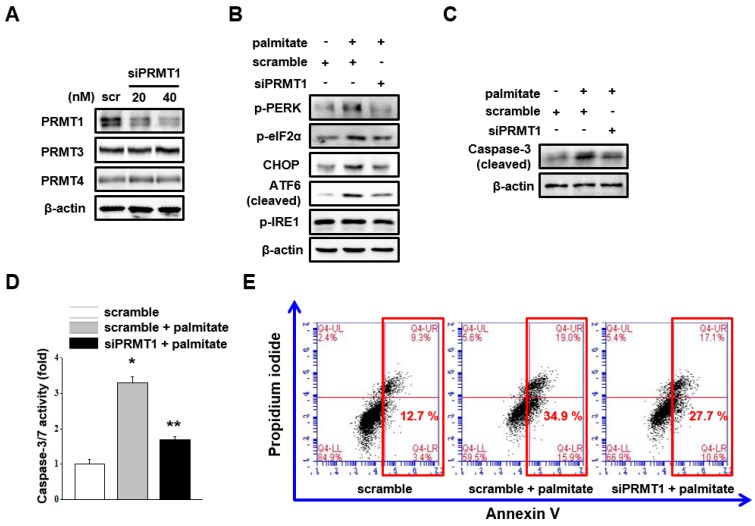
Lipotoxicity-induced mesangial cell apoptosis is implicated in the exacerbation of diabetic nephropathy (DN). Protein arginine methyltransferases (PRMTs) have been known to regulate a variety of biological functions. Recently, it was reported that PRMT1 expression is increased in proximal tubule cells under diabetic conditions. However, their roles in mesangial cells remain unexplored. Thus, we examined the pathophysiological roles of PRMTs in mesangial cell apoptosis. Treatment with palmitate, which mimics cellular lipotoxicity, induced mesangial cell apoptosis via protein kinase RNA-like endoplasmic reticulum kinase (PERK) and ATF6-mediated endoplasmic reticulum (ER) stress signaling. Palmitate treatment increased PRMT1 expression and activity in mesangial cells as well. Moreover, palmitate-induced ER stress activation and mesangial cell apoptosis was diminished by PRMT1 knockdown. In the mice study, high fat diet-induced glomerular apoptosis was attenuated in PRMT1 haploinsufficient mice. Together, these results provide evidence that lipotoxicity-induced PRMT1 expression promotes ER stress-mediated mesangial cell apoptosis. Strategies to regulate PRMT1 expression or activity could be used to prevent the exacerbation of DN.
脂毒性诱导的系膜细胞凋亡与糖尿病肾病(DN)的恶化有关。已知蛋白质精氨酸甲基转移酶(PRMTs)可调节多种生物学功能。最近有报道称,在糖尿病条件下近端小管细胞中PRMT1的表达增加。然而,它们在系膜细胞中的作用仍未被探索。因此,我们研究了PRMTs在系膜细胞凋亡中的病理生理作用。用模拟细胞脂毒性的棕榈酸处理,通过蛋白激酶RNA样内质网激酶(PERK)和ATF6介导的内质网(ER)应激信号诱导系膜细胞凋亡。棕榈酸处理也增加了系膜细胞中PRMT1的表达和活性。此外,PRMT1基因敲低可减轻棕榈酸诱导的内质网应激激活和系膜细胞凋亡。在小鼠研究中,高脂饮食诱导的肾小球凋亡在PRMT1单倍体不足的小鼠中减弱。总之,这些结果证明脂毒性诱导的PRMT1表达促进内质网应激介导的系膜细胞凋亡。调节PRMT1表达或活性的策略可用于预防DN的恶化。