
布基纳法索女性对疟疾的预防、病因、症状及防治措施的了解情况。
Knowledge of prevention, cause, symptom and practices of malaria among women in Burkina Faso.
作者信息
Yaya Sanni, Bishwajit Ghose, Ekholuenetale Michael, Shah Vaibhav, Kadio Bernard, Udenigwe Ogochukwu
机构信息
School of International Development and Global Studies, Faculty of Social Sciences, University of Ottawa, Ottawa, Ontario, Canada.
School of Medicine and Health Management, Tongji Medical College, Huazhong University of Science and Technology, Wuhan, Hubei, China.
出版信息
PLoS One. 2017 Jul 3;12(7):e0180508. doi: 10.1371/journal.pone.0180508. eCollection 2017.
BACKGROUND
Malaria remains a major public health issue in most southern African countries as the disease remains hyper endemic. Burkina Faso continues to face challenges in the treatment of malaria, as the utilization of preventive measures remains low on a national scale. While it has been acknowledged that understanding women's health-seeking behaviours, perception of malaria and its preventive measures will aid in the control of malaria, there is paucity of information on Knowledge, Attitudes and Practices among women in the reproductive age of 15-49 years in Burkina Faso. This study investigated women's knowledge of malaria, attitudes towards malaria, and practices of malaria control in order to create a synergy between community efforts and governmental/non-governmental malaria control interventions in Burkina Faso.
METHODS
The analysis used data from the 2014 Burkina Faso Malaria Indicator Survey (MIS). In total 8111 women aged between 15-49 years were included in the present study. We assessed women's knowledge about 1) preventive measures, 2) causes and 3) symptoms of malaria, as well as malaria prevention practices for their children and during pregnancy. The socio-demographic characteristics were considered for Age, Religion, Education, Wealth index, Number of household members, Sex of household head, Household possession of radio, TV and Received antenatal care. Data were analyzed using STATA, version 14. Associations between variables were tested using a Chi-square and logistic regression, with the level of statistical significance set at 95%.
RESULTS
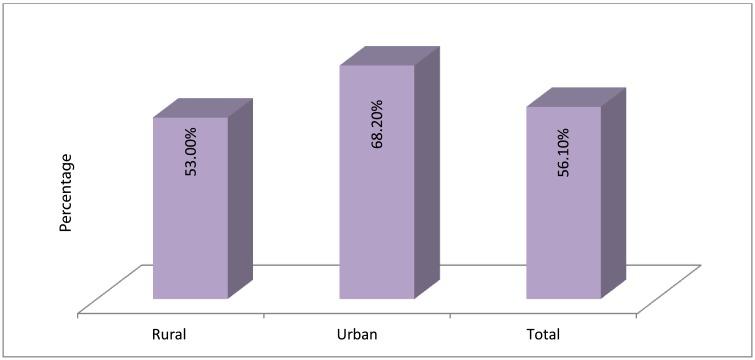
A preponderant proportion of respondents were aged 15-29 years (mean age was 28.63±9.41). About three-quarters of the respondents had no formal education. An estimated two-third of the participants were of Islamic faith, while access to media and behavioural communication were generally poor. The level of knowledge was 53% for rural women and 68.2% for urban dwellers. In sum, there was 56.1% level of accurate knowledge of malaria among women in Burkina Faso. In the multivariable logistic regression, women in rural location had 40% reduction in the odds of having accurate knowledge of malaria when compared to urban women (aOR = 0.60; 95%CI: 0.52-0.68). The educational level was a key factor in the knowledge of malaria. The odds of having accurate knowledge of malaria increased as the educational level increased, hence, women with secondary and higher education had 29% and 93% increase in the odds of having accurate knowledge of malaria when compared to the women without formal education. Results indicate that antenatal care (ANC) services were major sources of information on malaria. Women who reportedly received ANC were 3.9 times more likely to have accurate knowledge of malaria when compared to those who did not utilize skilled ANC services (aOR = 3.90; 95%CI = 3.34-4.56).
CONCLUSION
The overall knowledge of malaria prevention practices among a large proportion of women was found to be low, which implies that the knowledge about the prevention of malaria should be improved upon by both urban and rural dwellers. There is need for concerted behavioural communication intervention to improve the knowledge of malaria especially for rural dwellers regarding malaria prevention measures, causes and symptoms. Consistent efforts at providing relevant information by health organizations are needed to reduce and control incidences of malaria in the general public.
背景
在大多数南部非洲国家,疟疾仍是一个主要的公共卫生问题,因为该病仍然是高度流行的。布基纳法索在疟疾治疗方面继续面临挑战,因为全国范围内预防措施的利用率仍然很低。虽然人们已经认识到了解妇女的就医行为、对疟疾及其预防措施的认知将有助于控制疟疾,但布基纳法索15至49岁育龄妇女的知识、态度和行为方面的信息却很匮乏。本研究调查了妇女对疟疾的了解、对疟疾的态度以及疟疾控制措施,以便在布基纳法索使社区努力与政府/非政府疟疾控制干预措施形成协同效应。
方法
分析使用了2014年布基纳法索疟疾指标调查(MIS)的数据。本研究共纳入了8111名年龄在15至49岁之间的妇女。我们评估了妇女对1)预防措施、2)病因和3)疟疾症状的了解,以及她们对孩子和孕期疟疾预防措施的做法。社会人口学特征包括年龄、宗教、教育程度、财富指数、家庭成员数量、户主性别、家庭拥有收音机、电视情况以及接受产前护理情况。使用STATA 14版对数据进行分析。变量之间的关联通过卡方检验和逻辑回归进行检验,统计学显著性水平设定为95%。
结果
绝大多数受访者年龄在15至29岁之间(平均年龄为28.63±9.41)。约四分之三的受访者没有接受过正规教育。估计三分之二的参与者为伊斯兰教徒,而获得媒体和行为传播的机会普遍较差。农村妇女的知识水平为53%,城市居民为68.2%。总体而言,布基纳法索妇女对疟疾的准确知识水平为56.1%。在多变量逻辑回归中,与城市妇女相比,农村地区的妇女对疟疾有准确知识的几率降低了40%(调整后比值比 = 0.60;95%置信区间:0.52 - 0.68)。教育程度是疟疾知识的一个关键因素。随着教育程度的提高,对疟疾有准确知识的几率增加,因此,与未接受正规教育的妇女相比,接受过中等及以上教育的妇女对疟疾有准确知识的几率分别增加了29%和93%。结果表明,产前护理(ANC)服务是疟疾信息的主要来源。据报告接受过ANC的妇女对疟疾有准确知识的可能性是未利用专业ANC服务的妇女的3.9倍(调整后比值比 = 3.90;95%置信区间 = 3.34 - 4.56)。
结论
发现很大一部分妇女对疟疾预防措施的总体知识水平较低,这意味着城乡居民都应提高对疟疾预防的认识。需要进行协调一致的行为传播干预,以提高对疟疾的认识,特别是农村居民对疟疾预防措施、病因和症状的认识。卫生组织需要持续努力提供相关信息,以减少和控制公众中的疟疾发病率。
 Zotero 插件