Moreira-Rodríguez Melissa, Nair Vimal, Benavides Jorge, Cisneros-Zevallos Luis, Jacobo-Velázquez Daniel A
Tecnológico de Monterrey, Escuela de Ingeniería y Ciencias, Centro de Biotecnología FEMSA, Av. Eugenio Garza Sada 2501 Sur, C.P. 64849 Monterrey, NL, Mexico.
Department of Horticultural Sciences, Texas A&M University, College Station, TX 77843-2133, USA.
Molecules. 2017 Jun 26;22(7):1065. doi: 10.3390/molecules22071065.
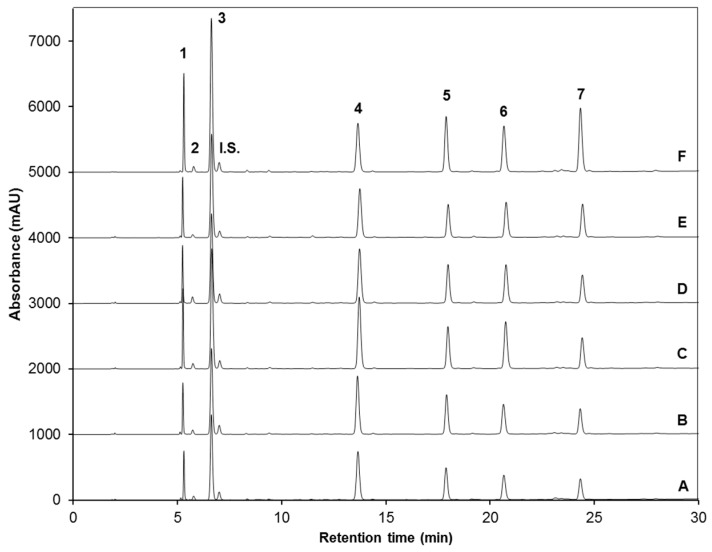
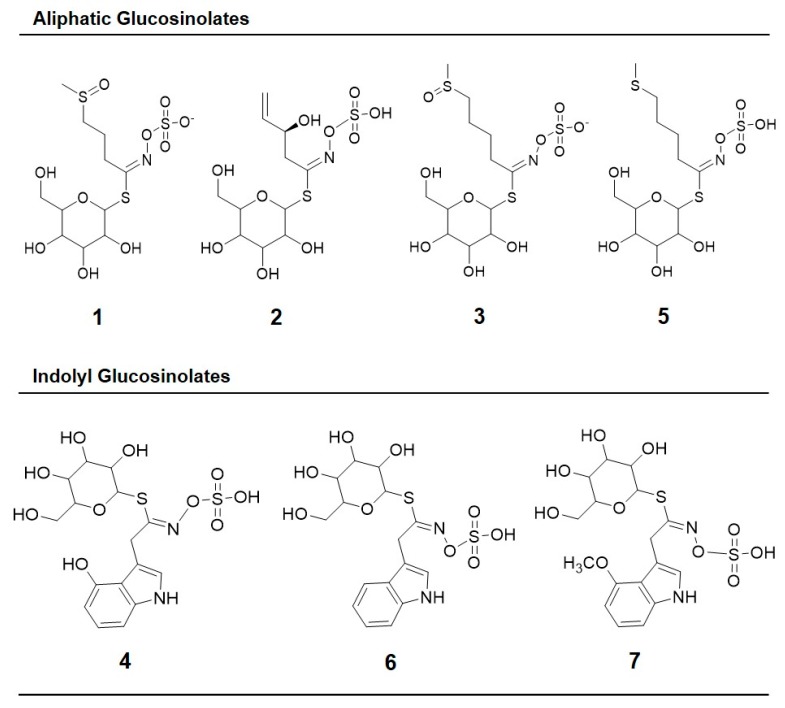
Broccoli sprouts contain health-promoting glucosinolate and phenolic compounds that can be enhanced by applying ultraviolet light (UV). Here, the effect of UVA or UVB radiation on glucosinolate and phenolic profiles was assessed in broccoli sprouts. Sprouts were exposed for 120 min to low intensity and high intensity UVA (UVA, UVA) or UVB (UVB, UVB) with UV intensity values of 3.16, 4.05, 2.28 and 3.34 W/m², respectively. Harvest occurred 2 or 24 h post-treatment; and methanol/water or ethanol/water (70%, /) extracts were prepared. Seven glucosinolates and 22 phenolics were identified. Ethanol extracts showed higher levels of certain glucosinolates such as glucoraphanin, whereas methanol extracts showed slight higher levels of phenolics. The highest glucosinolate accumulation occurred 24 h after UVB treatment, increasing 4-methoxy-glucobrassicin, glucobrassicin and glucoraphanin by 170, 78 and 73%, respectively. Furthermore, UVA radiation and harvest 2 h afterwards accumulated gallic acid hexoside I (14%), 4--caffeoylquinic acid (42%), gallic acid derivative (48%) and 1-sinapoyl-2,2-diferulolyl-gentiobiose (61%). Increases in sinapoyl malate (12%), gallotannic acid (48%) and 5-sinapoyl-quinic acid (121%) were observed with UVB Results indicate that UV-irradiated broccoli sprouts could be exploited as a functional food for fresh consumption or as a source of bioactive phytochemicals with potential industrial applications.
西兰花芽苗菜含有促进健康的硫代葡萄糖苷和酚类化合物,通过施加紫外线(UV)可增强这些成分。在此,评估了UVA或UVB辐射对西兰花芽苗菜中硫代葡萄糖苷和酚类成分的影响。将芽苗菜分别暴露于低强度和高强度的UVA(UVA、UVA)或UVB(UVB、UVB)下120分钟,其UV强度值分别为3.16、4.05、2.28和3.34 W/m²。在处理后2小时或24小时收获;并制备了甲醇/水或乙醇/水(70%,/)提取物。鉴定出了7种硫代葡萄糖苷和22种酚类化合物。乙醇提取物中某些硫代葡萄糖苷如萝卜硫苷的含量较高,而甲醇提取物中酚类化合物的含量略高。硫代葡萄糖苷的最高积累量出现在UVB处理后24小时,4-甲氧基-新萝卜硫素、新萝卜硫素和萝卜硫苷分别增加了约170%、78%和73%。此外,UVA辐射并在2小时后收获积累了没食子酸己糖苷I(约14%)、4-咖啡酰奎尼酸(约42%)、没食子酸衍生物(约48%)和1-芥子酰基-2,2-二阿魏酰基龙胆二糖(约61%)。UVB处理后观察到苹果酸芥子酰酯(约12%)、五倍子酸(约48%)和5-芥子酰基奎尼酸(约121%)有所增加。结果表明,紫外线照射的西兰花芽苗菜可作为新鲜食用的功能性食品,或作为具有潜在工业应用的生物活性植物化学物质的来源。