Department of Pharmacology and Toxicology, Medical College of Virginia Campus, Virginia Commonwealth University, Richmond, VA, USA.
RTI International, 3040 Cornwallis Road, Research Triangle Park, NC, 27709-2194, USA.
Neuropharmacology. 2017 Oct;125:80-86. doi: 10.1016/j.neuropharm.2017.06.032. Epub 2017 Jun 30.
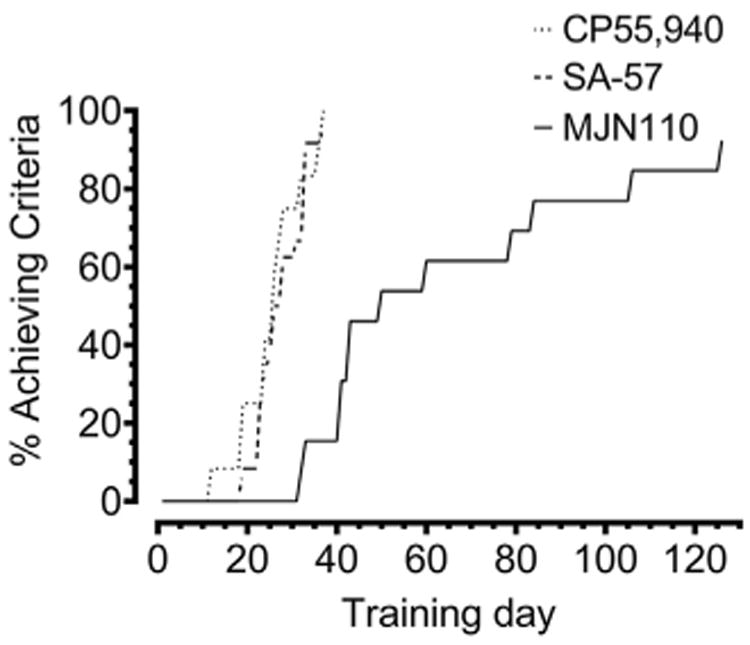
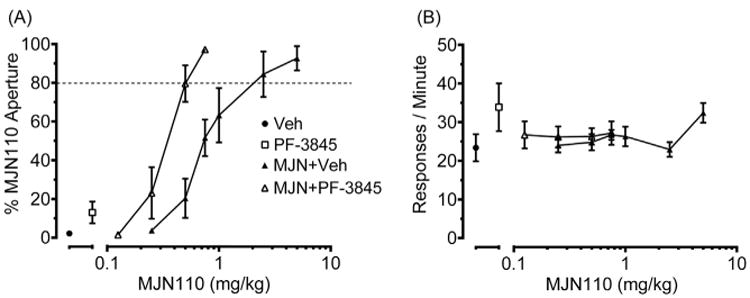
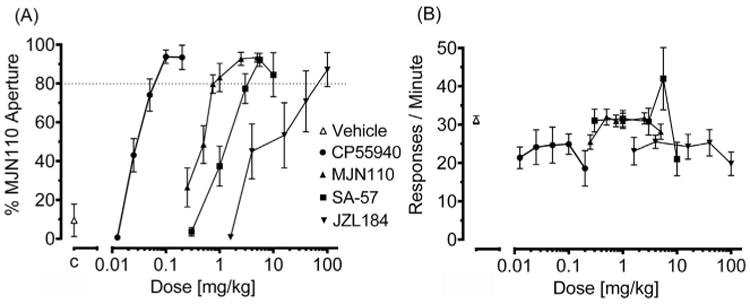
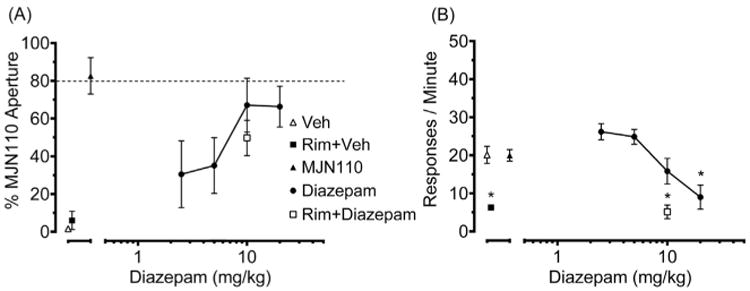
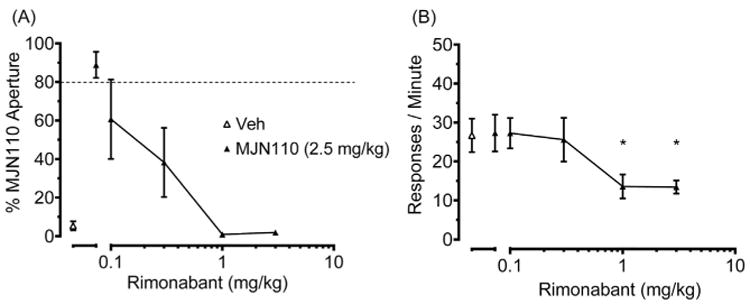
Substantial challenges exist for investigating the cannabinoid receptor type 1 (CB)-mediated discriminative stimulus effects of the endocannabinoids, 2-arachidonoylglycerol (2-AG) and N-arachidonoylethanolamine (anandamide; AEA), compared with exogenous CB receptor agonists, such as Δ-tetrahydrocannabinol (THC) and the synthetic cannabinoid CP55,940. Specifically, each endocannabinoid is rapidly degraded by the respective hydrolytic enzymes, monoacylglycerol lipase (MAGL) and fatty acid amide hydrolase (FAAH). Whereas MAGL inhibitors partially substitute for THC and fully substitute for CP55,940, FAAH inhibitors do not substitute for either drug. Interestingly, combined FAAH-MAGL inhibition results in full THC substitution, and the dual FAAH-MAGL inhibitor SA-57 serves as its own discriminative training stimulus. Because MAGL inhibitors fully substitute for SA-57, we tested whether the selective MAGL inhibitor MJN110 would serve as a training stimulus. Twelve of 13 C57BL/6J mice learned to discriminate MJN110 from vehicle, and the CB receptor antagonist rimonabant dose-dependently blocked its discriminative stimulus. CP55,940, SA-57, and another MAGL inhibitor JZL184, fully substituted for MJN110. In contrast, the FAAH inhibitor PF-3845 failed to substitute for the MJN110 discriminative stimulus, but produced a 1.6 (1.1-2.2; 95% confidence interval) leftward shift in the MJN110 dose-response curve. Inhibitors of other relevant enzymes (i.e., ABHD6, COX-2) and nicotine did not engender substitution. Diazepam partially substituted for MJN110, but rimonabant failed to block this partial effect. These findings suggest that MAGL normally throttles 2-AG stimulation of CB receptors to a magnitude insufficient to produce cannabimimetic subjective effects. Accordingly, inhibitors of this enzyme may release this endogenous brake producing effects akin to those produced by exogenously administered cannabinoids.
与外源性 CB 受体激动剂,如 Δ-四氢大麻酚(THC)和合成大麻素 CP55,940 相比,内源性大麻素受体 1(CB1)介导的内源性大麻素 2-花生四烯酸甘油(2-AG)和 N-花生四烯酸乙醇胺(AEA)的分辨刺激作用的研究存在很大的挑战。具体来说,每种内源性大麻素都被各自的水解酶,单酰基甘油脂肪酶(MAGL)和脂肪酸酰胺水解酶(FAAH)迅速降解。虽然 MAGL 抑制剂部分替代了 THC 并完全替代了 CP55,940,但 FAAH 抑制剂既不能替代任何一种药物。有趣的是,联合 FAAH-MAGL 抑制导致完全替代 THC,并且双重 FAAH-MAGL 抑制剂 SA-57 作为其自身的分辨训练刺激。由于 MAGL 抑制剂完全替代了 SA-57,我们测试了选择性 MAGL 抑制剂 MJN110 是否可以作为训练刺激。13 只 C57BL/6J 小鼠中的 12 只学会了区分 MJN110 和载体,CB 受体拮抗剂利莫那班剂量依赖性地阻断其分辨刺激。CP55,940、SA-57 和另一种 MAGL 抑制剂 JZL184 完全替代了 MJN110。相比之下,FAAH 抑制剂 PF-3845 不能替代 MJN110 的分辨刺激,但使 MJN110 的剂量反应曲线向左移动了 1.6(1.1-2.2;95%置信区间)。其他相关酶(即 ABHD6、COX-2)和尼古丁的抑制剂没有产生替代作用。地西泮部分替代了 MJN110,但利莫那班未能阻断这种部分作用。这些发现表明,MAGL 通常限制 2-AG 对 CB 受体的刺激程度,不足以产生大麻样主观效应。因此,该酶的抑制剂可能会释放这种内源性刹车,产生类似于外源性给予大麻素产生的效应。