Tao Liang, Peng Lisheng, Berntsson Ronnie P-A, Liu Sai Man, Park SunHyun, Yu Feifan, Boone Christopher, Palan Shilpa, Beard Matthew, Chabrier Pierre-Etienne, Stenmark Pål, Krupp Johannes, Dong Min
Department of Urology, Boston Children's Hospital, Department of Microbiology and Immunobiology, Department of Surgery, Harvard Medical School, 300 Longwood Avenue, Boston, Massachusetts, 02115, USA.
Department of Neurology, The Third Affiliated Hospital of Sun Yat-sen University, No. 600 Tianhe Road, Guangzhou, Guangdong, 510630, China.
Nat Commun. 2017 Jul 3;8(1):53. doi: 10.1038/s41467-017-00064-y.
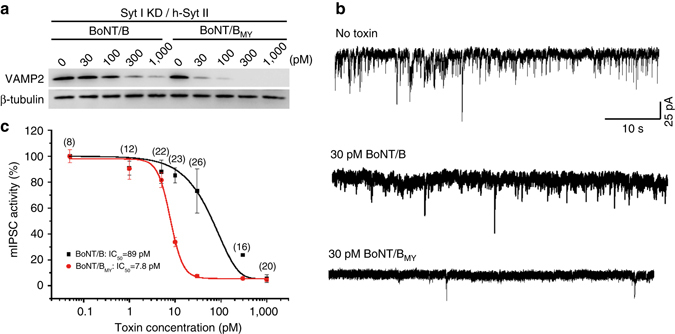
Botulinum neurotoxin B is a Food and Drug Administration-approved therapeutic toxin. However, it has lower binding affinity toward the human version of its major receptor, synaptotagmin II (h-Syt II), compared to mouse Syt II, because of a residue difference. Increasing the binding affinity to h-Syt II may improve botulinum neurotoxin B's therapeutic efficacy and reduce adverse effects. Here we utilized the bacterial adenylate cyclase two-hybrid method and carried out a saturation mutagenesis screen in the Syt II-binding pocket of botulinum neurotoxin B. The screen identifies E1191 as a key residue: replacing it with M/C/V/Q enhances botulinum neurotoxin B binding to human synaptotagmin II. Adding S1199Y/W or W1178Q as a secondary mutation further increases binding affinity. Mutant botulinum neurotoxin B containing E1191M/S1199Y exhibits ~11-fold higher efficacy in blocking neurotransmission than wild-type botulinum neurotoxin B in neurons expressing human synaptotagmin II, demonstrating that enhancing receptor binding increases the overall efficacy at functional levels. The engineered botulinum neurotoxin B provides a platform to develop therapeutic toxins with improved efficacy.Humans are less sensitive to the therapeutic effects of botulinum neurotoxin B (BoNT/B) than the animal models it is tested on due to differences between the human and the mouse receptors. Here, the authors engineer BoNT/B to improve its affinity to human receptors and enhance its therapeutic efficacy.
肉毒杆菌神经毒素B是一种经美国食品药品监督管理局批准的治疗性毒素。然而,由于一个残基差异,与小鼠的突触结合蛋白II(m-Syt II)相比,它对其主要人类受体——人类突触结合蛋白II(h-Syt II)的结合亲和力较低。提高对h-Syt II的结合亲和力可能会提高肉毒杆菌神经毒素B的治疗效果并减少不良反应。在此,我们利用细菌腺苷酸环化酶双杂交方法,在肉毒杆菌神经毒素B的Syt II结合口袋中进行了饱和诱变筛选。该筛选确定E1191为关键残基:用M/C/V/Q取代它可增强肉毒杆菌神经毒素B与人类突触结合蛋白II的结合。添加S1199Y/W或W1178Q作为二次突变可进一步提高结合亲和力。在表达人类突触结合蛋白II的神经元中,含有E1191M/S1199Y的突变型肉毒杆菌神经毒素B在阻断神经传递方面的效力比野生型肉毒杆菌神经毒素B高约11倍,这表明增强受体结合可在功能水平上提高整体效力。工程化的肉毒杆菌神经毒素B为开发疗效更佳的治疗性毒素提供了一个平台。由于人类和小鼠受体之间存在差异,人类对肉毒杆菌神经毒素B(BoNT/B)的治疗效果不如其测试所用的动物模型敏感。在此,作者对BoNT/B进行工程改造,以提高其对人类受体的亲和力并增强其治疗效果。