Peng Lisheng, Adler Michael, Demogines Ann, Borrell Andrew, Liu Huisheng, Tao Liang, Tepp William H, Zhang Su-Chun, Johnson Eric A, Sawyer Sara L, Dong Min
Department of Microbiology and Immunobiology, Harvard Medical School and Division of Neuroscience, New England Primate Research Center, Southborough, Massachusetts, United States of America.
Neurobehavioral Toxicology Branch, U.S. Army Medical Research Institute of Chemical Defense, Aberdeen Proving Ground, Aberdeen, Maryland, United States of America.
PLoS Pathog. 2014 Jul 10;10(7):e1004177. doi: 10.1371/journal.ppat.1004177. eCollection 2014 Jul.
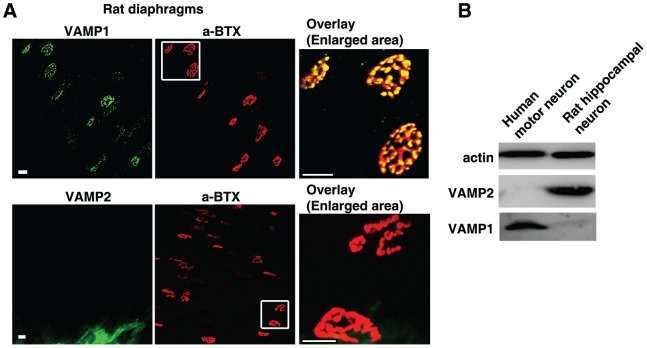
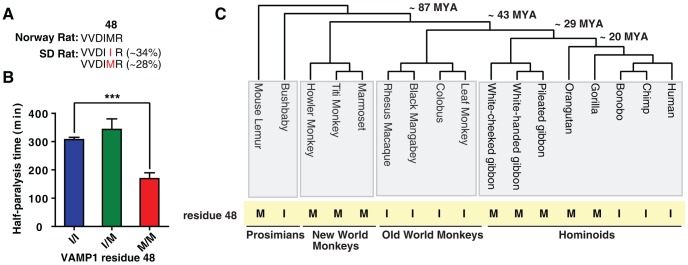
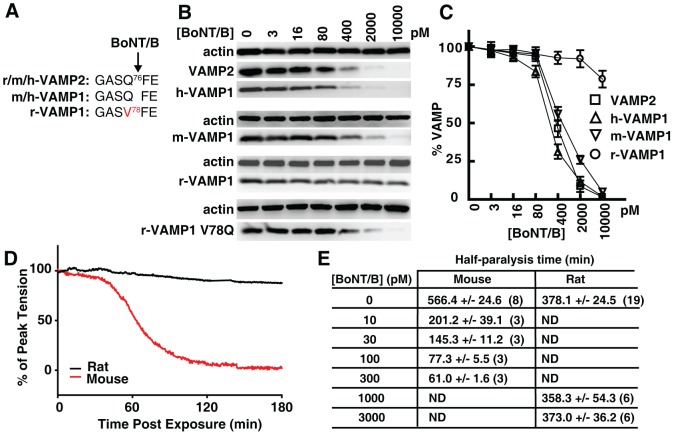
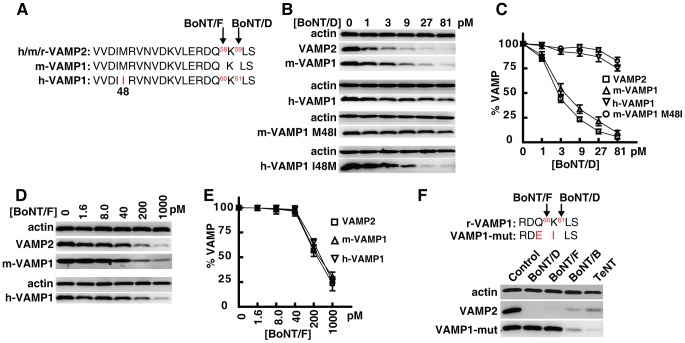
Botulinum neurotoxins (BoNT/A-G), the most potent toxins known, act by cleaving three SNARE proteins required for synaptic vesicle exocytosis. Previous studies on BoNTs have generally utilized the major SNARE homologues expressed in brain (VAMP2, syntaxin 1, and SNAP-25). However, BoNTs target peripheral motor neurons and cause death by paralyzing respiratory muscles such as the diaphragm. Here we report that VAMP1, but not VAMP2, is the SNARE homologue predominantly expressed in adult rodent diaphragm motor nerve terminals and in differentiated human motor neurons. In contrast to the highly conserved VAMP2, BoNT-resistant variations in VAMP1 are widespread across vertebrates. In particular, we identified a polymorphism at position 48 of VAMP1 in rats, which renders VAMP1 either resistant (I48) or sensitive (M48) to BoNT/D. Taking advantage of this finding, we showed that rat diaphragms with I48 in VAMP1 are insensitive to BoNT/D compared to rat diaphragms with M48 in VAMP1. This unique intra-species comparison establishes VAMP1 as a physiological toxin target in diaphragm motor nerve terminals, and demonstrates that the resistance of VAMP1 to BoNTs can underlie the insensitivity of a species to members of BoNTs. Consistently, human VAMP1 contains I48, which may explain why humans are insensitive to BoNT/D. Finally, we report that residue 48 of VAMP1 varies frequently between M and I across seventeen closely related primate species, suggesting a potential selective pressure from members of BoNTs for resistance in vertebrates.
肉毒杆菌神经毒素(BoNT/A - G)是已知毒性最强的毒素,通过切割突触小泡胞吐所需的三种SNARE蛋白发挥作用。以往对肉毒杆菌神经毒素的研究通常使用在大脑中表达的主要SNARE同源物(VAMP2、 syntaxin 1和SNAP - 25)。然而,肉毒杆菌神经毒素靶向外周运动神经元,并通过麻痹诸如膈肌等呼吸肌导致死亡。在此我们报告,VAMP1而非VAMP2是在成年啮齿动物膈肌运动神经末梢和分化的人类运动神经元中主要表达的SNARE同源物。与高度保守的VAMP2不同,VAMP1中对肉毒杆菌神经毒素具有抗性的变异在整个脊椎动物中广泛存在。特别是,我们在大鼠的VAMP1第48位鉴定出一种多态性,它使VAMP1对BoNT/D具有抗性(I48)或敏感性(M48)。利用这一发现,我们表明与VAMP1中为M48的大鼠膈肌相比,VAMP1中为I48的大鼠膈肌对BoNT/D不敏感。这种独特的种内比较确定了VAMP1是膈肌运动神经末梢中的一种生理毒素靶点,并证明VAMP1对肉毒杆菌神经毒素的抗性可能是一个物种对某些肉毒杆菌神经毒素不敏感的基础。一致的是,人类VAMP1含有I48,这可能解释了为什么人类对BoNT/D不敏感。最后,我们报告在十七种密切相关的灵长类物种中,VAMP1的第48位残基在M和I之间频繁变化,这表明肉毒杆菌神经毒素成员对脊椎动物的抗性可能存在潜在的选择压力。