Padmanabhan Kiran, Billaud Marc
"Molecular and Epigenetic Regulation of Biological Clocks", Université de Lyon, Institut de Génomique Fonctionnelle de Lyon, CNRS UMR 5242, École Normale Supérieure de Lyon, Université Claude Bernard Lyon 1, Lyon, France.
INSERM, Paris, France.
Front Endocrinol (Lausanne). 2017 Jun 19;8:136. doi: 10.3389/fendo.2017.00136. eCollection 2017.
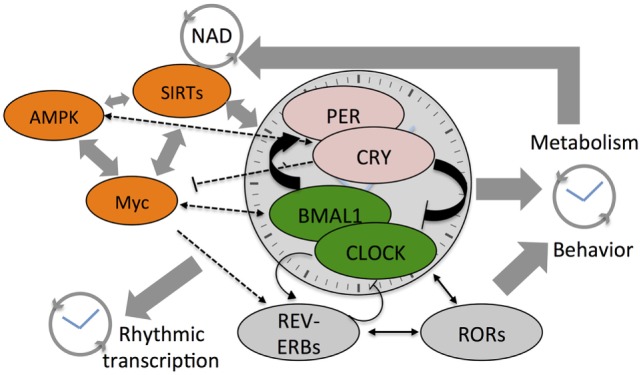
Circadian clocks are innate oscillators that drive daily rhythms in metabolism, physiology, and behavior. 24-h rhythms in gene expression, driven by core clock transcription factors, reflect the epigenetic state of the cell, which in turn is dictated by the metabolic environment. Cancer cells alter their metabolic state and gene expression and therefore are likely to tweak circadian clock function in their favor. Over the past decade, we have witnessed an extraordinary increase in systems-level studies that suggest intricate mechanistic links between the cellular metabolome and the circadian epigenome. In parallel, reprogramming of cellular clock function in cancers is increasingly evident and the role of clock genes in the development of hematological tumors, as well as their pathophysiological effects on tissues distal to the tumor, has been described. Furthermore, the interplay between components of the circadian clock, metabolic enzymes, and oncogenes is starting to be better understood, such as the close association between overexpression of the Myc oncogene and perturbation of circadian and metabolic rhythms, thus opening new avenues to treat cancers. This review article explores current knowledge on the circadian metabolome and the molecular pathways they control, with a focus on their involvement in the development of hematopoietic malignancies.
昼夜节律时钟是驱动新陈代谢、生理和行为中每日节律的内在振荡器。由核心时钟转录因子驱动的基因表达的24小时节律反映了细胞的表观遗传状态,而表观遗传状态又由代谢环境决定。癌细胞会改变其代谢状态和基因表达,因此很可能会调整昼夜节律时钟功能以利于自身。在过去十年中,我们见证了系统水平研究的显著增加,这些研究表明细胞代谢组与昼夜节律表观基因组之间存在复杂的机制联系。与此同时,癌症中细胞时钟功能的重编程越来越明显,并且已经描述了时钟基因在血液肿瘤发生发展中的作用及其对肿瘤远端组织的病理生理影响。此外,昼夜节律时钟、代谢酶和癌基因之间的相互作用开始得到更好的理解,例如Myc癌基因的过表达与昼夜节律和代谢节律紊乱之间的密切关联,从而为癌症治疗开辟了新途径。这篇综述文章探讨了关于昼夜节律代谢组及其控制的分子途径的当前知识,重点关注它们在造血系统恶性肿瘤发生发展中的作用。