Département de biologie, Université de Sherbrooke, Sherbrooke, Quebec, Canada J1K 2R1.
Département des Sciences Biologiques, Université du Québec à Montréal, Montréal, Quebec, Canada H3C 3P8.
Nat Commun. 2017 Jul 4;8:15947. doi: 10.1038/ncomms15947.
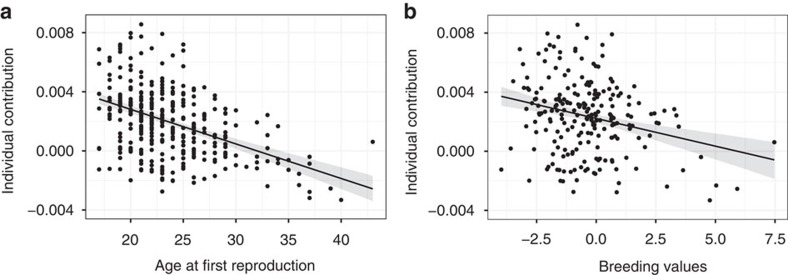
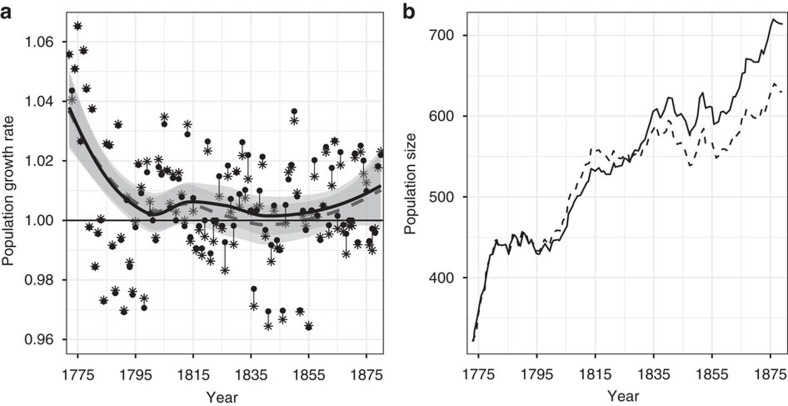
Recent studies of the joint dynamics of ecological and evolutionary processes show that changes in genotype or phenotype distributions can affect population, community and ecosystem processes. Such eco-evolutionary dynamics are likely to occur in modern humans and may influence population dynamics. Here, we study contributions to population growth from detailed genealogical records of a contemporary human population. We show that evolutionary changes in women's age at first reproduction can affect population growth: 15.9% of variation in individual contribution to population growth over 108 years is explained by mean age at first reproduction and at least one-third of this variation (6.1%) is attributed to the genetic basis of this trait, which showed an evolutionary response to selection during the period studied. Our study suggests that eco-evolutionary processes have modulated the growth of contemporary human populations.
最近对生态和进化过程的联合动态的研究表明,基因型或表型分布的变化会影响种群、群落和生态系统过程。这种生态进化动态很可能发生在现代人类身上,并可能影响人口动态。在这里,我们研究了当代人类群体的详细家谱记录对人口增长的贡献。我们表明,女性首次生育年龄的进化变化会影响人口增长:在 108 年内,个体对人口增长的贡献的变化有 15.9%可以用首次生育的平均年龄来解释,而这一变化的至少三分之一(6.1%)归因于该特征的遗传基础,该基础在研究期间表现出对选择的进化反应。我们的研究表明,生态进化过程已经调节了当代人类种群的增长。