Department of Hematology, Nanfang Hospital, Southern Medical University, No. 1838 North Guangzhou Avenue, Guangzhou, 510515, China.
Department of Hematology, First People's Hospital of Chenzhou, No. 102 Luojiajing District, Chenzhou, 423000, China.
J Hematol Oncol. 2017 Jul 4;10(1):135. doi: 10.1186/s13045-017-0503-2.
Granulocyte colony-stimulating factor (G-CSF)-mobilized peripheral blood stem cells (G-PBSC) has largely replaced unstimulated bone marrow (un-BM) for allografting because of accelerated engraftment, but with a higher morbidity and mortality of graft-versus-host-disease (GVHD). Recent studies suggested that G-CSF-primed BM (G-BM) had similar engraftment but lower morbidity and mortality of GVHD comparing to G-PBSC. A prospective, randomized, multicenter study was conducted to compare G-BM with G-PBSC as the grafts in allogeneic hematopoietic stem cell transplantation (allo-HSCT) for acute leukemia in first complete remission (CR1).
Totally 101 adult leukemia in CR1 undergoing HLA-identical sibling transplants were randomized into G-BM or G-PBSC group. The primary study endpoint was GVHD-free/relapse-free survival (GRFS).
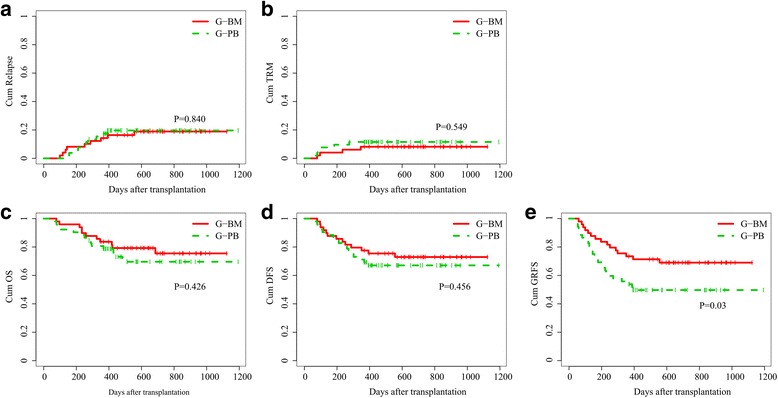
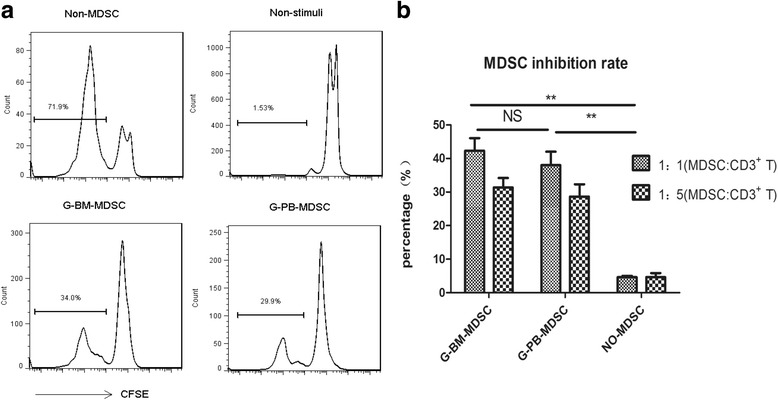
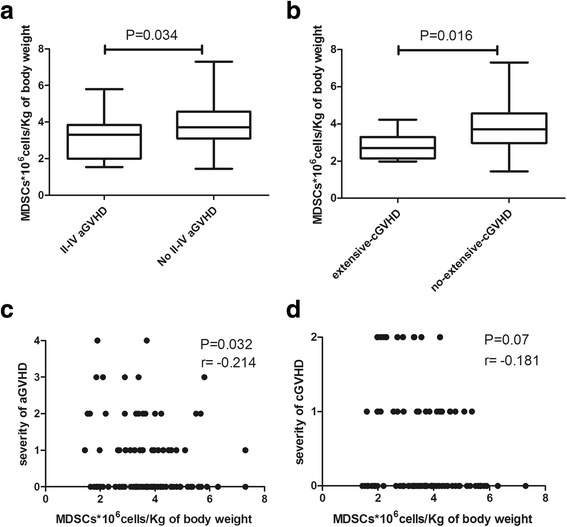
Both the engraftment of neutrophil and platelet were 2 days later in G-BM than in G-PBSC group (P = 0.412, P = 0.39). G-BM group showed significantly lower II-IV acute GVHD (aGVHD) and similar III-IV aGVHD compared with G-PBSC group (12.2% vs 28.8% for II-IV, P = 0.048; 4.1% vs 9.6% for III-IV aGVHD, P = 0.267, respectively). The overall cumulative incidence of chronic GVHD (cGVHD) at 3 years were 22.3% ± 6.3% and 44.8% ± 7.6% (P = 0.026), respectively, and extensive cGHVD were 4.5% ± 3.1% and 15% ± 5.3% (P = 0.08), respectively, in G-BM and G-PBSC groups. Two groups had similar 3-year relapse, transplant-related mortality (TRM), overall survival (OS), and disease-free survival (DFS) (all P > 0.05). G-BM group showed significantly higher probability of GRFS than G-PBSC group (73.5% ± 6.3% vs 55.8% ± 6.9% at 1 year, P = 0.049; 69.0% ± 6.7% vs 49.7% ± 7.0% at 2 and 3 years, P = 0.03, respectively). Graft content analysis revealed statistically higher frequency of myeloid-derived suppressor cells (MDSCs) in the G-BM than in G-PBSC grafts (P < 0.01), and recipients received statistically higher numbers of MDSCs in G-BM than in G-PBSC group (P = 0.045). Numbers of MDSCs infused to patients were negatively correlated with the severity of aGVHD (P = 0.032, r = -0.214). Multivariate analysis showed that MDSC cell dose below the median (HR = 3.49, P < 0.001), recipient age (HR = 2.02, P = 0.039), and high risk of disease (HR = 2.14, P = 0.018) were independent risk factors for GRFS.
G-BM grafts lead a better GRFS and less GVHD associated with a higher MDSCs content compared with G-PBSC grafts.
粒细胞集落刺激因子(G-CSF)动员的外周血干细胞(G-PBSC)由于加速植入而在异体造血干细胞移植(allo-HSCT)中已基本取代未刺激的骨髓(un-BM),但移植物抗宿主病(GVHD)的发病率和死亡率较高。最近的研究表明,与 G-PBSC 相比,G-CSF 预处理的骨髓(G-BM)具有相似的植入率,但 GVHD 的发病率和死亡率较低。一项前瞻性、随机、多中心研究比较了 G-BM 与 G-PBSC 作为急性白血病首次完全缓解(CR1)患者allo-HSCT 供体的疗效。
共纳入 101 例接受 HLA 同胞移植的 CR1 期白血病患者,随机分为 G-BM 或 G-PBSC 组。主要研究终点为无 GVHD/复发无事件生存(GRFS)。
G-BM 组中性粒细胞和血小板植入分别比 G-PBSC 组晚 2 天(P = 0.412,P = 0.39)。与 G-PBSC 组相比,G-BM 组 II-IV 级急性 GVHD(aGVHD)和 III-IV 级 aGVHD 的发生率较低(12.2%比 28.8%,P = 0.048;4.1%比 9.6%,P = 0.267)。3 年时慢性 GVHD(cGVHD)的总累积发生率分别为 22.3%±6.3%和 44.8%±7.6%(P = 0.026),广泛型 cGVHD 的发生率分别为 4.5%±3.1%和 15%±5.3%(P = 0.08)。G-BM 和 G-PBSC 组之间 3 年的复发率、移植相关死亡率(TRM)、总生存率(OS)和无病生存率(DFS)相似(均 P > 0.05)。G-BM 组的 GRFS 明显优于 G-PBSC 组(1 年时为 73.5%±6.3%比 55.8%±6.9%,P = 0.049;2 年和 3 年时分别为 69.0%±6.7%比 49.7%±7.0%,P = 0.03)。移植物分析显示 G-BM 中的髓源性抑制细胞(MDSCs)频率明显高于 G-PBSC(P < 0.01),并且 G-BM 组患者接受的 MDSCs数量也明显高于 G-PBSC 组(P = 0.045)。输注给患者的 MDSC 数量与 aGVHD 的严重程度呈负相关(P = 0.032,r = -0.214)。多变量分析显示,MDSC 细胞剂量低于中位数(HR = 3.49,P < 0.001)、患者年龄(HR = 2.02,P = 0.039)和疾病高危(HR = 2.14,P = 0.018)是 GRFS 的独立危险因素。
与 G-PBSC 相比,G-BM 移植物导致更好的 GRFS 和更少的 GVHD,与更高的 MDSCs 含量相关。