Liu Wenjuan, Son Dong Ok, Lau Harry K, Zhou Yinghui, Prud'homme Gerald J, Jin Tianru, Wang Qinghua
Department of Endocrinology and Metabolism, Huashan Hospital, Fudan UniversityShanghai, China.
Division of Endocrinology and Metabolism, The Keenan Research Centre in the Li Ka Shing Knowledge Institute, St. Michael's Hospital, TorontoON, Canada.
Front Pharmacol. 2017 Jun 20;8:362. doi: 10.3389/fphar.2017.00362. eCollection 2017.
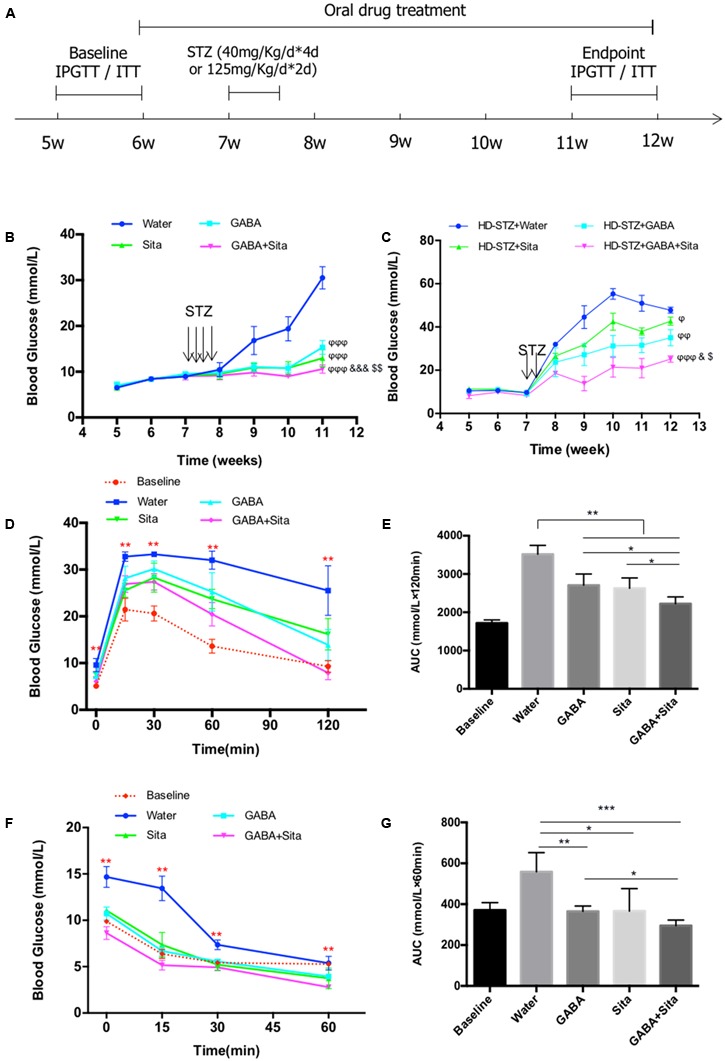
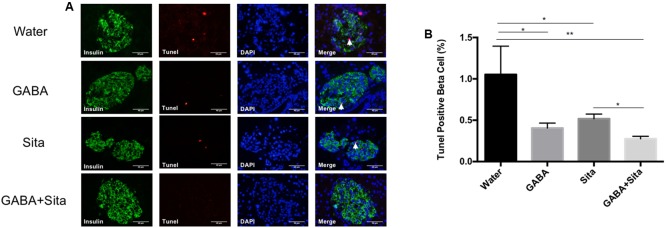
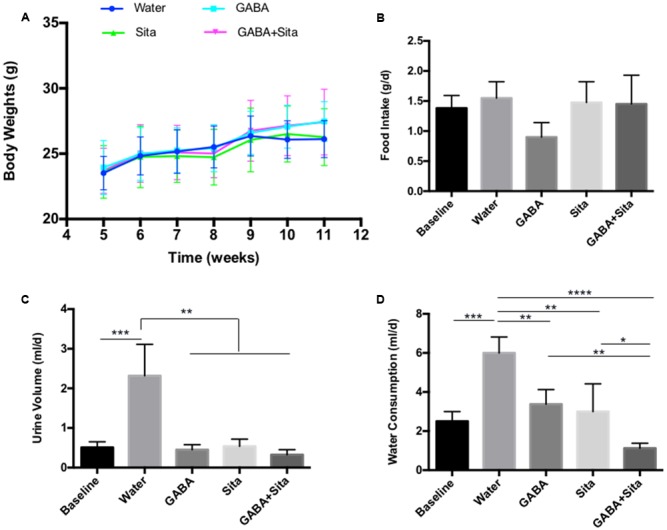
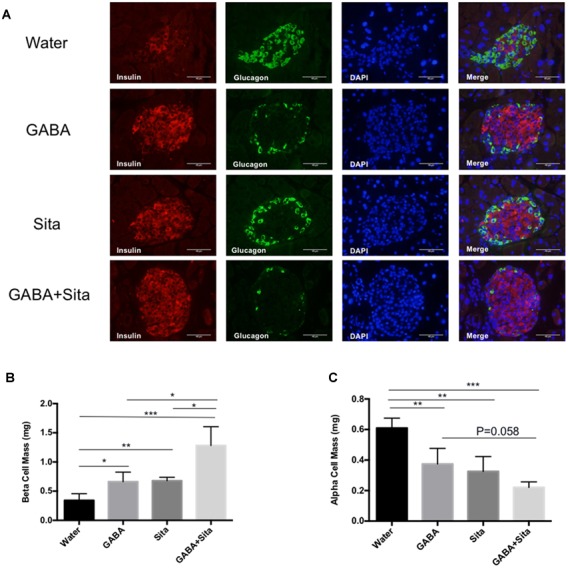
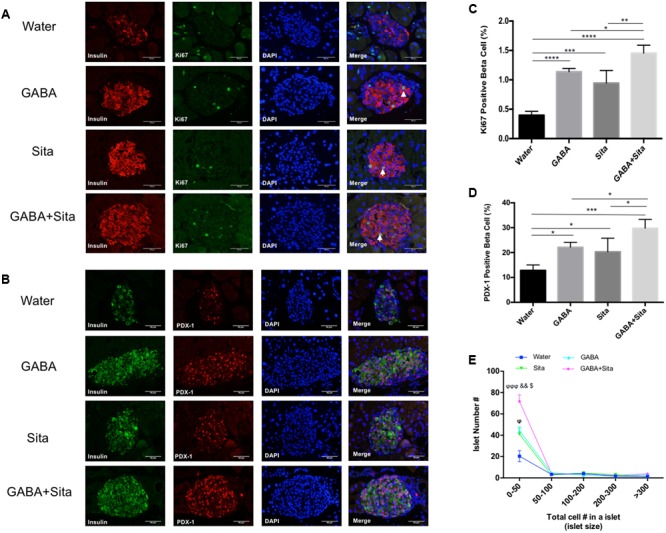
γ-aminobutyric acid (GABA) or glucagon-like peptide-1 based drugs, such as sitagliptin (a dipeptidyl peptidase-4 inhibitor), were shown to induce beta cell regenerative effects in various diabetic mouse models. We propose that their combined administration can bring forth an additive therapeutic effect. We tested this hypothesis in a multiple low-dose streptozotocin (STZ)-induced beta cell injury mouse model (MDSD). Male C57BL/6J mice were assigned randomly into four groups: non-treatment diabetic control, GABA, sitagliptin, or GABA plus sitagliptin. Oral drug administration was initiated 1 week before STZ injection and maintained for 6 weeks. GABA or sitagliptin administration decreased ambient blood glucose levels and improved the glucose excursion rate. This was associated with elevated plasma insulin and reduced plasma glucagon levels. Importantly, combined use of GABA and sitagliptin significantly enhanced these effects as compared with each of the monotherapies. An additive effect on reducing water consumption was also observed. Immunohistochemical analyses revealed that combined GABA and sitagliptin therapy was superior in increasing beta cell mass, associated with increased small-size islet numbers, Ki67 and PDX-1 beta cell counts; and reduced Tunel beta cell counts. Thus, beta cell proliferation was increased, whereas apoptosis was reduced. We also noticed a suppressive effect of GABA or sitagliptin on alpha cell mass, which was not significantly altered by combining the two agents. Although either GABA or sitagliptin administration delays the onset of MDSD, our study indicates that combined use of them produces superior therapeutic outcomes. This is likely due to an amelioration of beta cell proliferation and a decrease of beta cell apoptosis.
γ-氨基丁酸(GABA)或基于胰高血糖素样肽-1的药物,如西他列汀(一种二肽基肽酶-4抑制剂),已在多种糖尿病小鼠模型中显示出诱导β细胞再生的作用。我们认为联合使用这些药物可产生相加的治疗效果。我们在多次低剂量链脲佐菌素(STZ)诱导的β细胞损伤小鼠模型(MDSD)中验证了这一假设。将雄性C57BL/6J小鼠随机分为四组:未治疗的糖尿病对照组、GABA组、西他列汀组或GABA加西他列汀组。在注射STZ前1周开始口服给药,并持续6周。给予GABA或西他列汀可降低空腹血糖水平并改善血糖波动率。这与血浆胰岛素升高和血浆胰高血糖素水平降低有关。重要的是,与单一疗法相比,联合使用GABA和西他列汀可显著增强这些作用。还观察到对减少饮水量有相加作用。免疫组织化学分析显示,联合使用GABA和西他列汀治疗在增加β细胞量方面更具优势,这与小尺寸胰岛数量增加、Ki67和PDX-1阳性β细胞计数增加以及Tunel阳性β细胞计数减少有关。因此,β细胞增殖增加,而细胞凋亡减少。我们还注意到GABA或西他列汀对α细胞量有抑制作用,联合使用这两种药物后该作用未显著改变。尽管单独给予GABA或西他列汀均可延迟MDSD的发病,但我们的研究表明联合使用它们可产生更好的治疗效果。这可能是由于β细胞增殖改善和β细胞凋亡减少所致。