Muscedere John, Waters Braden, Varambally Aditya, Bagshaw Sean M, Boyd J Gordon, Maslove David, Sibley Stephanie, Rockwood Kenneth
Department of Critical Care Medicine, Queen's University, Kingston, ON, Canada.
Kingston General Hospital, Watkins C, Room 5-411, 76 Stuart Street, K7L 2V7, Kingston, ON, Canada.
Intensive Care Med. 2017 Aug;43(8):1105-1122. doi: 10.1007/s00134-017-4867-0. Epub 2017 Jul 4.
Functional status and chronic health status are important baseline characteristics of critically ill patients. The assessment of frailty on admission to the intensive care unit (ICU) may provide objective, prognostic information on baseline health. To determine the impact of frailty on the outcome of critically ill patients, we performed a systematic review and meta-analysis comparing clinical outcomes in frail and non-frail patients admitted to ICU.
We searched the Cochrane Central Register of Controlled Trials, MEDLINE, EMBASE, PubMed, CINAHL, and Clinicaltrials.gov. All study designs with the exception of narrative reviews, case reports, and editorials were included. Included studies assessed frailty in patients greater than 18 years of age admitted to an ICU and compared outcomes between fit and frail patients. Two reviewers independently applied eligibility criteria, assessed quality, and extracted data. The primary outcomes were hospital and long-term mortality. We also determined the prevalence of frailty, the impact on other patient-centered outcomes such as discharge disposition, and health service utilization such as length of stay.
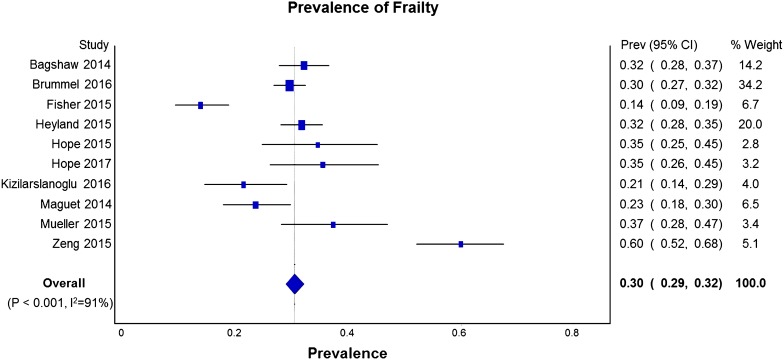
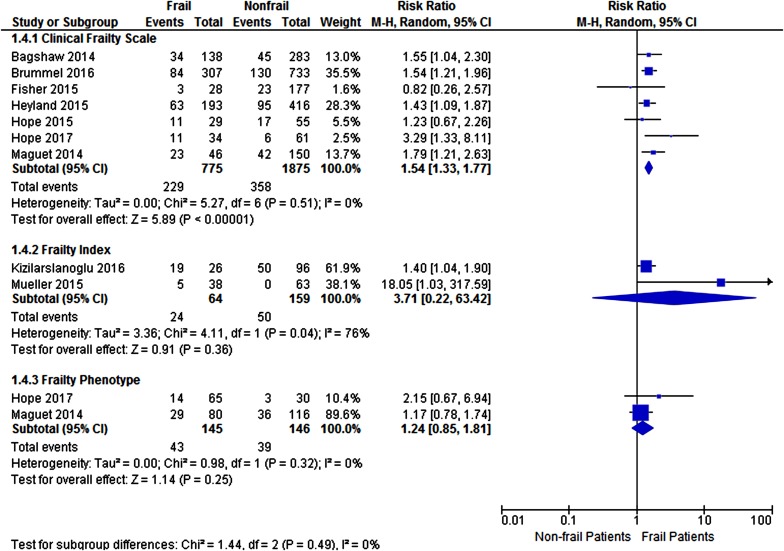
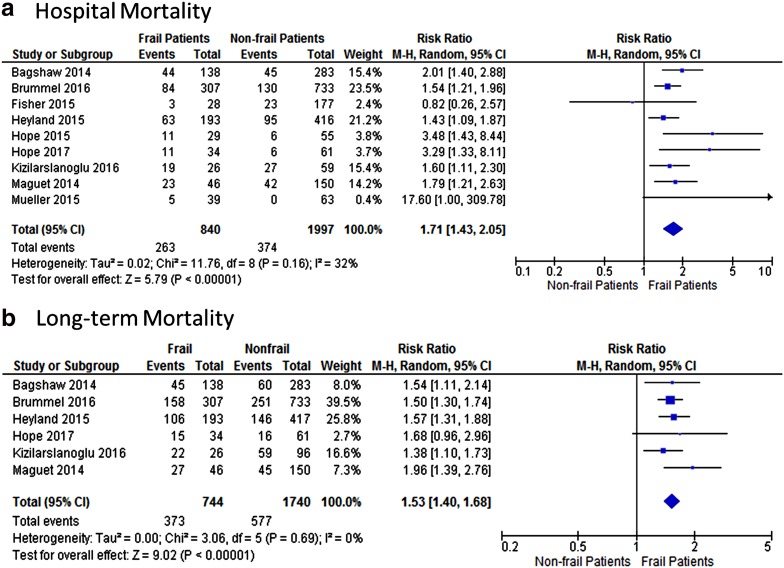
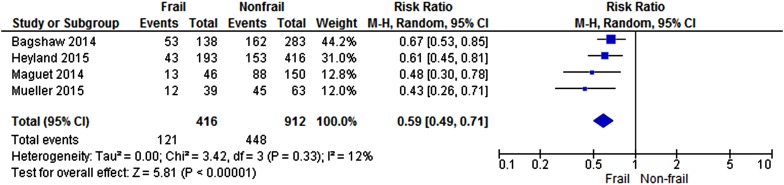
Ten observational studies enrolling a total of 3030 patients (927 frail and 2103 fit patients) were included. The overall quality of studies was moderate. Frailty was associated with higher hospital mortality [relative risk (RR) 1.71; 95% CI 1.43, 2.05; p < 0.00001; I = 32%] and long-term mortality (RR 1.53; 95% CI 1.40, 1.68; p < 0.00001; I = 0%). The pooled prevalence of frailty was 30% (95% CI 29-32%). Frail patients were less likely to be discharged home than fit patients (RR 0.59; 95% CI 0.49, 0.71; p < 0.00001; I = 12%).
Frailty is common in patients admitted to ICU and is associated with worsened outcomes. Identification of this previously unrecognized and vulnerable ICU population should act as the impetus for investigating and implementing appropriate care plans for critically ill frail patients. Registration: PROSPERO (ID: CRD42016053910).
功能状态和慢性健康状况是危重症患者重要的基线特征。在重症监护病房(ICU)入院时评估虚弱程度可为基线健康状况提供客观的预后信息。为确定虚弱对危重症患者结局的影响,我们进行了一项系统评价和荟萃分析,比较入住ICU的虚弱患者和非虚弱患者的临床结局。
我们检索了Cochrane对照试验中心注册库、MEDLINE、EMBASE、PubMed、CINAHL和Clinicaltrials.gov。除叙述性综述、病例报告和社论外,所有研究设计均纳入。纳入研究评估了入住ICU的18岁以上患者的虚弱程度,并比较了健康患者和虚弱患者的结局。两名研究者独立应用纳入标准、评估质量并提取数据。主要结局为住院死亡率和长期死亡率。我们还确定了虚弱的患病率、对其他以患者为中心的结局(如出院处置)的影响以及对医疗服务利用(如住院时间)的影响。
纳入10项观察性研究,共3030例患者(927例虚弱患者和2103例健康患者)。研究的总体质量中等。虚弱与较高的住院死亡率相关[相对危险度(RR)1.71;95%可信区间(CI)1.43,2.05;p<0.00001;I² = 32%]和长期死亡率(RR 1.53;95%CI 1.40,1.68;p<0.00001;I² = 0%)。虚弱的合并患病率为30%(95%CI 29 - 32%)。与健康患者相比,虚弱患者出院回家的可能性较小(RR 0.59;95%CI 0.49,0.71;p<0.00001;I² = 12%)。
虚弱在入住ICU的患者中很常见,且与更差的结局相关。识别这一先前未被认识且易受伤害的ICU人群应成为调查和实施针对危重症虚弱患者的适当护理计划的动力。注册信息:PROSPERO(编号:CRD420160�3910)。