Li Xindi, Mei Shenghui, Gong Xiaoqing, Zhou Heng, Yang Li, Zhou Anna, Liu Yonghong, Li Xingang, Zhao Zhigang, Zhang Xinghu
Neuroinfection and Neuroimmunology Center, Department of Neurology, Beijing Tiantan Hospital, Capital Medical University, 6 TiantanXili, Dongcheng District, Beijing, 100050, People's Republic of China.
China National Clinical Research Center for Neurological Diseases, Beijing Tiantan Hospital, Capital Medical University, 6 TiantanXili, Dongcheng District, Beijing, 100050, People's Republic of China.
BMC Neurol. 2017 Jul 5;17(1):130. doi: 10.1186/s12883-017-0903-5.
Neuromyelitis optica spectrum disorders (NMOSD) are demyelinating autoimmune diseases in the central nervous system (CNS) that are characterized by a high relapse rate and the presence of anti-aquaporin 4 antibodies (AQP4-IgG) in the serum. Azathioprine (AZA) is a first-line immunomodulatory drug that is widely used for the treatment of patients with NMOSD. However, the efficacy and safety of AZA vary in different individuals.
Thirty-two patients with NMOSD who regularly took AZA were enrolled in the study at Beijing Tiantan Hospital, Capital Medical University. The efficacy of AZA was evaluated using the expanded disability status scale (EDSS) and the annual relapse rate (ARR). The erythrocyte concentrations of AZA metabolites were detected using an LC-MS/MS method.
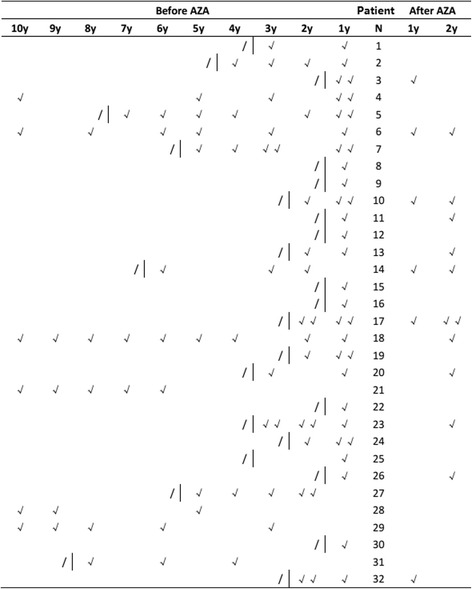
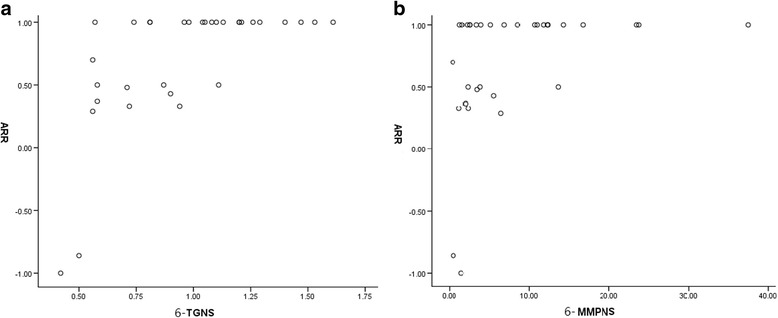
The erythrocyte concentrations of 6-thioguanine nucleotides (6-TGNs) and 6-methylmercaptopurine nucleotides (6-MMPNs) were 202.03 ± 63.35 pmol/810 RBC and 1618.90 ± 1607.06 pmol/810 RBC, respectively. After the patients had received AZA therapy for more than one year, the EDSS score decreased from 5.21 ± 0.24 to 2.57 ± 0.33 (p < 0.0001), and the ARR decreased from 1.41 ± 0.23 to 0.36 ± 0.09 (p < 0.0001). The 6-TGN and 6-MMPN levels were significantly different between the non-relapsed and relapsed groups (p < 0.0001, p = 0.006, respectively). A higher ARR was significantly correlated with higher erythrocyte concentrations of 6-TGNs (p < 0.0001) and 6-MMPNs (p = 0.004).
AZA can reduce the EDSS score and ARR in NMOSD patients. Additionally, the efficacy of AZA is significantly related to the erythrocyte concentrations of 6-TGNs and 6-MMPNs. Within the safe upper limits, a higher concentration of 6-TGNs is associated with better efficacy of AZA.
ISRCTN16551495 , retrospectively registered on May 22, 2017.
视神经脊髓炎谱系障碍(NMOSD)是中枢神经系统(CNS)的脱髓鞘自身免疫性疾病,其特征为高复发率以及血清中存在抗水通道蛋白4抗体(AQP4-IgG)。硫唑嘌呤(AZA)是一种一线免疫调节药物,广泛用于治疗NMOSD患者。然而,AZA的疗效和安全性在不同个体中存在差异。
32例规律服用AZA的NMOSD患者入组首都医科大学附属北京天坛医院的这项研究。使用扩展残疾状态量表(EDSS)和年复发率(ARR)评估AZA的疗效。采用液相色谱-串联质谱法(LC-MS/MS)检测AZA代谢产物的红细胞浓度。
6-硫鸟嘌呤核苷酸(6-TGNs)和6-甲基巯基嘌呤核苷酸(6-MMPNs)红细胞浓度分别为202.03±63.35 pmol/8×10⁶红细胞和1618.90±1607.06 pmol/8×10⁶红细胞。患者接受AZA治疗1年以上后,EDSS评分从5.21±0.24降至2.57±0.33(p<0.0001),ARR从1.41±0.23降至0.36±0.09(p<0.0001)。未复发组和复发组的6-TGN和6-MMPN水平存在显著差异(分别为p<0.0001,p = 0.006)。较高的ARR与较高的6-TGNs红细胞浓度(p<0.0001)和6-MMPNs红细胞浓度(p = 0.004)显著相关。
AZA可降低NMOSD患者的EDSS评分和ARR。此外,AZA的疗效与6-TGNs和6-MMPNs的红细胞浓度显著相关。在安全上限范围内,较高浓度的6-TGNs与AZA更好的疗效相关。
ISRCTN16551495,于2017年5月22日进行回顾性注册。