Smith Edward G, D'Angelo Cecilia, Sharon Yoni, Tchernov Dan, Wiedenmann Joerg
Coral Reef Laboratory, Ocean and Earth Science, University of Southampton, European Way, Southampton SO14 3ZH, UK.
Marine Biology Laboratory/Centre for Genomics and Systems Biology, New York University Abu Dhabi, Abu Dhabi, United Arab Emirates.
Proc Biol Sci. 2017 Jul 12;284(1858). doi: 10.1098/rspb.2017.0320.
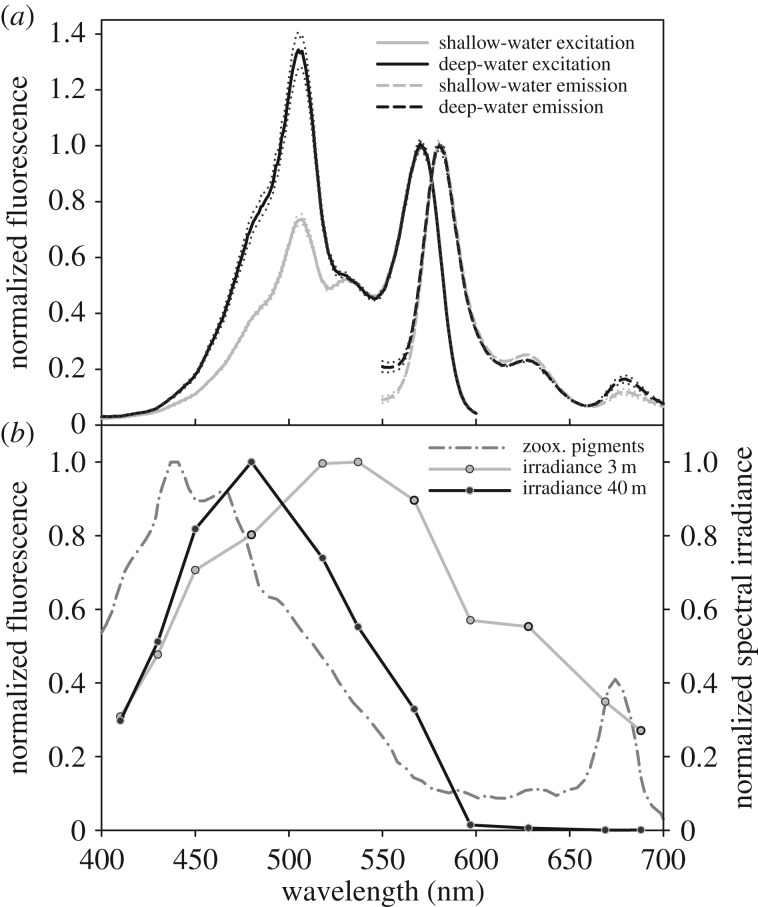
The depth distribution of reef-building corals exposes their photosynthetic symbionts of the genus to extreme gradients in the intensity and spectral quality of the ambient light environment. Characterizing the mechanisms used by the coral holobiont to respond to the low intensity and reduced spectral composition of the light environment in deeper reefs (greater than 20 m) is fundamental to our understanding of the functioning and structure of reefs across depth gradients. Here, we demonstrate that host pigments, specifically photoconvertible red fluorescent proteins (pcRFPs), can promote coral adaptation/acclimatization to deeper-water light environments by transforming the prevalent blue light into orange-red light, which can penetrate deeper within zooxanthellae-containing tissues; this facilitates a more homogeneous distribution of photons across symbiont communities. The ecological importance of pcRFPs in deeper reefs is supported by the increasing proportion of red fluorescent corals with depth (measured down to 45 m) and increased survival of colour morphs with strong expression of pcRFPs in long-term light manipulation experiments. In addition to screening by host pigments from high light intensities in shallow water, the spectral transformation observed in deeper-water corals highlights the importance of GFP-like protein expression as an ecological mechanism to support the functioning of the coral- association across steep environmental gradients.
造礁珊瑚的深度分布使其光合共生体暴露于周围光环境的强度和光谱质量的极端梯度中。了解珊瑚共生体用于应对较深珊瑚礁(大于20米)中低强度和光谱组成减少的光环境的机制,对于我们理解跨深度梯度的珊瑚礁的功能和结构至关重要。在这里,我们证明宿主色素,特别是光可转换红色荧光蛋白(pcRFPs),可以通过将普遍存在的蓝光转化为橙红光来促进珊瑚对深水光环境的适应/驯化,橙红光可以在含有虫黄藻的组织中穿透得更深;这有助于光子在共生体群落中更均匀地分布。随着深度增加(测量深度达45米)红色荧光珊瑚比例的增加以及在长期光照操纵实验中具有强烈pcRFPs表达的颜色变体的存活率增加,支持了pcRFPs在较深珊瑚礁中的生态重要性。除了通过宿主色素在浅水中筛选高光强度外,在深水珊瑚中观察到的光谱转换突出了类绿色荧光蛋白表达作为一种生态机制的重要性,以支持珊瑚共生体在陡峭环境梯度中的功能。