Lyons Nicholas A, Kolter Roberto
Department of Microbiology and Immunobiology, Harvard Medical School, Boston, Massachusetts, USA.
Department of Microbiology and Immunobiology, Harvard Medical School, Boston, Massachusetts, USA
mBio. 2017 Jul 5;8(4):e00723-17. doi: 10.1128/mBio.00723-17.
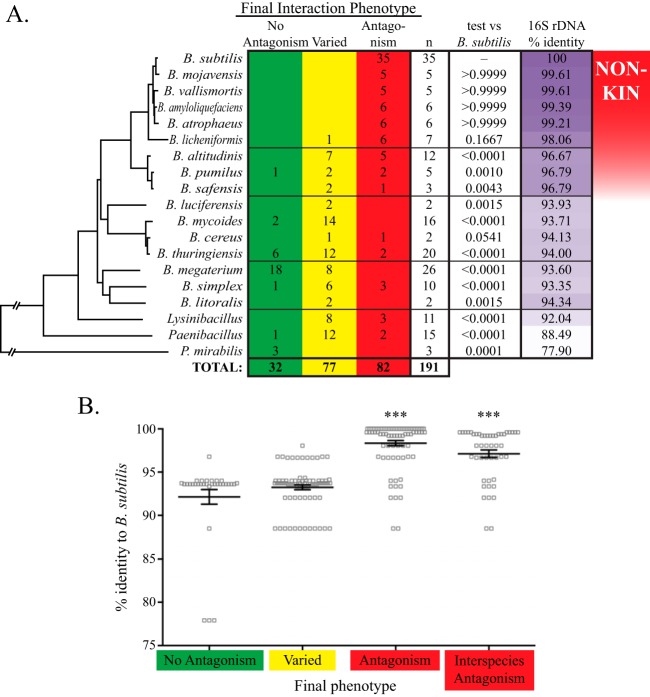
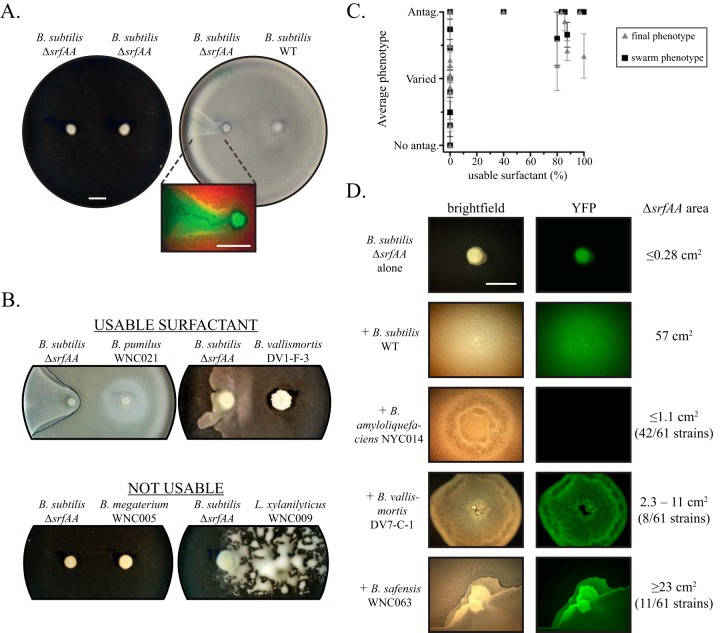
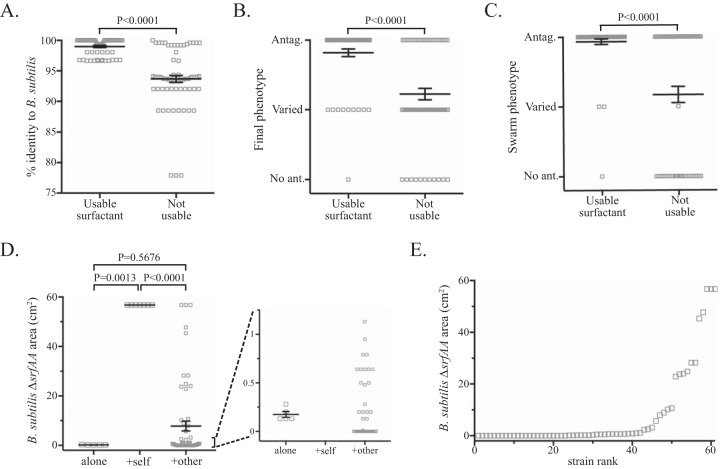
Kin discrimination systems are found in numerous communal contexts like multicellularity and are theorized to prevent exploitation of cooperative behaviors. The kin discrimination system in differs from most other such systems because it excludes nonkin cells rather than including kin cells. Because nonkin are the target of the system, can potentially distinguish degrees of nonkin relatedness, not just kin versus nonkin. We examined this by testing a large strain collection of diverse species against in different multicellular contexts. The effects of kin discrimination extend to nearby species, as the other clade species were treated with the same antagonism as nonkin. Species in the less-related clade started to display varied phenotypes but were mostly still discriminated against, while clade members and beyond were no longer subject to kin discrimination. Seeking a reason why other species are perceived as antagonistic nonkin, we tested the ability of to steal communally produced surfactant from these species. We found that the species treated as nonkin were the only ones that made a surfactant that could utilize and that nonkin antagonism prevented such stealing when the two strains were mixed. The nonkin exclusion kin discrimination method thus allows effective protection of the cooperative behaviors prevalent in multicellularity while still permitting interactions with more distant species that are not a threat. Multicellular systems like bacterial biofilms and swarms rely on cooperative behaviors that could be undermined by exploitative invaders. Discriminating kin from nonkin is one way to help guard against such exploitation but has thus far been examined only intraspecifically, so the phylogenetic range of this important trait is unknown. We tested whether treats other species as nonkin by testing a single strain against a diverse collection of isolates. We found that the species in the same clade were treated as nonkin, which then lessened in more distant relatives. Further experiments showed that these nonkin species produced a cooperative good that could be stolen by and that treating each other as nonkin largely prevented this exploitation. These results impact our understanding of interspecies interactions, as bacterial populations can interact only after they have diverged enough to no longer be a threat to their cooperative existences.
亲缘识别系统存在于众多群体环境中,如多细胞生物中,其理论作用是防止合作行为被利用。[具体生物名称]中的亲缘识别系统与大多数其他此类系统不同,因为它排除非亲缘细胞而非包含亲缘细胞。由于非亲缘细胞是该系统的目标,[具体生物名称]有可能区分非亲缘关系的程度,而不仅仅是亲缘与非亲缘。我们通过在不同多细胞环境中测试大量不同[具体生物名称]物种的菌株集合与[具体生物名称]的相互作用来研究这一点。亲缘识别的影响扩展到附近物种,因为其他[具体生物名称]进化枝物种受到与非亲缘细胞相同的拮抗作用。亲缘关系较远的[具体生物名称]进化枝中的物种开始表现出不同的表型,但大多仍受到歧视,而[具体生物名称]进化枝成员及更远的物种不再受到亲缘识别。为了寻找其他物种被视为敌对非亲缘的原因,我们测试了[具体生物名称]从这些物种中窃取共同产生的表面活性剂的能力。我们发现被视为非亲缘的物种是唯一能产生[具体生物名称]可利用的表面活性剂的物种,并且当两种菌株混合时,非亲缘拮抗作用可防止这种窃取。因此,非亲缘排除亲缘识别方法既能有效保护多细胞生物中普遍存在的合作行为,同时仍允许与无威胁的更远距离物种进行相互作用。像细菌生物膜和群体这样的多细胞系统依赖于可能被剥削性入侵者破坏的合作行为。区分亲缘与非亲缘是防范此类剥削的一种方式,但迄今为止仅在种内进行过研究,所以这一重要特征的系统发育范围尚不清楚。我们通过测试一个单一菌株与不同[具体生物名称]分离株的集合来检验[具体生物名称]是否将其他物种视为非亲缘。我们发现同一进化枝中的物种被视为非亲缘,而在亲缘关系更远的物种中这种情况则有所减轻。进一步的实验表明,这些非亲缘物种产生了一种可被[具体生物名称]窃取的合作性产物,并且将彼此视为非亲缘在很大程度上防止了这种剥削。这些结果影响了我们对物种间相互作用的理解,因为细菌群体只有在分化到不再对其合作生存构成威胁之后才能相互作用。