Brandetti Elisa, Veneziani Irene, Melaiu Ombretta, Pezzolo Annalisa, Castellano Aurora, Boldrini Renata, Ferretti Elisa, Fruci Doriana, Moretta Lorenzo, Pistoia Vito, Locatelli Franco, Cifaldi Loredana
Department of Pediatric Hematology and Oncology, Bambino Gesù Children's Hospital, IRCCS, Rome, Italy.
School of Medicine, Programme in Immunology and Advanced Biotechnology, "Tor Vergata" University of Rome, Rome, Italy.
Oncoimmunology. 2017 Apr 20;6(6):e1316439. doi: 10.1080/2162402X.2017.1316439. eCollection 2017.
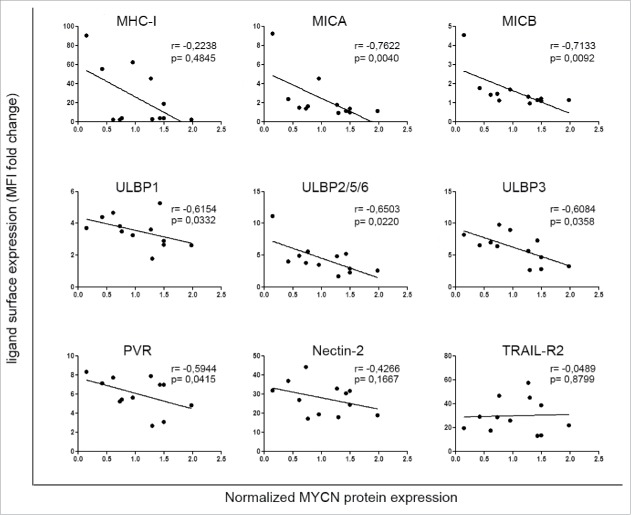
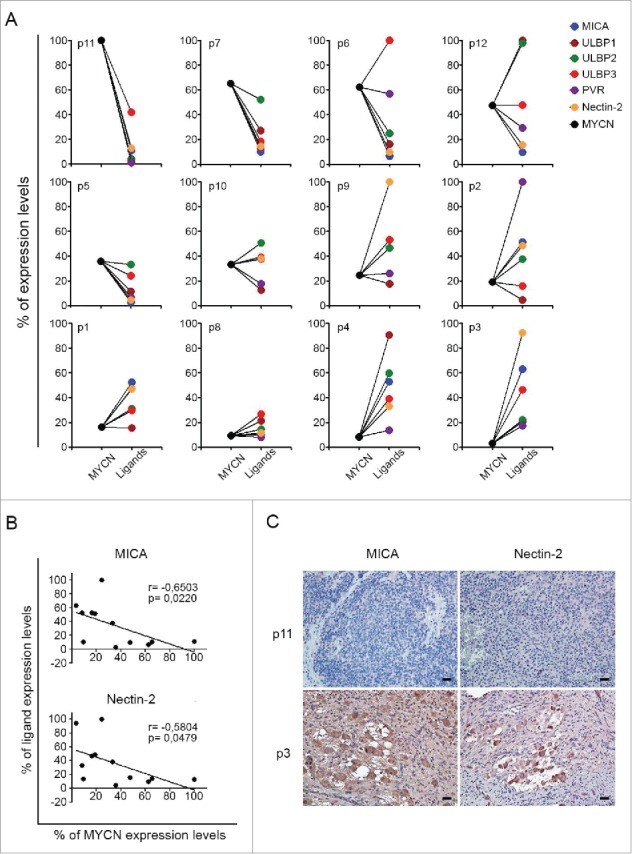
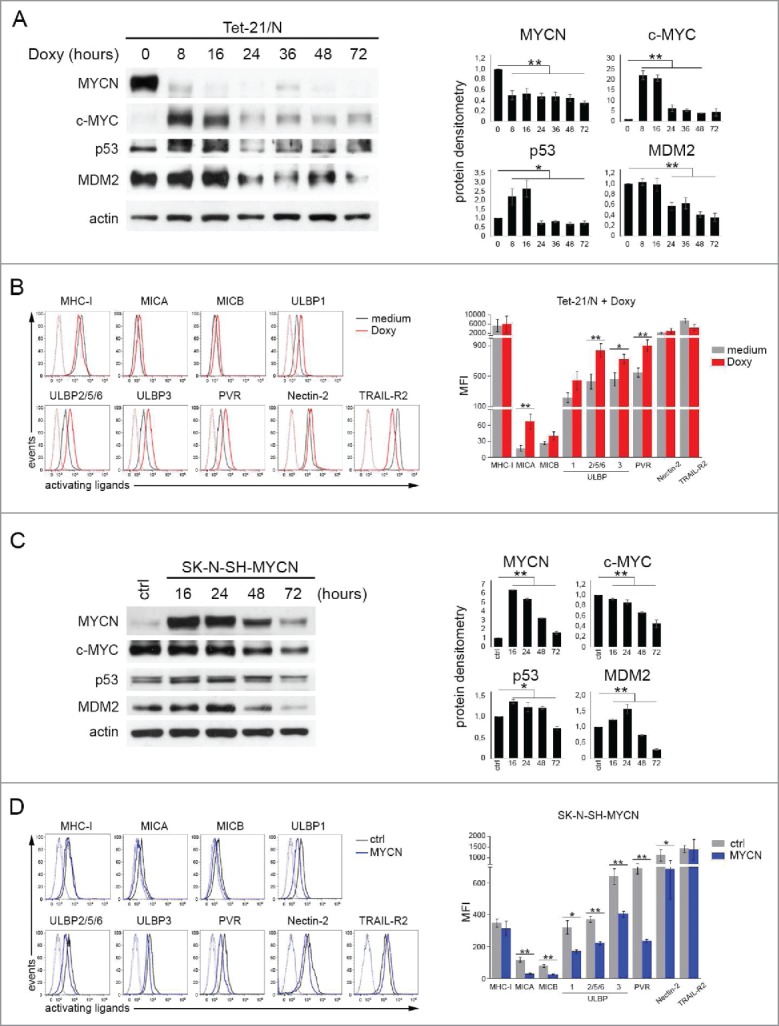
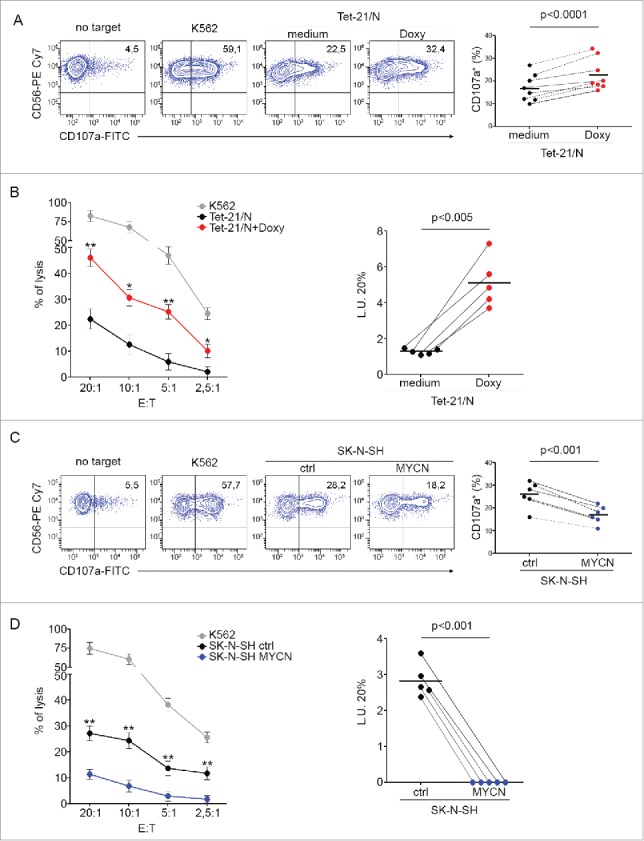
Neuroblastoma (NB) is the most common extracranial solid tumor occurring in childhood. Amplification of the oncogene is associated with poor prognosis. Downregulation on NB cells of ligands recognized by Natural Killer (NK) cell-activating receptors, involved in tumor cell recognition and lysis, may contribute to tumor progression and relapse. Here, we demonstrate that in human NB cell lines MYCN expression inversely correlates with that of ligands recognized by NKG2D and DNAM1 activating receptors in human NB cell lines. In the MYCN-inducible Tet-21/N cell line, downregulation of MYCN resulted in enhanced expression of the activating ligands MICA, ULBPs and PVR, which rendered tumor cells more susceptible to recognition and lysis mediated by NK cells. Conversely, a MYCN non-amplified NB cell line transfected with MYCN showed an opposite behavior compared with control cells. Consistent with these findings, an inverse correlation was detected between the expression of MYCN and that of ligands for NK-cell-activating receptors in 12 NB patient specimens both at mRNA and protein levels. Taken together, these results provide the first demonstration that MYCN acts as an immunosuppressive oncogene in NB cells that negatively regulates the expression of ligands for NKG2D and DNAM-1 NK-cell-activating receptors. Our study provides a clue to exploit MYCN expression levels as a biomarker to predict the efficacy of NK-cell-based immunotherapy in NB patients.
神经母细胞瘤(NB)是儿童期最常见的颅外实体瘤。癌基因的扩增与预后不良相关。自然杀伤(NK)细胞激活受体所识别的配体在NB细胞上的下调,这些配体参与肿瘤细胞的识别和裂解,可能导致肿瘤进展和复发。在此,我们证明在人NB细胞系中,MYCN的表达与NKG2D和DNAM1激活受体所识别的配体的表达呈负相关。在MYCN可诱导的Tet-21/N细胞系中,MYCN的下调导致激活配体MICA、ULBPs和PVR的表达增强,这使得肿瘤细胞更容易被NK细胞介导的识别和裂解。相反,转染MYCN的非MYCN扩增的NB细胞系与对照细胞相比表现出相反的行为。与这些发现一致,在12例NB患者标本的mRNA和蛋白质水平上,均检测到MYCN的表达与NK细胞激活受体配体的表达呈负相关。综上所述,这些结果首次证明MYCN在NB细胞中作为一种免疫抑制癌基因,负向调节NKG2D和DNAM-1 NK细胞激活受体配体的表达。我们的研究为利用MYCN表达水平作为生物标志物来预测NB患者基于NK细胞的免疫治疗疗效提供了线索。