Sormani Maria Pia, Truffinet Philippe, Thangavelu Karthinathan, Rufi Pascal, Simonson Catherine, De Stefano Nicola
Biostatistics Unit (M.P.S.), University of Genoa, Italy; Sanofi Genzyme (P.T., P.R.), Chilly-Mazarin, France; Sanofi Genzyme (K.T.), Cambridge, MA; Fishawack Communications Ltd (C.S.), Abingdon, Oxfordshire, UK; and Department of Medicine, Surgery, and Neurosciences (N.D.S.), University of Siena, Italy.
Neurol Neuroimmunol Neuroinflamm. 2017 Jun 28;4(5):e379. doi: 10.1212/NXI.0000000000000379. eCollection 2017 Sep.
To predict long-term disability outcomes in TEMSO core (NCT00134563) and extension (NCT00803049) studies in patients with relapsing forms of MS treated with teriflunomide.
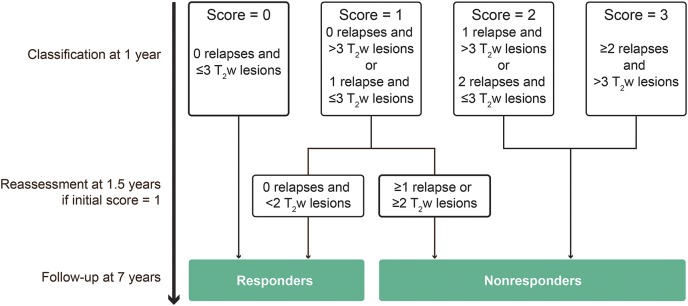
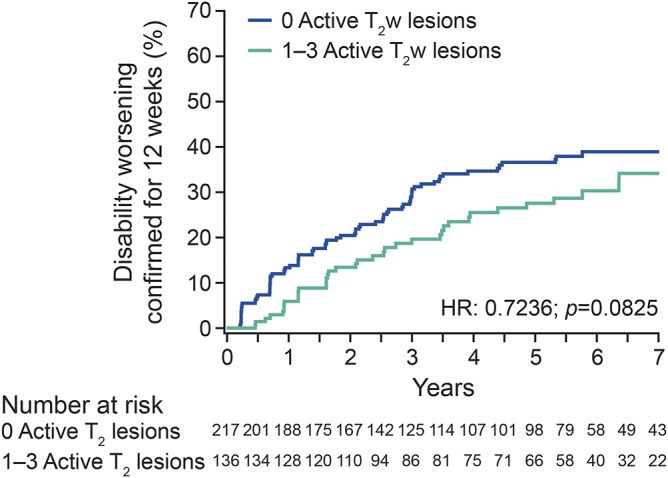
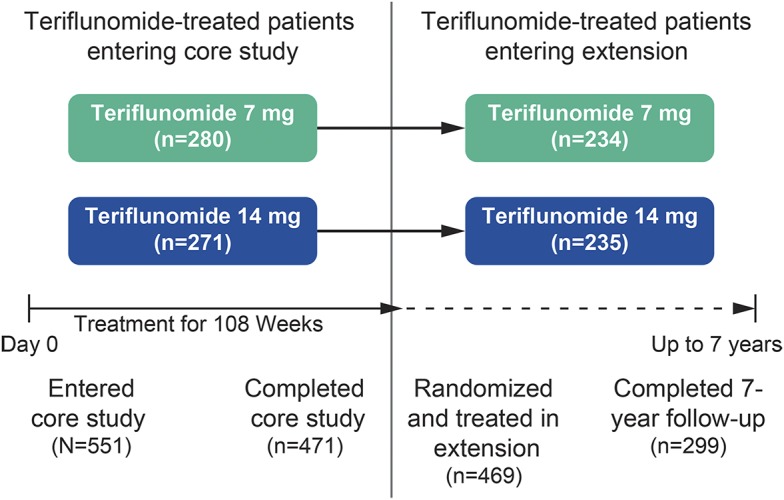
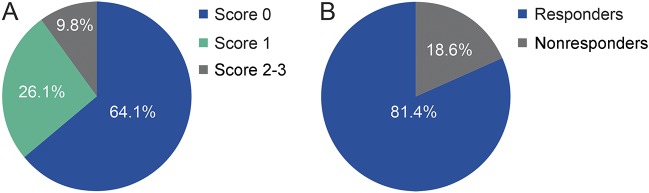
A post hoc analysis was conducted in a subgroup of patients who received teriflunomide in the core study, had MRI and clinical relapse assessments at months 12 (n = 552) and 18, and entered the extension. Patients were allocated risk scores for disability worsening (DW) after 1 year of teriflunomide treatment: 0 = low risk; 1 = intermediate risk; and 2-3 = high risk, based on the occurrence of relapses (0 to ≥2) and/or active (new and enlarging) T-weighted (Tw) lesions (≤3 or >3) after the 1-year MRI. Patients in the intermediate-risk group were reclassified as responders or nonresponders (low or high risk) according to relapses and Tw lesions on the 18-month MRI. Long-term risk (7 years) of DW was assessed by Kaplan-Meier survival curves.
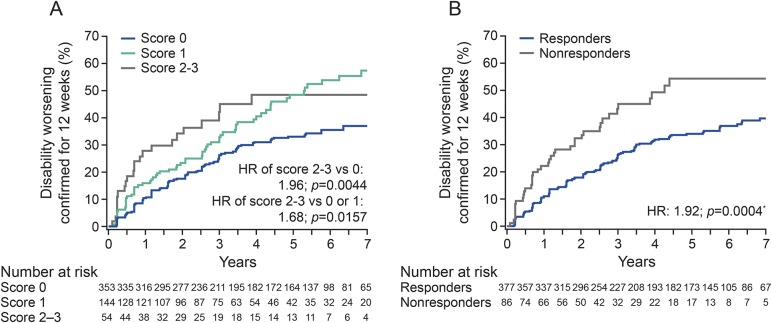
In patients with a score of 2-3, the risk of 12-week-confirmed DW over 7 years was significantly higher vs those with a score of 0 (hazard ratio [HR] = 1.96, = 0.0044). Patients reclassified as high risk at month 18 (18.6%) had a significantly higher risk of DW vs those in the low-risk group (81.4%; HR = 1.92; = 0.0004).
Over 80% of patients receiving teriflunomide were classified as low risk (responders) and had a significantly lower risk of DW than those at increased risk (nonresponders) over 7 years of follow-up in TEMSO. Close monitoring of relapses and active Tw lesions after short-term teriflunomide treatment predicts a differential rate of subsequent DW long term.
TEMSO, NCT00134563; TEMSO extension, NCT00803049.
预测在TEMSO核心研究(NCT00134563)和扩展研究(NCT00803049)中接受特立氟胺治疗的复发型多发性硬化症(MS)患者的长期残疾结局。
对核心研究中接受特立氟胺治疗、在第12个月(n = 552)和第18个月进行了MRI和临床复发评估并进入扩展研究的患者亚组进行事后分析。根据特立氟胺治疗1年后复发情况(0至≥2次)和/或1年MRI检查后T加权(Tw)加权像上活动性(新出现和扩大)病灶数量(≤3个或>3个),为患者分配残疾恶化(DW)风险评分:0 =低风险;1 =中度风险;2 - 3 =高风险。根据18个月MRI检查的复发情况和Tw病灶,将中度风险组患者重新分类为反应者或无反应者(低风险或高风险)。通过Kaplan-Meier生存曲线评估DW的长期风险(7年)。
评分2 - 3分的患者,7年中12周确认的DW风险显著高于评分为0分的患者(风险比[HR] = 1.96,P = 0.0044)。在第18个月重新分类为高风险的患者(18.6%),其DW风险显著高于低风险组患者(81.4%;HR = 1.92;P = 0.0004)。
在TEMSO研究中,超过80%接受特立氟胺治疗的患者被分类为低风险(反应者),在7年随访期间,其DW风险显著低于风险增加的患者(无反应者)。短期特立氟胺治疗后密切监测复发情况和活动性Tw病灶可预测后续长期DW的不同发生率。
TEMSO,NCT00134563;TEMSO扩展研究,NCT00803049。