Moyes Alyson Jayne, Lamb Rebecca May, Ella-Tongwiis Peter, Pushkaran Anish, Ahmed Issam, Shergill Iqbal, Hughes Stephen Fôn
Department of Biological Sciences, University of Chester, Chester, United Kingdom.
North Wales & North West Urological Research Centre (NW2URC), Betsi Cadwaladr University Health Board (BCUHB) Wrexham Maelor Hospital, Wrexham, Wales, United Kingdom.
PLoS One. 2017 Jul 6;12(7):e0179599. doi: 10.1371/journal.pone.0179599. eCollection 2017.
Currently there is limited research documenting the changes in blood parameters, following Flexible Ureterorenoscopy. This study aims to determine whether there are any changes in haematology and biochemistry parameters, following Flexible Ureterorenoscopy for the treatment of kidney stones.
40 consecutive patients aged between 27-87 years (median 49 years) undergoing Flexible Ureterorenoscopy for the treatment of kidney stones were recruited (26 male, 14 female). Blood samples were collected from each patient at four time points: baseline (pre-operatively) followed by 30 minutes, 120 minutes and 240 minutes post-operatively. On these samples, routine haematological and biochemistry tests were carried out. In addition to the assessment of clinical parameters prospectively from the medical notes.
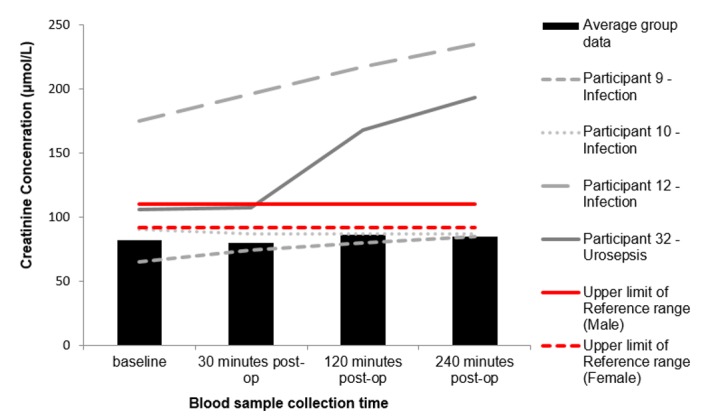
There was a significant decrease observed following Flexible Ureterorenoscopy in the following parameters: lymphocytes (p = 0.007), eosinophils (p = 0.001), basophils (p = 0.001), haemoglobin (p = 0.002), red blood cells (p = 0.001), platelet count (p = 0.001), fibrinogen concentration (p = 0.001), von Willebrand factor (p = 0.046), C reactive protein (p = 0.01), total protein (p = 0.001), albumin (p = 0.001), globulin (p = 0.001) and alkaline phosphatase (p = 0.001). In addition, there was a significant increase observed in the following parameters: white blood cells (p = 0.001), neutrophils (p = 0.001), activated partial thromboplastin time (p = 0.001), total bilirubin (p = 0.012), creatinine (p = 0.008), sodium (p = 0.002) and potassium (p = 0.001). Limiting factors for this study were the sample size, and restriction on the recruitment time points.
Significant changes were noted to occur in haematology and biochemistry parameters following Flexible Ureterorenoscopy. Some of the data presented in this study may represent the 'normal' post-operative response following FURS, as no major complications occurred, in the majority of our patients. This data on the 'normal response' will need to be validated but may ultimately aid clinicians in distinguishing patients at risk of complications, if reproduced in larger multi-centre studies.
目前,关于软性输尿管肾镜检查后血液参数变化的研究有限。本研究旨在确定在采用软性输尿管肾镜治疗肾结石后,血液学和生物化学参数是否发生任何变化。
招募了40例年龄在27至87岁之间(中位数49岁)接受软性输尿管肾镜治疗肾结石的连续患者(男性26例,女性14例)。在四个时间点采集每位患者的血样:基线(术前),然后是术后30分钟、120分钟和240分钟。对这些样本进行常规血液学和生物化学检测。此外,还前瞻性地从病历中评估临床参数。
软性输尿管肾镜检查后,观察到以下参数有显著下降:淋巴细胞(p = 0.007)、嗜酸性粒细胞(p = 0.001)、嗜碱性粒细胞(p = 0.001)、血红蛋白(p = 0.002)、红细胞(p = 0.001)、血小板计数(p = 0.001)、纤维蛋白原浓度(p = 0.001)、血管性血友病因子(p = 0.046)、C反应蛋白(p = 0.01)、总蛋白(p = 0.001)、白蛋白(p = 0.001)、球蛋白(p = 0.001)和碱性磷酸酶(p = 0.001)。此外,观察到以下参数有显著增加:白细胞(p = 0.001)、中性粒细胞(p = 0.001)、活化部分凝血活酶时间(p = 0.001)、总胆红素(p = 0.012)、肌酐(p = 0.008)、钠(p = 0.002)和钾(p = 0.001)。本研究的限制因素是样本量和招募时间点的限制。
软性输尿管肾镜检查后,血液学和生物化学参数发生了显著变化。本研究中呈现的一些数据可能代表了软性输尿管肾镜检查术后的“正常”反应,因为在我们的大多数患者中未发生重大并发症。这些关于“正常反应”的数据需要得到验证,但如果在更大规模的多中心研究中得到重现,最终可能有助于临床医生区分有并发症风险的患者。