Faculty of Chemistry, Institute of Inorganic Chemistry, University of Vienna, Althanstrasse 14, 1090, Vienna, Austria.
Biological Sciences Department, Egerton University, P. O. Box 536, Egerton, Kenya.
Environ Sci Pollut Res Int. 2017 Aug;24(24):19767-19776. doi: 10.1007/s11356-017-9518-z. Epub 2017 Jul 7.
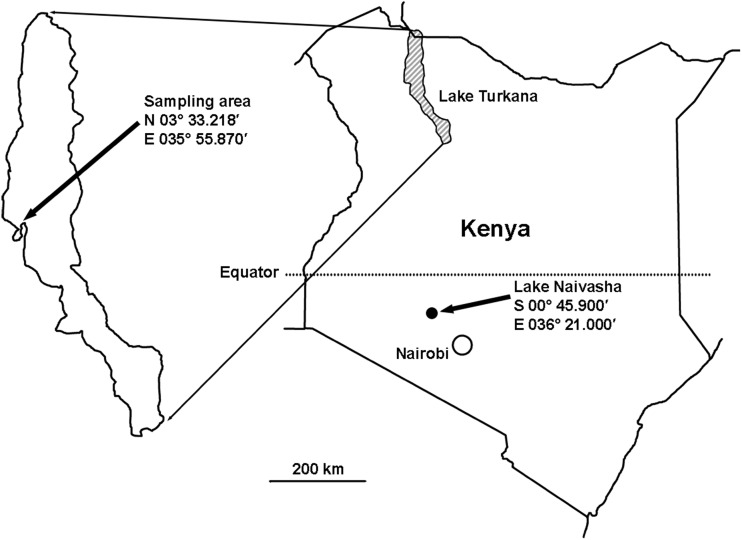
Lake Turkana and Lake Naivasha are two freshwater lakes in the Kenyan Rift Valley that differ significantly in water chemistry and anthropogenic influence: Lake Turkana is believed to be rather pristine and unpolluted, but a previous study has shown rather high levels of Li, Zn, and Cd in the migratory fish species Hydrocynus forskahlii, questioning this pristine status. Lake Naivasha is heavily influenced by agricultural activity in its catchment area and by direct water use, and high levels of metal pollutants have been reported in fish. This study presents the distribution of nine important trace elements in liver and muscle of the nonmigratory red belly tilapia Tilapia zillii from Lake Turkana and from Lake Naivasha (before and after a significant rise in water level due to as yet not fully understood reasons). In addition, trace element levels in the common carp Cyprinus carpio from Lake Naivasha are presented. Metal concentrations measured in the liver and muscle of T. zillii collected in Lake Turkana confirm the pristine status of the study site, but contrast with the results obtained for the migratory H. forskahlii. Comparing T. zillii from the two lakes reveals a clear difference in accumulation patterns between essential and nonessential trace elements: physiologically regulated essential elements are present in a very similar range in fish from both lakes, while levels of nonessential metals reflect short- or long-term exposure to those elements. The comparison of trace element concentrations in the fish samples from Lake Naivasha showed lower levels of most trace elements after the significant increase of the water level. This study demonstrates that fish are valuable bioindicators for evaluating trace element pollution even in contrasting lakes as long as the way-of-life habits of the species are taken into account.
图尔卡纳湖和奈瓦沙湖是肯尼亚裂谷中的两个淡水湖,在水化学和人为影响方面有很大的不同:图尔卡纳湖被认为是相当原始和未受污染的,但之前的一项研究表明,洄游鱼类 Hydrocynus forskahlii 中的 Li、Zn 和 Cd 含量相当高,质疑其原始状态。奈瓦沙湖受到集水区农业活动和直接用水的强烈影响,鱼类中报告了高水平的金属污染物。本研究展示了来自图尔卡纳湖和奈瓦沙湖(由于尚未完全了解的原因,水位显著上升前后)的非洄游红腹罗非鱼 Tilapia zillii 的肝脏和肌肉中 9 种重要微量元素的分布。此外,还介绍了奈瓦沙湖鲤鱼 Cyprinus carpio 的微量元素水平。在图尔卡纳湖采集的 T. zillii 的肝脏和肌肉中测量的金属浓度证实了研究地点的原始状态,但与迁徙的 H. forskahlii 的结果形成对比。对来自两个湖泊的 T. zillii 进行比较,揭示了必需和非必需微量元素积累模式之间的明显差异:来自两个湖泊的鱼类中,生理调节的必需元素存在非常相似的范围,而非必需金属的水平反映了对这些元素的短期或长期暴露。奈瓦沙湖鱼类样本中微量元素浓度的比较表明,水位显著升高后,大多数微量元素的水平都降低了。本研究表明,只要考虑到物种的生活方式习惯,鱼类就是评估微量元素污染的有价值的生物指标,即使在对比鲜明的湖泊中也是如此。