Endo Yusuke, Tamura Jun, Ishizuka Tomohito, Itami Takaharu, Hanazono Kiwamu, Miyoshi Kenjiro, Sano Tadashi, Yamashita Kazuto, Muir William W
Department of Small Animal Clinical Sciences, School of Veterinary Medicine, Rakuno Gakuen University, Ebetsu, Hokkaido 069-8591, Japan.
Veterinary Teaching Hospital, Graduate School of Veterinary Medicine, Hokkaido University, Sapporo, Hokkaido 060-0818, Japan.
J Vet Med Sci. 2017 Aug 18;79(8):1437-1445. doi: 10.1292/jvms.16-0287. Epub 2017 Jul 10.
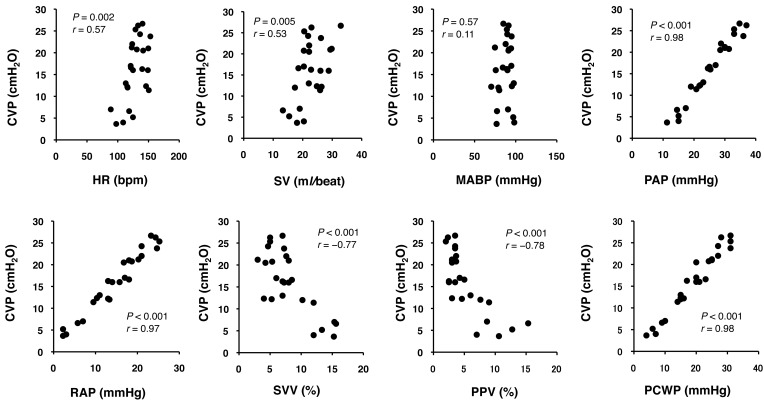
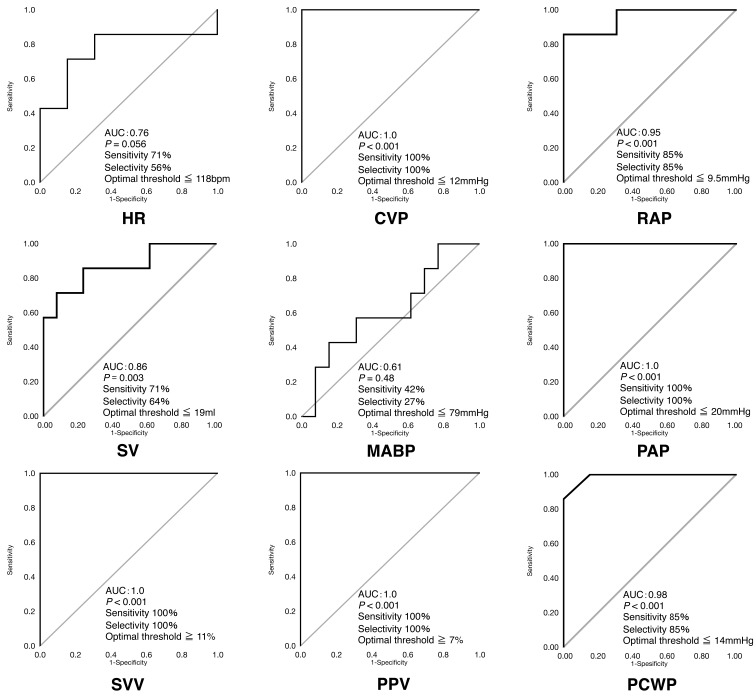
Changes in stroke volume variation (SVV) and pulse pressure variation (PPV) in response to fluid infusion were experimentally evaluated during vecuronium infusion and sevoflurane anesthesia in 5 adult, mechanically ventilated, euvolemic, beagle dogs. Sequential increases in central venous pressure (CVP; 3-7[baseline], 8-12, 13-17, 18-22 and 23-27 mmHg) were produced by infusing lactated Ringer's solution and 6% hydroxyethyl starch solution. Heart rate (beats/min), right atrial pressure (RAP, mmHg), pulmonary arterial pressure (PAP, mmHg), pulmonary capillary wedge pressure (PCWP, mmHg), transpulmonary thermodilution cardiac output (TPTDCO, l/min), stroke volume (SV, ml/beat), arterial blood pressure (ABP, mmHg), extravascular lung water (EVLW, ml), pulmonary vascular permeability index (PVPI, calculated), SVV (%), PPV (%) and systemic vascular resistance (SVR, dynes/sec/cm) were determined at each predetermined CVP range. Heart rate (P=0.019), RAP (P<0.001), PAP (P<0.001), PCWP (P<0.001), TPTDCO (P=0.009) and SV (P=0.04) increased and SVR (P<0.001), SVV (P<0.001) and PPV (P<0.001) decreased associated with each stepwise increase in CVP. Arterial blood pressure, EVLW, PVPI and the arterial partial pressures of oxygen and carbon dioxide did not change. The changes in SVV and PPV directly reflected the fluid load and the minimum threshold values for detecting fluid responsiveness were SVV ≥11% and PPV ≥7% in dogs.
在5只成年、机械通气、血容量正常的比格犬中,在维库溴铵输注和七氟醚麻醉期间,通过实验评估了液体输注时每搏量变异(SVV)和脉压变异(PPV)的变化。通过输注乳酸林格氏液和6%羟乙基淀粉溶液,使中心静脉压(CVP;3 - 7[基线]、8 - 12、13 - 17、18 - 22和23 - 27 mmHg)依次升高。在每个预定的CVP范围内,测定心率(次/分钟)、右心房压(RAP,mmHg)、肺动脉压(PAP,mmHg)、肺毛细血管楔压(PCWP,mmHg)、经肺热稀释心输出量(TPTDCO,升/分钟)、每搏量(SV,毫升/搏)、动脉血压(ABP,mmHg)、血管外肺水(EVLW,毫升)、肺血管通透性指数(PVPI,计算值)、SVV(%)、PPV(%)和全身血管阻力(SVR,达因/秒/厘米)。随着CVP的每一步升高,心率(P = 0.019)、RAP(P < 0.001)、PAP(P < 0.001)、PCWP(P < 0.001)、TPTDCO(P = 0.009)和SV(P = 0.04)升高,而SVR(P < 0.001)、SVV(P < 0.001)和PPV(P < 0.001)降低。动脉血压、EVLW、PVPI以及动脉血氧分压和二氧化碳分压没有变化。SVV和PPV的变化直接反映了液体负荷,犬中检测液体反应性的最小阈值为SVV≥11%和PPV≥7%。