Johnson Daniel J, Johnson Christine C, Cohen David B, Wetzler Joshua A, Kebaish Khaled M, Frank Steven M
Vanderbilt University School of Medicine, Nashville, TN 37232 USA.
Hospital for Special Surgery, New York, NY 10021 USA.
HSS J. 2017 Jul;13(2):152-158. doi: 10.1007/s11420-017-9545-9. Epub 2017 Feb 14.
Although previous investigators have established an association between blood transfusion and adverse outcomes, the relative frequency of different morbid events and the association with transfusion dose are not well understood.
QUESTIONS/PURPOSES: The purpose of the study is to characterize the relationship between blood transfusion and different types of morbidity after posterior spine fusion.
We retrospectively analyzed electronic medical records for 963 patients who underwent posterior spinal fusion surgery at a single institution, of which 603 (62.6%) received an allogeneic blood transfusion. Then, we assessed patient and surgical characteristics in a risk-adjusted fashion to identify various morbid event rates and independent predictors in these adverse outcomes.
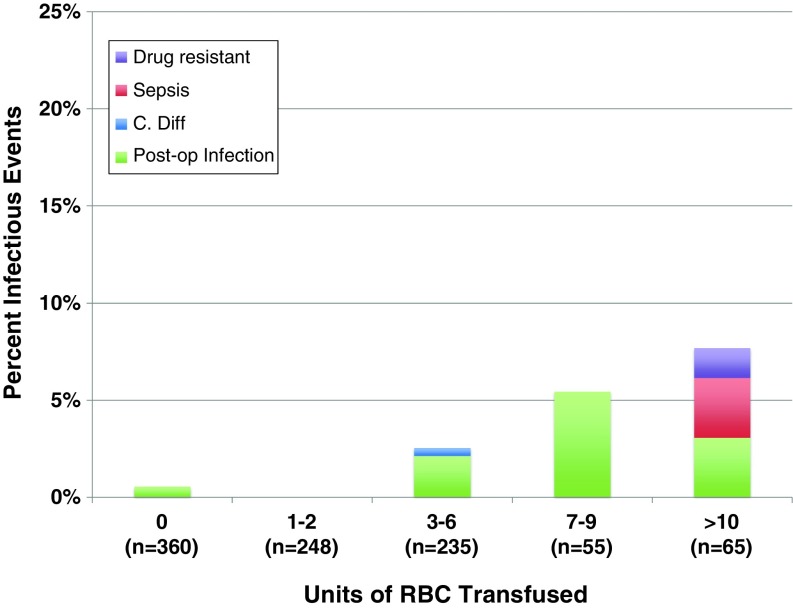
Compared to the non-transfused patients, transfused patients had a higher incidence of any morbid event (9.1 vs. 2.5%. < 0.0001), thrombotic events (4.6 vs. 1.1%, = 0.0025), and hospital-acquired infections (2.3 vs. 0.6%, = 0.039). Renal, respiratory, and ischemic morbidity occurred less frequently and were not more common in transfused patients. Risk-adjusted analysis revealed a dose-response effect, whereby for each unit of allogeneic blood transfused, the risks of any morbid event (OR 1.183; 95% CI 1.103-1.274; < 0.0001), thrombotic complication (OR 1.104; 95% CI 1.032-1.194; = 0.0035), and infectious complication (OR 1.182; 95% CI 1.077-1.332; = 0.0002) were increased.
Our data demonstrate risk-adjusted and transfusion dose-related increases in perioperative morbidity, with thrombotic and infectious events being the most common.
尽管先前的研究人员已经确定输血与不良后果之间存在关联,但不同病态事件的相对频率以及与输血剂量的关联尚不清楚。
问题/目的:本研究的目的是描述后路脊柱融合术后输血与不同类型发病率之间的关系。
我们回顾性分析了在单一机构接受后路脊柱融合手术的963例患者的电子病历,其中603例(62.6%)接受了异体输血。然后,我们以风险调整的方式评估患者和手术特征,以确定这些不良后果中的各种病态事件发生率和独立预测因素。
与未输血患者相比,输血患者任何病态事件的发生率更高(9.1%对2.5%,P<0.0001)、血栓形成事件(4.6%对1.1%,P=0.0025)和医院获得性感染(2.3%对0.6%,P=0.039)。肾脏、呼吸和缺血性发病率较低,在输血患者中并不更常见。风险调整分析显示出剂量反应效应,即每输注一个单位的异体血,任何病态事件(OR 1.183;95%CI 1.103-1.274;P<0.0001)、血栓并发症(OR 1.104;95%CI 1.032-1.194;P=0.0035)和感染并发症(OR 1.182;95%CI 1.077-1.332;P=0.0002)的风险都会增加。
我们的数据表明,围手术期发病率在风险调整和输血剂量相关方面有所增加,血栓形成和感染事件最为常见。