Perttila Niko M, Öhman Hannareeta, Strandberg Timo E, Kautiainen Hannu, Raivio Minna, Laakkonen Marja-Liisa, Savikko Niina, Tilvis Reijo S, Pitkala Kaisu H
Department of General Practice and Unit of Primary Health Care, University of Helsinki, Helsinki University Hospital, Helsinki, Finland.
Rehabilitation and Care Services, City Hospital, Helsinki, Finland.
Dement Geriatr Cogn Dis Extra. 2017 Jun 19;7(2):195-203. doi: 10.1159/000477394. eCollection 2017 May-Aug.
People with dementia are at high risk for falls. However, little is known of the features causing falls in Alzheimer disease (AD). Our aim was to investigate how participants with AD fall.
In the FINALEX (Finnish Alzheimer Disease Exercise Trial) study, participants' ( = 194) falls were followed up for 1 year by diaries kept by their spouses.
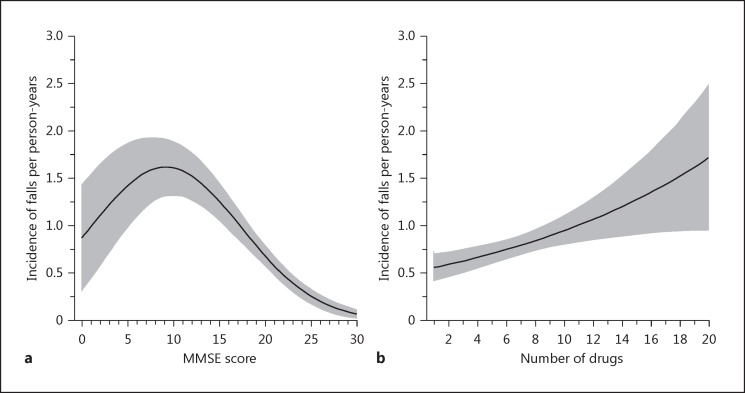
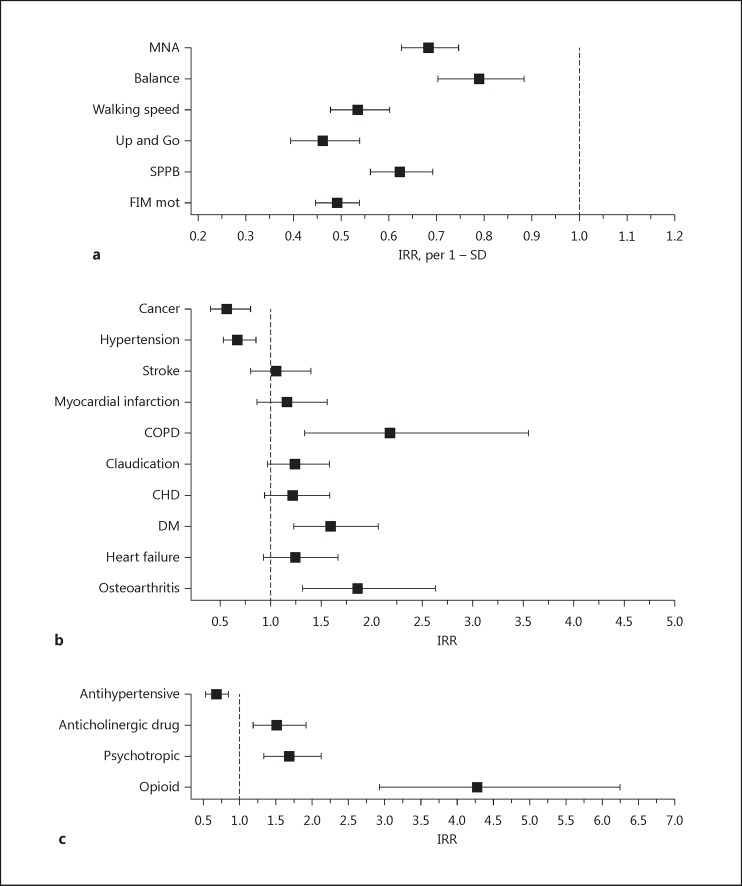
The most common reason for falls ( = 355) was stumbling ( = 61). Of the falls, 123 led to injuries, 50 to emergency department visits, and 13 to fractures. The participants without falls ( = 103) were younger and had milder dementia than those with 1 ( = 34) or ≥2 falls ( = 57). Participants with a Mini Mental State Examination score of around 10 points were most prone to fall. In adjusted regression models, good nutritional status, good physical functioning, and use of antihypertensive medication (incident rate ratio [IRR] 0.68, 95% confidence interval [CI] 0.54-0.85) protected against falls, whereas fall history (IRR 2.71, 95% CI 2.13-3.44), osteoarthritis, diabetes mellitus, chronic obstructive pulmonary disease, higher number of drugs, drugs with anticholinergic properties, psychotropics, and opioids (IRR 4.27, 95% CI 2.92-6.24) were risk factors for falls.
Our study provides a detailed account on how and why people with AD fall, suggesting several risk and protective factors.
痴呆症患者跌倒风险很高。然而,对于阿尔茨海默病(AD)患者跌倒的特征知之甚少。我们的目的是调查AD患者如何跌倒。
在芬兰阿尔茨海默病运动试验(FINALEX)研究中,通过其配偶记录的日记对194名参与者的跌倒情况进行了为期1年的随访。
跌倒的最常见原因(共355次跌倒)是绊倒(61次)。在这些跌倒中,123次导致受伤,50次导致急诊就诊,13次导致骨折。未跌倒的参与者(103人)比有1次跌倒(34人)或≥2次跌倒(57人)的参与者更年轻,痴呆程度也更轻。简易精神状态检查表得分约为10分的参与者最容易跌倒。在调整后的回归模型中,良好的营养状况、良好的身体功能以及使用抗高血压药物(发生率比[IRR]0.68,95%置信区间[CI]0.54 - 0.85)可预防跌倒,而跌倒史(IRR 2.71,95% CI 2.13 - 3.44)、骨关节炎、糖尿病、慢性阻塞性肺疾病、药物数量较多、具有抗胆碱能特性的药物、精神药物和阿片类药物(IRR 4.27,95% CI 2.92 - 6.24)是跌倒的风险因素。
我们的研究详细说明了AD患者如何跌倒以及为何跌倒,提示了多种风险和保护因素。