Erdmann Kati, Ringel Jessica, Hampel Silke, Wirth Manfred P, Fuessel Susanne
Department of Urology, Medizinische Fakultät Carl Gustav Carus, Technische Universität Dresden, Fetscherstraße 74, Dresden 01307, Germany.
Leibniz Institute of Solid State and Material Research Dresden, P.O. Box 270016, Dresden 01171, Germany.
Beilstein J Nanotechnol. 2017 Jun 23;8:1307-1317. doi: 10.3762/bjnano.8.132. eCollection 2017.
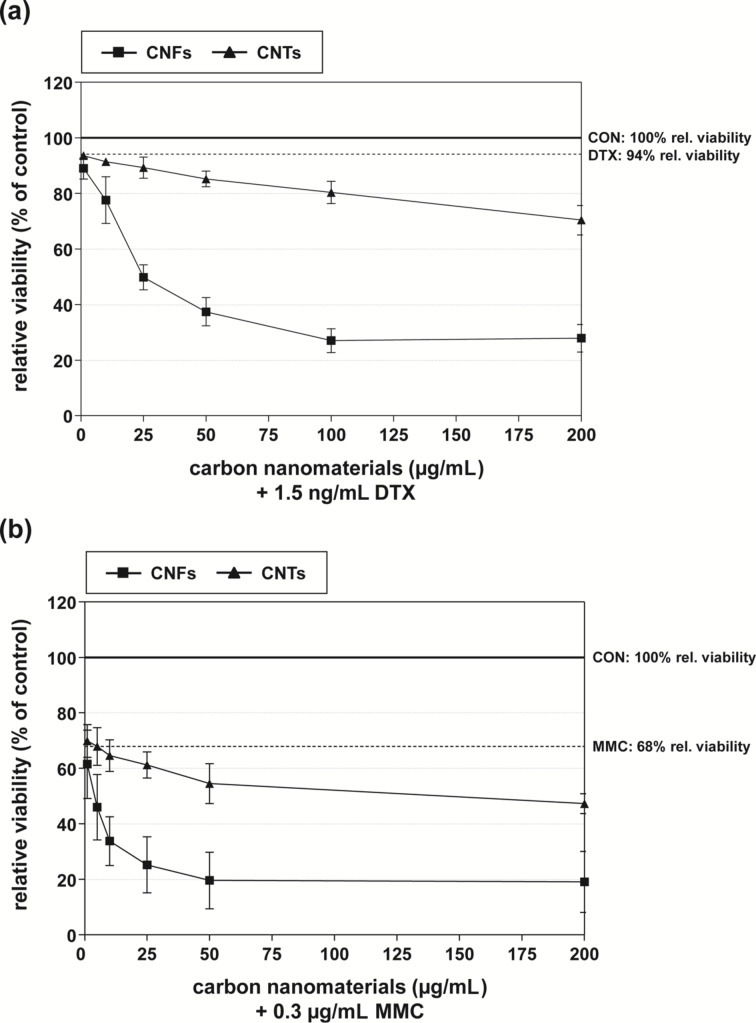
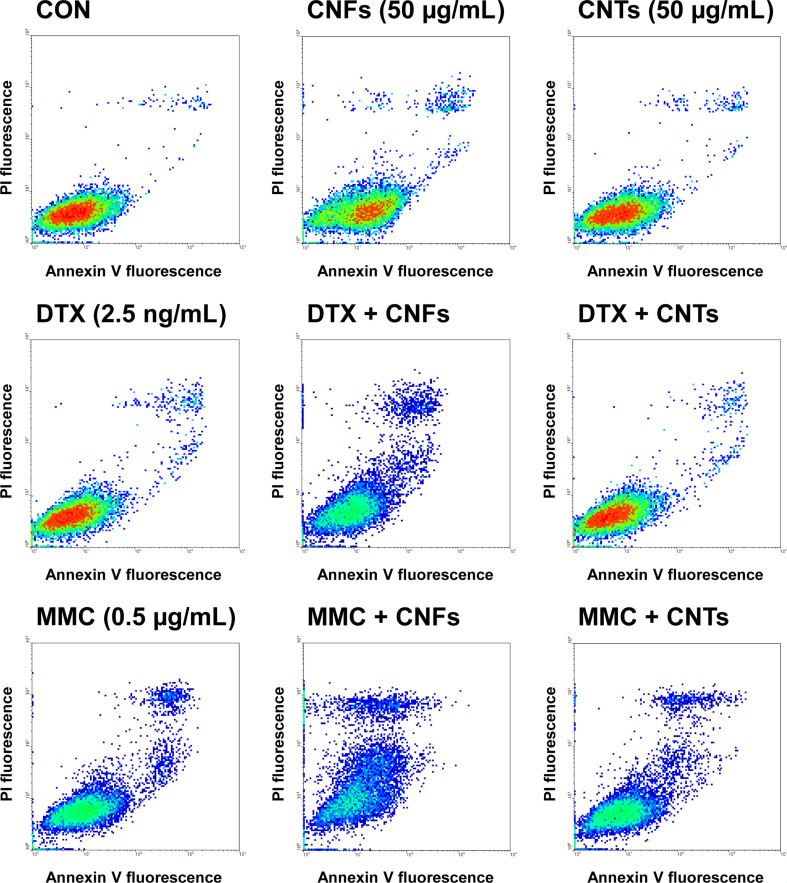
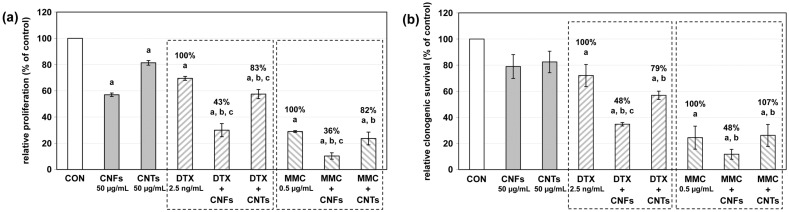
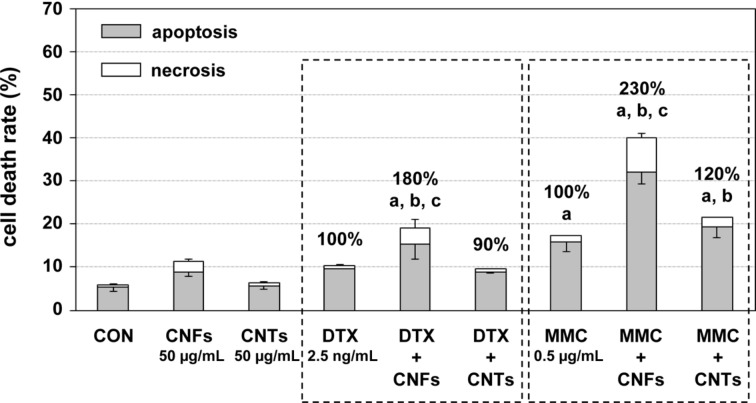
We have previously shown that carbon nanofibers (CNFs) and carbon nanotubes (CNTs) can sensitize prostate cancer (PCa) cells to platinum-based chemotherapeutics. In order to further verify this concept and to avoid a bias, the present study investigates the chemosensitizing potential of CNFs and CNTs to the conventional chemotherapeutics docetaxel (DTX) and mitomycin C (MMC), which have different molecular structures and mechanisms of action than platinum-based chemotherapeutics. DU-145 PCa cells were treated with DTX and MMC alone or in combination with the carbon nanomaterials. The impact of the monotreatments and the combinatory treatments on cellular function was then systematically analyzed by using different experimental approaches (viability, short-term and long-term proliferation, cell death rate). DTX and MMC alone reduced the viability of PCa cells to 94% and 68%, respectively, whereas a combined treatment with CNFs led to less than 30% remaining viable cells. Up to 17- and 7-fold higher DTX and MMC concentrations were needed in order to evoke a similar inhibition of viability as mediated by the combinatory treatments. In contrast, the dose of platinum-based chemotherapeutics could only be reduced by up to 3-fold by combination with carbon nanomaterials. Furthermore, combinatory treatments with CNFs led mostly to an additive inhibition of short- and long-term proliferation compared to the individual treatments. Also, higher cell death rates were observed in combinatory treatments than in monotreatments, e.g., a combination of MMC and CNFs more than doubled the cell death rate mediated by apoptosis. Combinations with CNTs showed a similar, but less pronounced impact on cellular functions. In summary, carbon nanomaterials in combination with DTX and MMC evoked additive to partly synergistic anti-tumor effects. CNFs and CNTs possess the ability to sensitize cancer cells to a wide range of structurally diverse chemotherapeutics and thus represent an interesting option for the development of multimodal cancer therapies. Co-administration of chemotherapeutics with carbon nanomaterials could result in a reduction of the chemotherapeutic dosage and thus limit systemic side effects.
我们之前已经表明,碳纳米纤维(CNFs)和碳纳米管(CNTs)可使前列腺癌细胞(PCa)对铂类化疗药物敏感。为了进一步验证这一概念并避免偏差,本研究调查了CNFs和CNTs对传统化疗药物多西他赛(DTX)和丝裂霉素C(MMC)的化学增敏潜力,这两种药物的分子结构和作用机制与铂类化疗药物不同。DU - 145前列腺癌细胞单独用DTX和MMC处理,或与碳纳米材料联合处理。然后通过使用不同的实验方法(活力、短期和长期增殖、细胞死亡率)系统地分析单一处理和联合处理对细胞功能的影响。单独使用DTX和MMC分别将PCa细胞的活力降低至94%和68%,而与CNFs联合处理导致存活细胞少于30%。为了产生与联合处理介导的相似的活力抑制作用,需要高达17倍和7倍的DTX和MMC浓度。相比之下,与碳纳米材料联合使用时,铂类化疗药物的剂量最多只能降低3倍。此外,与单独处理相比,CNFs联合处理大多导致对短期和长期增殖的累加抑制。同样,联合处理中观察到的细胞死亡率高于单一处理,例如,MMC和CNFs的联合使凋亡介导的细胞死亡率增加了一倍多。与CNTs联合使用对细胞功能显示出类似但不太明显的影响。总之,碳纳米材料与DTX和MMC联合使用可产生累加至部分协同的抗肿瘤作用。CNFs和CNTs具有使癌细胞对多种结构不同的化疗药物敏感的能力,因此是开发多模式癌症治疗的一个有趣选择。化疗药物与碳纳米材料共同给药可导致化疗药物剂量的减少,从而限制全身副作用。