Huang Yuran, Li Yiwen, Hu Ziying, Yue Xiujun, Proetto Maria T, Jones Ying, Gianneschi Nathan C
Materials Science and Engineering Program, University of California San Diego, 9500 Gilman Drive, La Jolla, California 92037, United States.
Department of Chemistry and Biochemistry, University of California San Diego, 9500 Gilman Drive, La Jolla, California 92037, United States.
ACS Cent Sci. 2017 Jun 28;3(6):564-569. doi: 10.1021/acscentsci.6b00230. Epub 2017 May 18.
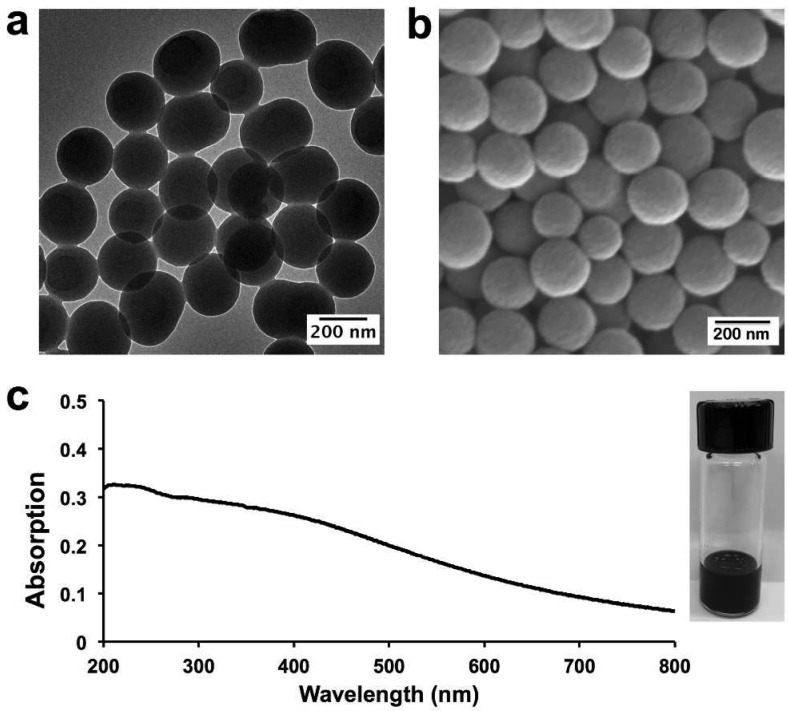
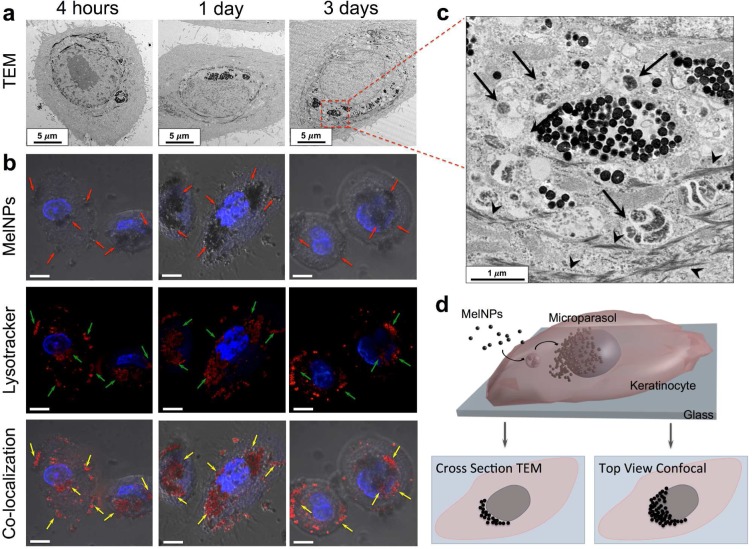
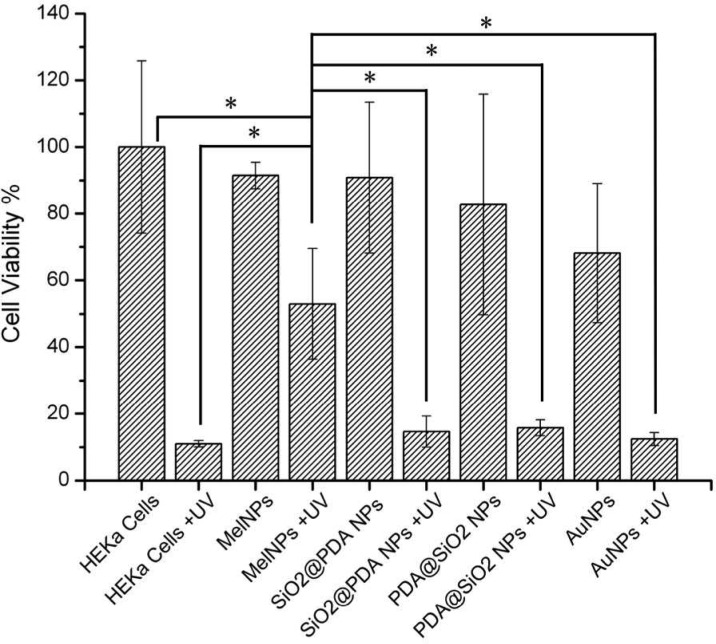
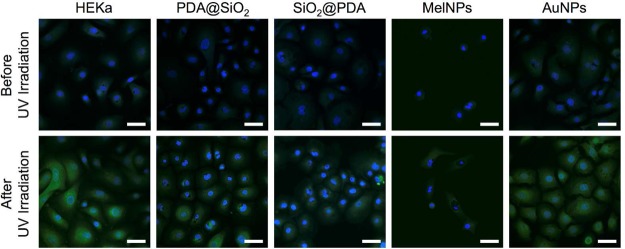
A primary role of melanin in skin is the prevention of UV-induced nuclear DNA damage to human skin cells, where it serves to screen out harmful UV radiation. Melanin is delivered to keratinocytes in the skin after being excreted as melanosomes from melanocytes. Defects in melanin production in humans can cause diseases, many of which currently lack effective treatments due to their genetic origins (e.g., skin cancer, vitiligo, and albinism). The widespread prevalence of melanin-related diseases and an increasing interest in the performance of various polymeric materials related to melanin necessitates novel synthetic routes for preparing melanin-like materials. In this work, we prepared melanin-like nanoparticles (MelNPs) via spontaneous oxidation of dopamine, as biocompatible, synthetic analogues of naturally occurring melanosomes, and investigated their uptake, transport, distribution, and UV-protective capabilities in human keratinocytes. Critically, we demonstrate that MelNPs are endocytosed, undergo perinuclear aggregation, and form a supranuclear cap, or so-called microparasol in human epidermal keratinocytes (HEKa), mimicking the behavior of natural melananosomes in terms of cellular distribution and the fact that they serve to protect the cells from UV damage.
黑色素在皮肤中的主要作用是防止紫外线诱导的人类皮肤细胞核DNA损伤,它能筛选出有害的紫外线辐射。黑色素作为黑素小体从黑素细胞排出后,被输送到皮肤中的角质形成细胞。人类黑色素生成缺陷会导致多种疾病,其中许多由于其遗传起源目前缺乏有效的治疗方法(如皮肤癌、白癜风和白化病)。黑色素相关疾病的广泛流行以及对各种与黑色素相关的聚合物材料性能的兴趣日益增加,使得制备类黑色素材料需要新的合成路线。在这项工作中,我们通过多巴胺的自发氧化制备了类黑色素纳米颗粒(MelNPs),作为天然黑素小体的生物相容性合成类似物,并研究了它们在人角质形成细胞中的摄取、运输、分布和紫外线防护能力。至关重要的是,我们证明了MelNPs在人表皮角质形成细胞(HEKa)中被内吞,发生核周聚集,并形成核上帽,即所谓的微伞,在细胞分布方面模仿天然黑素小体的行为,并且它们能够保护细胞免受紫外线损伤。