Centre for Misfolding Diseases, Department of Chemistry, University of Cambridge, Cambridge CB2 1EW, UK.
Department of Chemistry and Applied Biosciences, ETH Zurich, 8093 Zurich, Switzerland.
Sci Adv. 2017 Jun 21;3(6):e1700488. doi: 10.1126/sciadv.1700488. eCollection 2017 Jun.
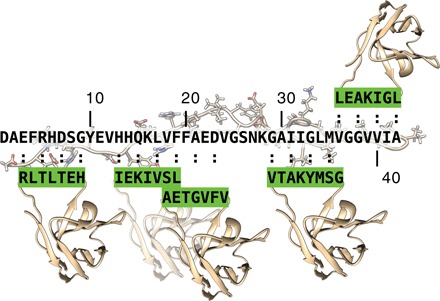
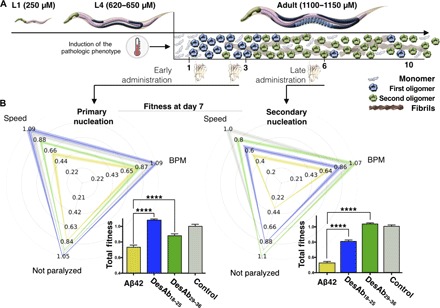
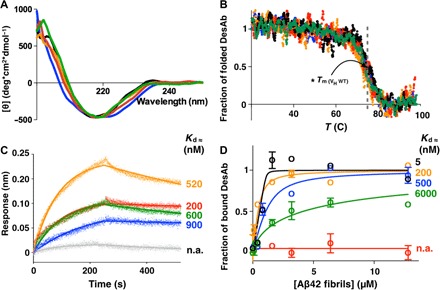
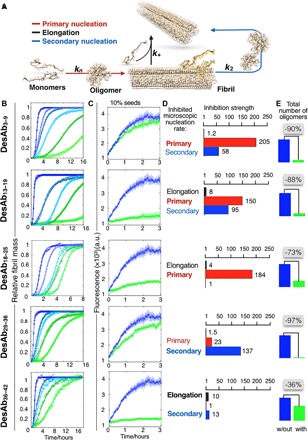
Antibodies targeting Aβ42 are under intense scrutiny because of their therapeutic potential for Alzheimer's disease. To enable systematic searches, we present an "antibody scanning" strategy for the generation of a panel of antibodies against Aβ42. Each antibody in the panel is rationally designed to target a specific linear epitope, with the selected epitopes scanning the Aβ42 sequence. By screening in vitro the panel to identify the specific microscopic steps in the Aβ42 aggregation process influenced by each antibody, we identify two antibodies that target specifically the primary and the secondary nucleation steps, which are key for the production of Aβ42 oligomers. These two antibodies act, respectively, to delay the onset of aggregation and to block the proliferation of aggregates, and correspondingly reduce the toxicity in a model overexpressing Aβ42. These results illustrate how the antibody scanning method described here can be used to readily obtain very small antibody libraries with extensive coverage of the sequences of target proteins.
针对 Aβ42 的抗体受到了广泛关注,因为它们具有治疗阿尔茨海默病的潜力。为了能够进行系统的搜索,我们提出了一种“抗体扫描”策略,用于生成针对 Aβ42 的抗体组合。该组合中的每个抗体都是经过合理设计,以针对特定的线性表位,所选表位扫描 Aβ42 序列。通过在体外筛选该组合,以鉴定受每个抗体影响的 Aβ42 聚集过程中的特定微观步骤,我们鉴定出两种针对初级核化和次级核化步骤的特异性抗体,这两个步骤是产生 Aβ42 寡聚物的关键步骤。这两种抗体分别作用于延迟聚集的开始和阻止聚集物的增殖,并相应地减少过表达 Aβ42 的模型中的毒性。这些结果说明了如何使用这里描述的抗体扫描方法来轻松获得具有广泛目标蛋白序列覆盖的非常小的抗体文库。