Teasdale Chloe A, Sogaula Nonzwakazi, Yuengling Katharine A, Peters Zachary J, Mutiti Anthony, Pepeta Lungile, Abrams Elaine J
ICAP, Mailman School of Public Health, Columbia University, New York, NY, USA.
Department of Epidemiology, Mailman School of Public Health, Columbia University New York, New York, NY, USA.
J Int AIDS Soc. 2017 Jun 28;20(1):21748. doi: 10.7448/IAS.20.1.21748.
Decentralization of HIV care for children has been recommended to improve paediatric outcomes by making antiretroviral treatment (ART) more accessible. We documented outcomes of children transferred after initiating ART at a large tertiary hospital in the Eastern Cape of South Africa.
Electronic medical records for all children 0-15 years initiating ART at Dora Nginza Hospital (DNH) in Port Elizabeth, South Africa January 2004 to September 2015 were examined. Records for children transferred to primary and community clinics were searched at 16 health facilities to identify children with successful (at least one recorded visit) and unsuccessful transfer (no visits). We identified all children lost to follow-up (LTF) after ART initiation: those LTF at DNH (no visit >6 months), children with unsuccessful transfer, and children LTF after successful transfer (no visit >6 months). Community tracing was conducted to locate caregivers of children LTF and electronic laboratory data were searched to measure reengagement in care, including silent transfers.
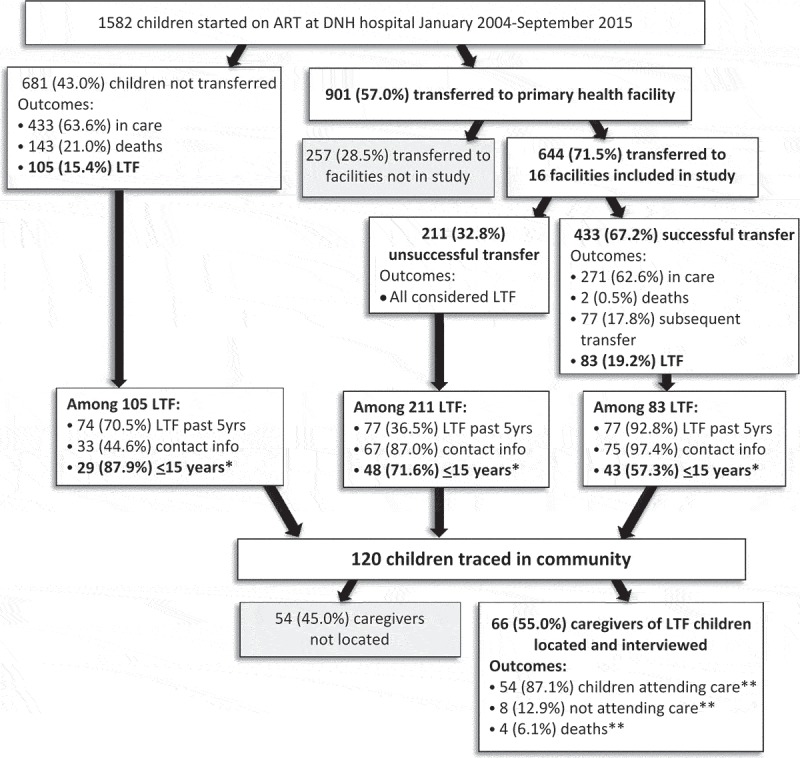
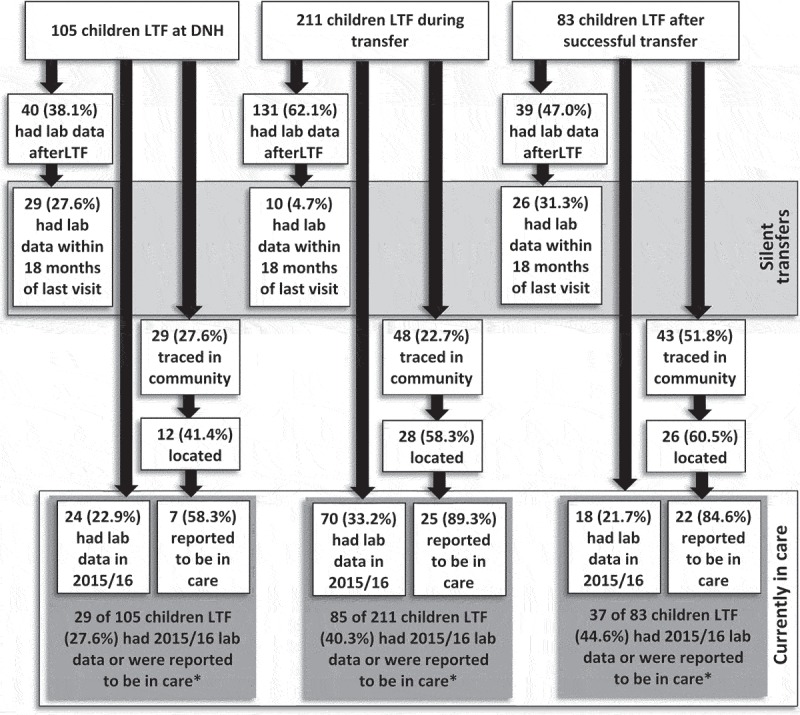
1,582 children initiated ART at median age of 4 years [interquartile range (IQR): 1-8] and median CD4+ of 278 cells/mm [IQR: 119-526]. A total of 901 (57.0%) children were transferred, 644 (71.5%) to study facilities; 433 (67.2%) children had successful transfer and 211 (32.8%) had unsuccessful transfer. In total, 399 children were LTF: 105 (26.3%) from DNH, 211 (52.9%) through unsuccessful transfer and 83 (20.8%) following successful transfer. Community tracing was conducted for 120 (30.1%) of 399 children LTF and 66 (55.0%) caregivers were located and interviewed. Four children had died. Among 62 children still alive, 8 (12.9%) were reported to not be in care or taking ART and 18 (29.0%) were also not taking ART. Overall, 65 (16.3%) of 399 children LTF had a laboratory result within 18 months of their last visit indicating silent transfer and 112 (28.1%) had lab results from 2015 to 2016 indicating current care.
We found that only two-thirds of children on ART transferred to primary and community health clinics had successful transfer. These findings suggest that transfer is a particularly vulnerable step in the paediatric HIV care cascade.
为改善儿童抗逆转录病毒治疗(ART)的可及性,从而提高儿科治疗效果,有人建议将儿童HIV护理去中心化。我们记录了在南非东开普省一家大型三级医院开始接受ART治疗后转诊的儿童的治疗结果。
对2004年1月至2015年9月在南非伊丽莎白港多拉·恩金扎医院(DNH)开始接受ART治疗的所有0至15岁儿童的电子病历进行了检查。在16个医疗机构搜索转诊至基层和社区诊所的儿童记录,以确定转诊成功(至少有一次记录就诊)和转诊失败(无就诊记录)的儿童。我们确定了所有开始接受ART治疗后失访(LTF)的儿童:在DNH失访的儿童(无就诊记录>6个月)、转诊失败的儿童以及转诊成功后失访的儿童(无就诊记录>6个月)。开展社区追踪以查找失访儿童的照料者,并搜索电子实验室数据以衡量其重新接受治疗的情况,包括隐性转诊。
1582名儿童开始接受ART治疗,中位年龄为4岁[四分位间距(IQR):1 - 8岁],CD4 + 细胞计数中位数为278个细胞/mm³[IQR:119 - 526]。共有901名(57.0%)儿童被转诊,其中644名(71.5%)被转诊至研究机构;433名(67.2%)儿童转诊成功,211名(32.8%)儿童转诊失败。总共有399名儿童失访:105名(26.3%)在DNH失访,211名(52.9%)因转诊失败失访,83名(20.8%)在转诊成功后失访。对399名失访儿童中的120名(30.1%)进行了社区追踪,找到了66名(55.0%)照料者并进行了访谈。有4名儿童死亡。在62名仍在世的儿童中,据报告有8名(12.9%)未接受治疗或未服用ART,18名(29. .0%)也未服用ART。总体而言,399名失访儿童中有65名(16.3%)在最后一次就诊后18个月内有实验室检查结果,表明为隐性转诊,112名(28.1%)有2015年至2016年的实验室检查结果,表明目前正在接受治疗。
我们发现,转诊至基层和社区卫生诊所接受ART治疗的儿童中,只有三分之二转诊成功。这些发现表明,转诊是儿科HIV治疗流程中一个特别脆弱的环节。