Zhang Ying, Wang Hu, Wu Kezhou, Liu Zhaoyong
Department of Pathology, Shantou University Medical College, Shantou, Guangdong 515041, P.R. China.
Department of Orthopaedic Oncology, First Affiliated Hospital of Shantou University Medical College, Shantou, Guangdong 515041, P.R. China.
Oncol Lett. 2017 Jul;14(1):35-40. doi: 10.3892/ol.2017.6127. Epub 2017 May 5.
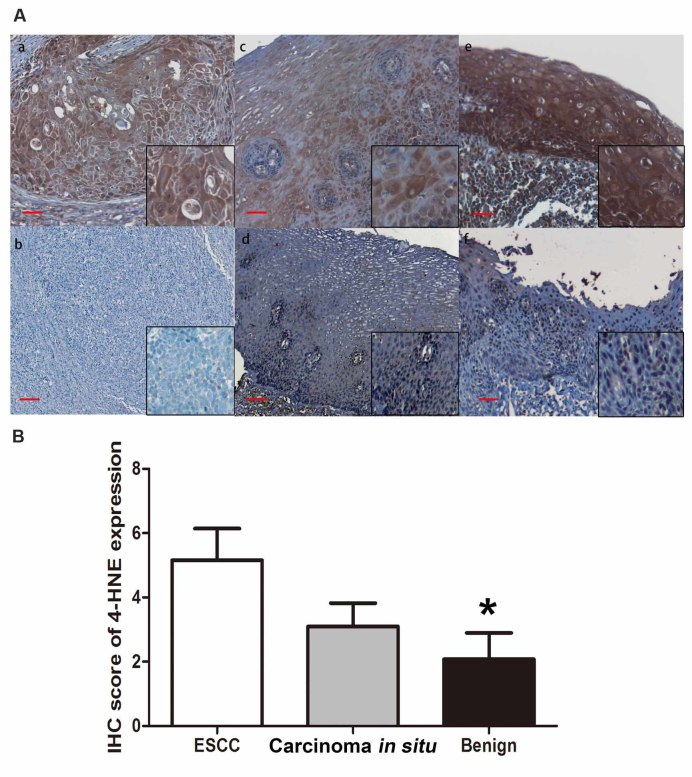
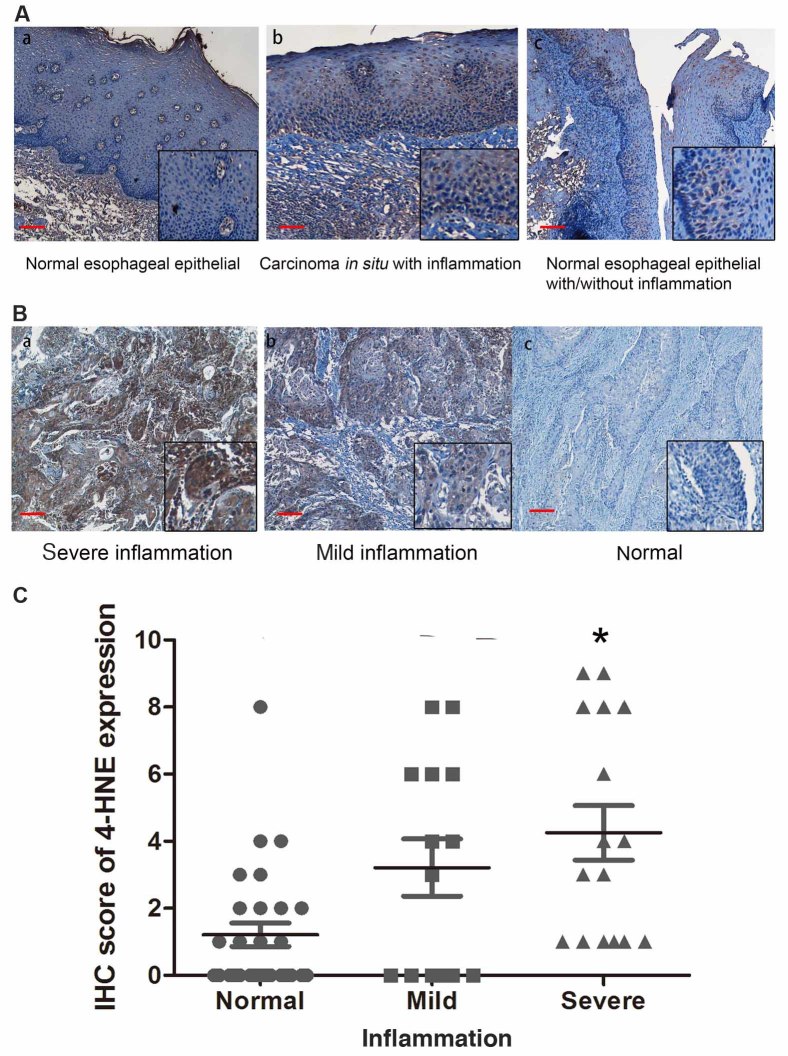
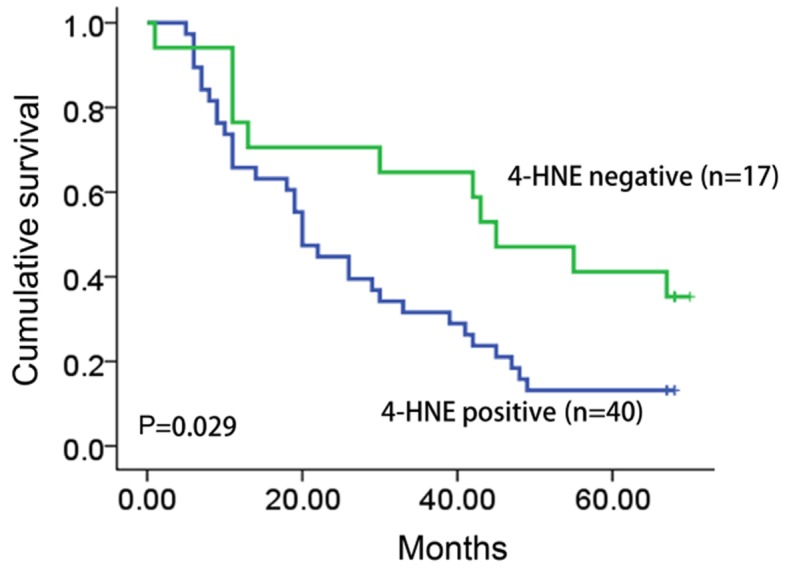
Esophageal squamous cell carcinoma (ESCC) is one of the most common types of cancer in Asia, particular in China. However, the pathogenesis of ESCC has not previously been well demonstrated. A major product of lipid peroxidation, 4-hydroxynonenal (4-HNE), is considered to be an oxidative stress inducer, as it is involved in the pathogenesis of a number of degenerative diseases, including Alzheimer's disease, atherosclerosis, cataracts and cancer. In order to investigate the association between oxidative stress and the pathogenic process of ESCC, the present study determined the expression levels of 4-HNE in 23 non-malignant esophageal epithelial tissues, 11 esophageal carcinoma tissues and 57 ESCC tissues from patients in the Chaoshan area, a high-risk region for esophageal cancer in China. A significantly higher expression level of 4-HNE was identified in ESCC tissues compared with that in non-malignant esophageal epithelial tissues (P<0.05). Furthermore, immunohistochemical analysis demonstrated that expression levels of 4-HNE were significantly associated with the clinical stage. The patients with positive staining of 4-HNE revealed a poorer clinical outcome compared with that of patients with negative staining. 4-HNE was significantly associated with the severity of inflammation and increased with the progression of precancerous lesions (P<0.05). These results provide pathological evidence that oxidative stress is a driving force of ESCC carcinogenesis.
食管鳞状细胞癌(ESCC)是亚洲最常见的癌症类型之一,在中国尤为如此。然而,ESCC的发病机制此前尚未得到充分证实。脂质过氧化的主要产物4-羟基壬烯醛(4-HNE)被认为是一种氧化应激诱导剂,因为它参与了包括阿尔茨海默病、动脉粥样硬化、白内障和癌症在内的多种退行性疾病的发病过程。为了研究氧化应激与ESCC致病过程之间的关联,本研究测定了来自中国食管癌高发地区潮汕地区患者的23例非恶性食管上皮组织、11例食管癌组织和57例ESCC组织中4-HNE的表达水平。与非恶性食管上皮组织相比,ESCC组织中4-HNE的表达水平显著更高(P<0.05)。此外,免疫组化分析表明,4-HNE的表达水平与临床分期显著相关。4-HNE染色阳性的患者与染色阴性的患者相比,临床结局更差。4-HNE与炎症严重程度显著相关,并随着癌前病变的进展而增加(P<0.05)。这些结果提供了病理证据,证明氧化应激是ESCC致癌作用的驱动力。