Zhu Yan-Juan, Zhang Hai-Bo, Liu Yi-Hong, Bai Jian-Ping, Li Yong, Liu Li-Rong, Qu Yan-Chun, Qu Xin, Chen Xian
Department of Oncology, The Second Affiliated Hospital of Guangzhou University of Chinese Medicine, Guangdong Provincial Hospital of Chinese Medicine, Guangzhou, Guangdong 510120, P.R. China.
Oncol Lett. 2017 Jul;14(1):655-664. doi: 10.3892/ol.2017.6249. Epub 2017 May 25.
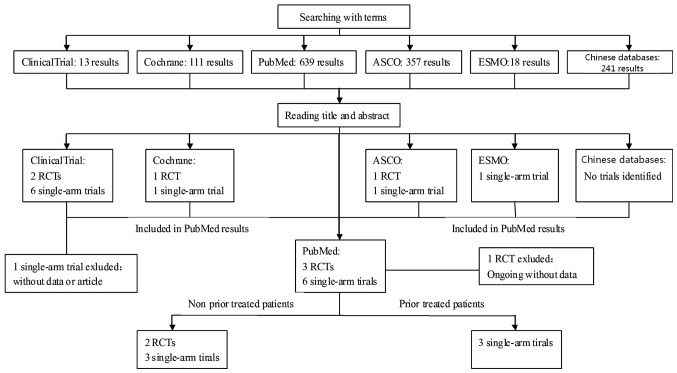
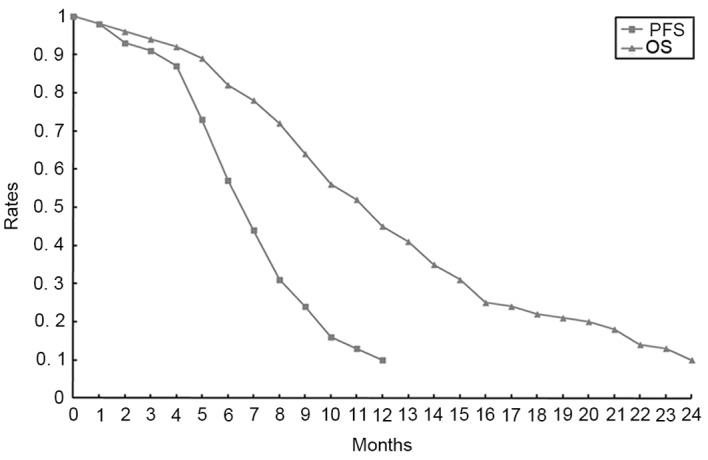
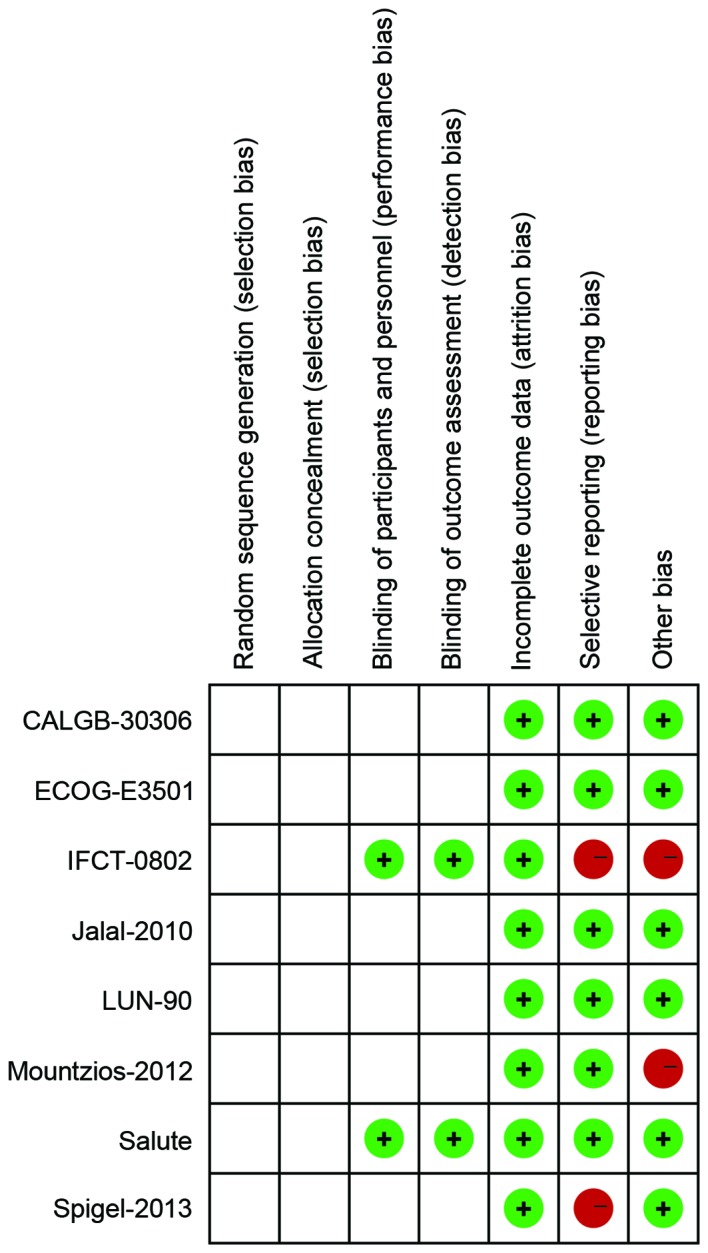
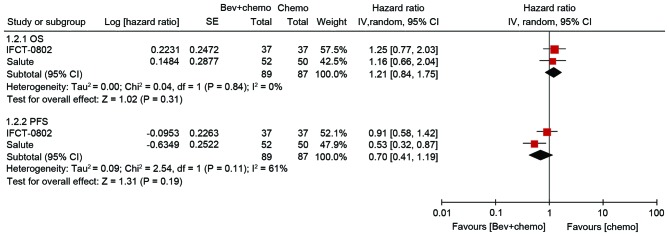
Progress in the treatment options for small cell lung cancer (SCLC) remains poor. Concerns exist regarding the efficacy of bevacizumab in SCLC. The present study aimed to evaluate the efficacy of bevacizumab in extensive stage (ES)-SCLC. A meta-analysis on studies conducted and listed on the Medline, Cochrane Trials, ASCO, ESMO and ClinicalTrial databases, and Chinese databases prior to April 2015 was performed. All clinical trials in which patients with ES-SCLC were treated with bevacizumab were considered. Survival rates at specific time points were extracted from the reported survival curves. Hazard ratios (HR) for progression-free survival (PFS) and overall survival (OS), rates for PFS, OS, overall response rate (ORR), and side-effects were synthesized using random-effects or fixed-effects model. Two randomized control trials (RCT) (176 patients) and six single-arm trials (292 patients) were identified. In RCTs, no statistically significant differences were observed in PFS [HR, 0.70; 95% confidence interval (CI), 0.41-1.19; P=0.19] or OS (HR, 1.21; 95% CI, 0.84-1.75; P=0.31). In the first-line trials, pooled 6-month and 1-year PFS rates were 57% (95% CI, 39-76%) and 10% (95% CI, 4-16%), respectively. Synthesized 1-year and 2-year OS rates were 45% (95% CI, 36-54%) and 10% (95% CI, 6-14%), respectively. Reported median PFS and OS times for pretreated patients were 2.7-4.0 months and 6.3-7.4 months, respectively. Pooled ORRs were 71% (95% CI, 59-82%) in the first-line trials and 18% (95% CI, 11-25%) in the second-line trials. The most common types of reported toxicities were chemotherapy-associated, including neutropenia, leukopenia, fatigue and thrombocytopenia. According to the RCTs, bevacizumab did not appear to improve the PFS or OS for patients with ES-SCLC, with low quality of evidence. Due to the disappointing pooled efficacy in the single-arm trials, more clinical studies on bevacizumab in SCLC may not be valuable, although the evidence was with low quality.
小细胞肺癌(SCLC)的治疗方案进展仍然不佳。对于贝伐单抗在SCLC中的疗效存在担忧。本研究旨在评估贝伐单抗在广泛期(ES)-SCLC中的疗效。对2015年4月之前在Medline、Cochrane试验、美国临床肿瘤学会(ASCO)、欧洲肿瘤内科学会(ESMO)和临床试验数据库以及中国数据库中进行并列出的研究进行了荟萃分析。纳入所有使用贝伐单抗治疗ES-SCLC患者的临床试验。从报告的生存曲线中提取特定时间点的生存率。使用随机效应或固定效应模型综合无进展生存期(PFS)和总生存期(OS)的风险比(HR)、PFS率、OS率、总缓解率(ORR)和副作用。共识别出两项随机对照试验(RCT)(176例患者)和六项单臂试验(292例患者)。在RCT中,PFS[HR,0.70;95%置信区间(CI),0.41-1.19;P=0.19]或OS(HR,1.21;95%CI,0.84-1.75;P=0.31)均未观察到统计学显著差异。在一线试验中,汇总的6个月和1年PFS率分别为57%(95%CI,39-76%)和10%(95%CI,4-16%)。综合的1年和2年OS率分别为45%(95%CI,36-54%)和10%(95%CI,6-14%)。预处理患者报告的中位PFS和OS时间分别为2.7-4.0个月和6.3-7.4个月。一线试验中汇总的ORR为71%(95%CI,59-82%),二线试验中为18%(95%CI,11-25%)。报告的最常见毒性类型与化疗相关,包括中性粒细胞减少、白细胞减少、疲劳和血小板减少。根据RCT,贝伐单抗似乎并未改善ES-SCLC患者的PFS或OS,证据质量较低。由于单臂试验中汇总疗效令人失望,尽管证据质量较低,但更多关于贝伐单抗在SCLC中的临床研究可能没有价值。