Kiss I, Mlčochová J, Součková K, Fabian P, Poprach A, Halamkova J, Svoboda M, Vyzula R, Slaby O
Department of Comprehensive Cancer Care, Masaryk Memorial Cancer Institute, 656 53 Brno, Czech Republic.
Department of Molecular Medicine, Central European Institute of Technology, Masaryk University, 625 00 Brno, Czech Republic.
Oncol Lett. 2017 Jul;14(1):743-750. doi: 10.3892/ol.2017.6255. Epub 2017 May 26.
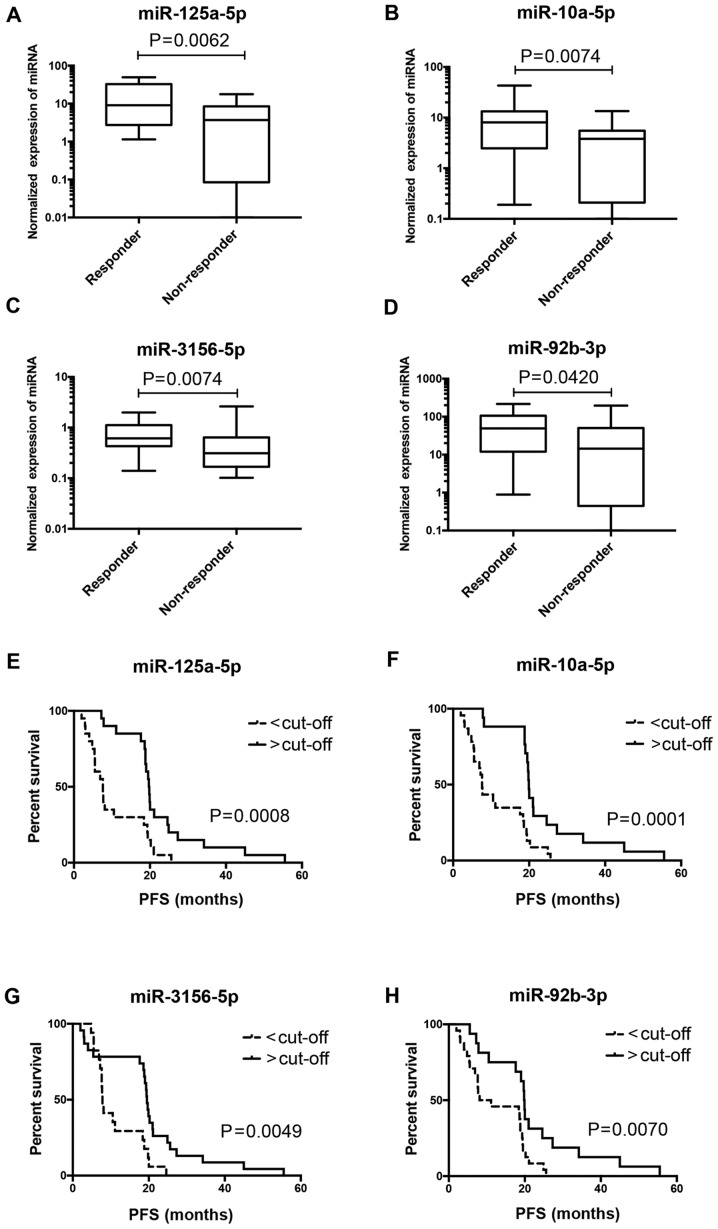
Bevacizumab is a humanized anti-vascular endothelial growth factor monoclonal antibody, used in combination with a oxaliplatin-based chemotherapy in the treatment of metastatic colorectal cancer (mCRC). The aim of the present study was to identify microRNA (miRNA)-based predictive biomarkers of therapy response in order to avoid unnecessary and costly therapy to non-responding patients. High-throughput miRNA microarray profiling (Affymetrix miRNA array) was performed on a discovery cohort of patients with mCRC. The discovery cohort was (n=20) divided into either responding (n=10) or non-responding (n=10) groups of bevacizumab/5-flourouracil, leucovorin, oxaliplatin (FOLFOX) treatment according to Response Evaluation Criteria in Solid Tumors criteria. Validation of candidate miRNAs was performed on an independent cohort of 41 patients with mCRC using quantitative reverse transcription polymerase chain reaction. Normalized data were subjected to receiver operating characteristic and Kaplan-Meier analyses. In total, 67 miRNAs were identified to be differentially expressed when miRNA expression was compared between responding and non-responding patients to bevacizumab/FOLFOX treatment (P<0.05). A total of 7 miRNAs were chosen for independent validation, which confirmed significantly higher expression of miR-92b-3p, miR-3156-5p, miR-10a-5p and miR-125a-5p (P<0.005) in tumor tissue of responding patients compared with non-reponding patients. Using the combination of miRNAs, the present study identified responders to the therapy with sensitivity 82% and specificity 64% (area under the curve = 0.8015). In conclusion, 4 predictive miRNAs associated with progression-free survival (PFS) were identified in patients with mCRC treated with bevacizumab/FOLFOX. Following further independent validations, detection of these miRNA may enable identification of patients with mCRC who may potentially benefit from the therapy.
贝伐单抗是一种人源化抗血管内皮生长因子单克隆抗体,与基于奥沙利铂的化疗联合用于治疗转移性结直肠癌(mCRC)。本研究的目的是确定基于微小RNA(miRNA)的治疗反应预测生物标志物,以避免对无反应患者进行不必要且昂贵的治疗。对mCRC患者的发现队列进行了高通量miRNA微阵列分析(Affymetrix miRNA阵列)。根据实体瘤疗效评价标准,将发现队列(n = 20)分为贝伐单抗/5-氟尿嘧啶、亚叶酸钙、奥沙利铂(FOLFOX)治疗的反应组(n = 10)和无反应组(n = 10)。使用定量逆转录聚合酶链反应在41例mCRC患者的独立队列中对候选miRNA进行验证。对标准化数据进行受试者工作特征分析和Kaplan-Meier分析。在比较贝伐单抗/FOLFOX治疗的反应患者和无反应患者的miRNA表达时,总共鉴定出67种miRNA差异表达(P<0.05)。总共选择了7种miRNA进行独立验证,结果证实反应患者肿瘤组织中miR-92b-3p、miR-3156-5p、miR-10a-5p和miR-125a-5p的表达明显高于无反应患者(P<0.005)。本研究使用miRNA组合鉴定出治疗反应者,灵敏度为82%,特异性为64%(曲线下面积 = 0.8015)。总之,在接受贝伐单抗/FOLFOX治疗的mCRC患者中鉴定出4种与无进展生存期(PFS)相关的预测性miRNA。经过进一步独立验证后,检测这些miRNA可能有助于识别可能从该治疗中获益的mCRC患者。