Rinnerthaler Gabriel, Gampenrieder Simon Peter, Hackl Hubert, Steiner Markus, Monzo-Fuentes Claudia, Melchardt Thomas, Magnes Teresa, Huemer Florian, Westphal Theresa, Hufnagl Clemens, Hauser-Kronberger Cornelia, Egle Alexander, Greil Richard
Laboratory for Immunological and Molecular Cancer Research (SCRI-LIMCR), Medical Oncology, Haemostaseology, Infectiology and Rheumatology, Department of Internal Medicine III with Haematology, Salzburg Cancer Research Institute, Oncologic Center Salzburg, Paracelsus Medical University Salzburg, 5020 Salzburg, Austria.
Cancer Cluster Salzburg, 5020 Salzburg, Austria.
J Clin Med. 2020 Jun 1;9(6):1663. doi: 10.3390/jcm9061663.
In metastatic breast cancer (MBC) patients, no biomarker predicting benefit to a bevacizumab-containing therapy has been established yet. MicroRNAs (miRNAs) are involved in angiogenesis and treatment resistance and therefore could be of predictive value.
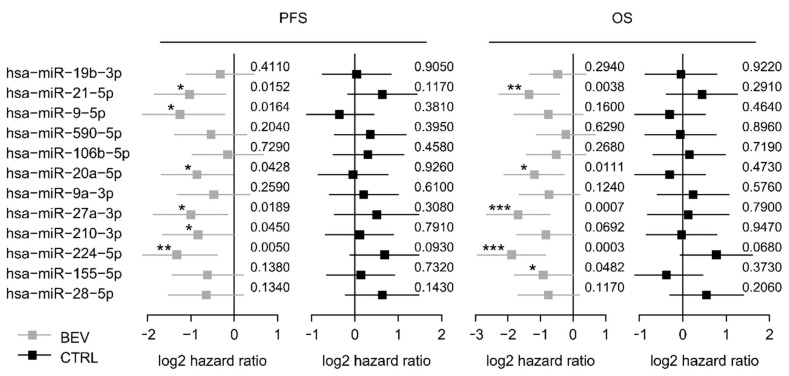
Profiling of 754 miRNAs was performed in tumor samples of 58 MBC patients treated with a bevacizumab-containing first-line regimen (learning set). Based on progression-free survival (PFS), patients were divided into responders (R) and non-responders (NR). Differentially expressed miRNAs between R and NR were analyzed in a cohort of 57 patients treated with first-line chemotherapy without bevacizumab (control set), to exclude miRNAs providing prognostic information. MiRNA candidates significantly associated with PFS in multivariate analysis were further validated in tumor samples of 203 patients treated within the phase III trial TANIA randomizing between chemotherapy either alone or with bevacizumab after progression on first-line bevacizumab.
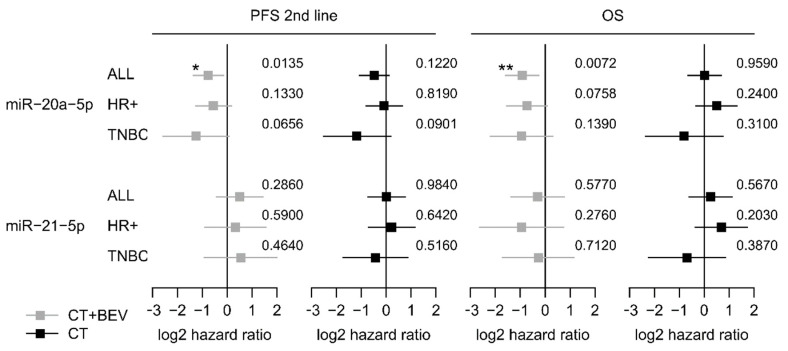
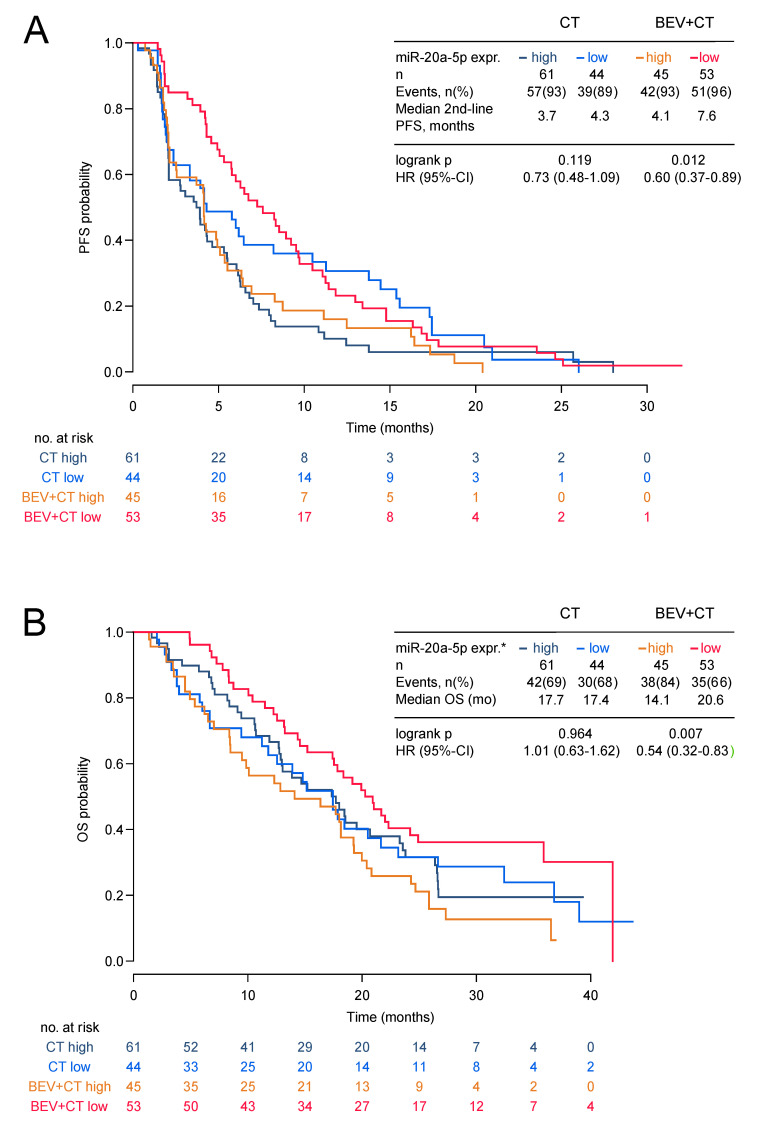
Low expression of miR-20a-5p (multivariate = 0.035) and miR-21-5p (multivariate = 0.004) were significantly associated with longer PFS in the learning set, but not in the control set. In samples from the TANIA trial, low expression of miR-20a-5p was also significantly associated with longer PFS (hazard ration (HR) 0.60; 95%-CI 0.37-0.89; = 0.012) and longer overall survival (OS; HR 0.54; 95%-CI 0.32-0.83; = 0.007) in the bevacizumab arm but not in the chemotherapy-only arm (PFS: HR 0.73, = 0.119; OS: HR 1.01; = 0.964). For miR-21-5p no significant association with PFS or OS in both treatment arms was observed.
MiR-20a-5p expression in breast cancer tissue was predictive for a greater benefit from bevacizumab-containing therapy in two independent cohorts.
在转移性乳腺癌(MBC)患者中,尚未确立可预测含贝伐单抗治疗获益的生物标志物。微小RNA(miRNA)参与血管生成和治疗耐药,因此可能具有预测价值。
对58例接受含贝伐单抗一线治疗方案的MBC患者的肿瘤样本进行了754种miRNA的分析(学习集)。根据无进展生存期(PFS),将患者分为反应者(R)和无反应者(NR)。在57例接受一线不含贝伐单抗化疗的患者队列中分析R组和NR组之间差异表达的miRNA,以排除提供预后信息的miRNA。在III期试验TANIA中接受治疗的203例患者的肿瘤样本中,对多变量分析中与PFS显著相关的miRNA候选物进行进一步验证,该试验在一线贝伐单抗治疗进展后,将患者随机分为单独化疗组或化疗联合贝伐单抗组。
在学习集中,miR-20a-5p低表达(多变量P = 0.035)和miR-21-5p低表达(多变量P = 0.004)与更长的PFS显著相关,但在对照组中并非如此。在TANIA试验的样本中,miR-20a-5p低表达在贝伐单抗治疗组中也与更长的PFS(风险比(HR)0.60;95%置信区间0.37 - 0.89;P = 0.012)和更长的总生存期(OS;HR 0.54;95%置信区间0.32 - 0.83;P = 0.007)显著相关,而在单纯化疗组中则不然(PFS:HR 0.73,P = 0.119;OS:HR 1.01;P = 0.964)。对于miR-21-5p,在两个治疗组中均未观察到与PFS或OS有显著关联。
在两个独立队列中,乳腺癌组织中miR-20a-5p的表达可预测含贝伐单抗治疗能带来更大获益。