Virtanen Eunice, Nurmi Tapio, Söder Per-Östen, Airila-Månsson Stella, Söder Birgitta, Meurman Jukka H
Biomedicum Helsinki, Department of Oral and Maxillofacial Diseases, University of Helsinki and Helsinki University Hospital, P.O.Box 63, Haartmaninkatu 8, FIN-00014, Helsinki, Finland.
Department of Dental Medicine, Karolinska Institutet, Huddinge, Sweden.
BMC Oral Health. 2017 Jul 11;17(1):107. doi: 10.1186/s12903-017-0401-6.
Periodontal disease associates with systemic diseases but corresponding links regarding apical periodontitis (AP) are not so clear. Hence our aim was to study association between AP and the prevalence of systemic diseases in a study population from Sweden.
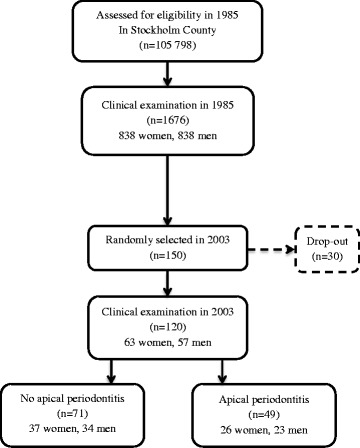
The subjects were 150 patients from a randomly selected epidemiological sample of 1676 individuals. 120 accepted to participate and their basic and clinical examination data were available for these secondary analyses where dental radiographs were used to record signs for endodontic treatments and AP. Periapical Index and modified Total Dental Index scores were calculated from the x-rays to classify the severity of AP and dental infection burden, respectively. Demographic and hospital record data were collected from the Swedish National Statistics Center. T-test, chi-square and univariate analysis of covariance (ANCOVA) and regressions analyses were used for statistics.
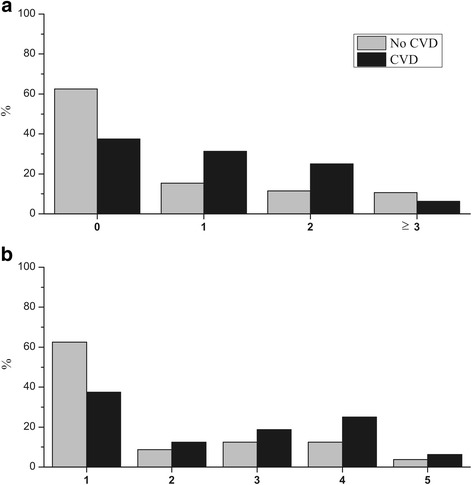
Of the 120 patients 41% had AP and 61% had received endodontic treatments of which 52% were radiographically unsatisfactory. AP patients were older and half of them were smokers. AP and periodontitis often appeared in the same patient (32.5%). From all hospital diagnoses, cardiovascular diseases (CVD) were most common, showing 20.4% prevalence in AP patients. Regression analyses, controlled for age, gender, income, smoking and periodontitis, showed AP to associate with CVD with odds ratio 3.83 (95% confidence interval 1.18-12.40; p = 0.025).
The results confirmed our hypothesis by showing that AP statistically associated with cardiovascular diseases. The finding that subjects with AP also often had periodontitis indicates an increased oral inflammatory burden.
牙周疾病与全身疾病相关,但根尖周炎(AP)的相应联系尚不清楚。因此,我们的目的是在瑞典的一个研究人群中研究AP与全身疾病患病率之间的关联。
研究对象为从1676名个体的随机选择的流行病学样本中选取的150名患者。120名患者同意参与,他们的基本和临床检查数据可用于这些二次分析,其中牙科X光片用于记录牙髓治疗和AP的体征。根据X光片计算根尖指数和改良全牙指数得分,分别对AP的严重程度和牙齿感染负担进行分类。人口统计学和医院记录数据从瑞典国家统计局收集。采用t检验、卡方检验、单因素协方差分析(ANCOVA)和回归分析进行统计。
120名患者中,41%患有AP,61%接受过牙髓治疗,其中52%的治疗在X光片上显示效果不佳。AP患者年龄较大,其中一半是吸烟者。AP和牙周炎常出现在同一患者身上(32.5%)。在所有医院诊断中,心血管疾病(CVD)最为常见,在AP患者中的患病率为20.4%。在控制了年龄、性别、收入、吸烟和牙周炎的回归分析中,显示AP与CVD相关,比值比为3.83(95%置信区间1.18 - 12.40;p = 0.025)。
结果证实了我们的假设,即AP与心血管疾病存在统计学关联。AP患者也常患有牙周炎这一发现表明口腔炎症负担增加。