Wu Xiang, Zhang Chao, Feng Junfeng, Mao Qing, Gao Guoyi, Jiang Jiyao
Department of Neurosurgery, Renji Hospital, School of Medicine, Shanghai Jiaotong University, Shanghai, China.
Trials. 2017 Jul 10;18(1):311. doi: 10.1186/s13063-017-2045-x.
Traumatic brain injury (TBI) has become the most common cause of death and disability in persons between 15 and 30 years of age, and about 10-15% of patients affected by TBI will end up in a coma. Coma caused by TBI presents a significant challenge to neuroscientists. Right median nerve electrical stimulation has been reported as a simple, inexpensive, non-invasive technique to speed recovery and improve outcomes for traumatic comatose patients.
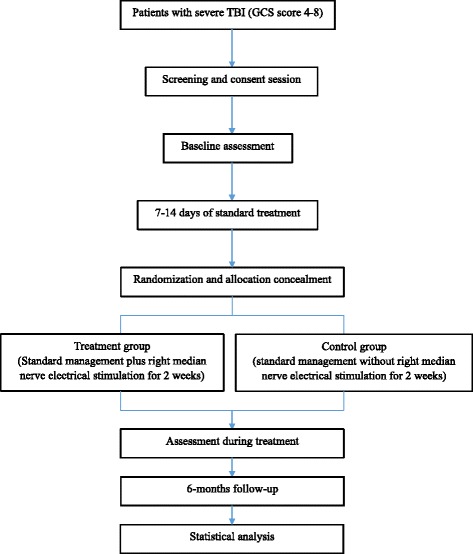
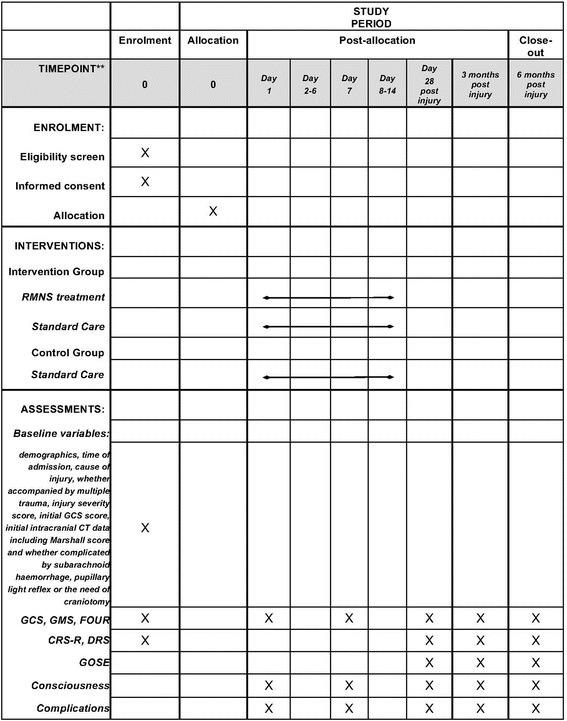
METHODS/DESIGN: This multicentre, prospective, randomised (1:1) controlled trial aims to demonstrate the efficacy and safety of electrical right median nerve stimulation (RMNS) in both accelerating emergence from coma and promoting long-term outcomes. This trial aims to enrol 380 TBI comatose patients to partake in either an electrical stimulation group or a non-stimulation group. Patients assigned to the stimulation group will receive RMNS in addition to standard treatment at an amplitude of 15-20 mA with a pulse width of 300 μs at 40 Hz ON for 20 s and OFF for 40 s. The electrical treatment will last for 8 h per day for 2 weeks. The primary endpoint will be the percentage of patients regaining consciousness 6 months after injury. The secondary endpoints will be Extended Glasgow Outcome Scale, Coma Recovery Scale-Revised and Disability Rating Scale scores at 28 days, 3 months and 6 months after injury; Glasgow Coma Scale, Glasgow Coma Scale Motor Part and Full Outline of Unresponsiveness scale scores on day 1 and day 7 after enrolment and 28 days, 3 months and 6 months after injury; duration of unconsciousness and mechanical ventilation; length of intensive care unit and hospital stays; and incidence of adverse events.
Right median nerve electrical stimulation has been used as a safe, inexpensive, non-invasive therapy for neuroresuscitation of coma patients for more than two decades, yet no trial has robustly proven the efficacy and safety of this treatment. The Asia Coma Electrical Stimulation (ACES) trial has the following novel features compared with other major RMNS trials: (1) the ACES trial is an Asian multicentre randomised controlled trial; (2) RMNS therapy starts at an early stage 7-14 days after the injury; and (3) various assessment scales are used to evaluate the condition of patients. We hope the ACES trial will lead to optimal use of right median nerve electrical treatment.
ClinicalTrials.gov, NCT02645578 . Registered on 23 December 2015.
创伤性脑损伤(TBI)已成为15至30岁人群中最常见的死亡和残疾原因,约10%-15%的TBI患者最终会陷入昏迷。TBI导致的昏迷给神经科学家带来了重大挑战。据报道,右侧正中神经电刺激是一种简单、廉价、非侵入性的技术,可加速创伤性昏迷患者的康复并改善预后。
方法/设计:这项多中心、前瞻性、随机(1:1)对照试验旨在证明右侧正中神经电刺激(RMNS)在加速昏迷苏醒和促进长期预后方面的有效性和安全性。该试验旨在招募380名TBI昏迷患者,分为电刺激组或非刺激组。分配到刺激组的患者除接受标准治疗外,还将接受RMNS治疗,刺激幅度为15-20 mA,脉冲宽度为300 μs,频率为40 Hz,开20秒,关40秒。电治疗每天持续8小时,共2周。主要终点将是受伤6个月后恢复意识的患者百分比。次要终点将是受伤后28天、3个月和6个月时的扩展格拉斯哥预后量表、昏迷恢复量表修订版和残疾评定量表得分;入组后第1天和第7天以及受伤后28天、3个月和6个月时的格拉斯哥昏迷量表、格拉斯哥昏迷量表运动部分和完全无反应量表得分;昏迷持续时间和机械通气时间;重症监护病房和住院时间;以及不良事件的发生率。
右侧正中神经电刺激作为昏迷患者神经复苏的一种安全、廉价、非侵入性治疗方法已使用了二十多年,但尚无试验有力地证明这种治疗的有效性和安全性。与其他主要的RMNS试验相比,亚洲昏迷电刺激(ACES)试验具有以下新特点:(1)ACES试验是一项亚洲多中心随机对照试验;(2)RMNS治疗在受伤后7-14天的早期开始;(3)使用多种评估量表来评估患者的病情。我们希望ACES试验将导致右侧正中神经电治疗的最佳应用。
ClinicalTrials.gov,NCT02645578。于2015年12月23日注册。