Balabaskaran Nina Praveen, Mohanty Ajeet Kumar, Ballav Shuvankar, Vernekar Smita, Bhinge Sushma, D'souza Maria, Walke Jayashree, Manoharan Suresh Kumar, Mascarenhas Anjali, Gomes Edwin, Chery Laura, Valecha Neena, Kumar Ashwani, Rathod Pradipsinh K
Departments of Chemistry and of Global Health, University of Washington, Seattle, WA, 98195, USA.
National Institute of Malaria Research, Field Unit, Campal, Goa, 403001, India.
Malar J. 2017 Jul 11;16(1):284. doi: 10.1186/s12936-017-1931-8.
In global efforts to track mosquito infectivity and parasite elimination, controlled mosquito-feeding experiments can help in understanding the dynamics of parasite development in vectors. Anopheles stephensi is often accepted as the major urban malaria vector that transmits Plasmodium in Goa and elsewhere in South Asia. However, much needs to be learned about the interactions of Plasmodium vivax with An. stephensi. As a component of the US NIH International Center of Excellence for Malaria Research (ICEMR) for Malaria Evolution in South Asia (MESA), a series of membrane-feeding experiments with wild An. stephensi and P. vivax were carried out to better understand this vector-parasite interaction.
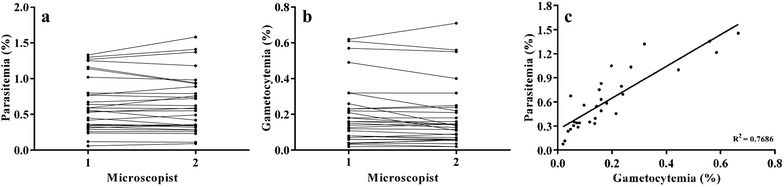
Wild An. stephensi larvae and pupae were collected from curing water in construction sites in the city of Ponda, Goa, India. The larvae and pupae were reared at the MESA ICEMR insectary within the National Institute of Malaria Research (NIMR) field unit in Goa until they emerged into adult mosquitoes. Blood for membrane-feeding experiments was obtained from malaria patients at the local Goa Medical College and Hospital who volunteered for the study. Parasites were counted by Miller reticule technique and correlation between gametocytaemia/parasitaemia and successful mosquito infection was studied.
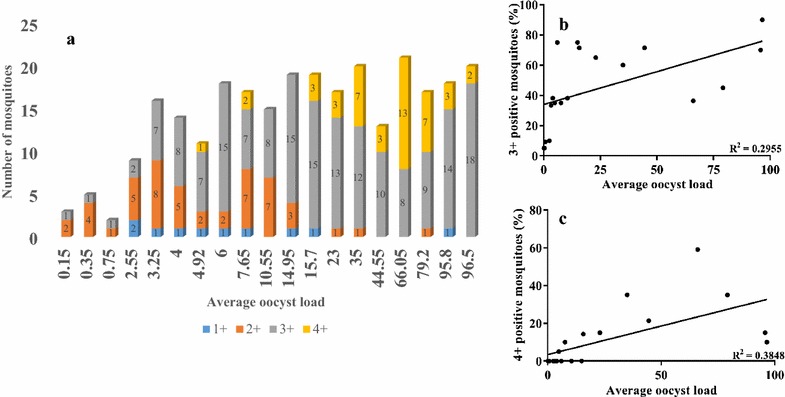
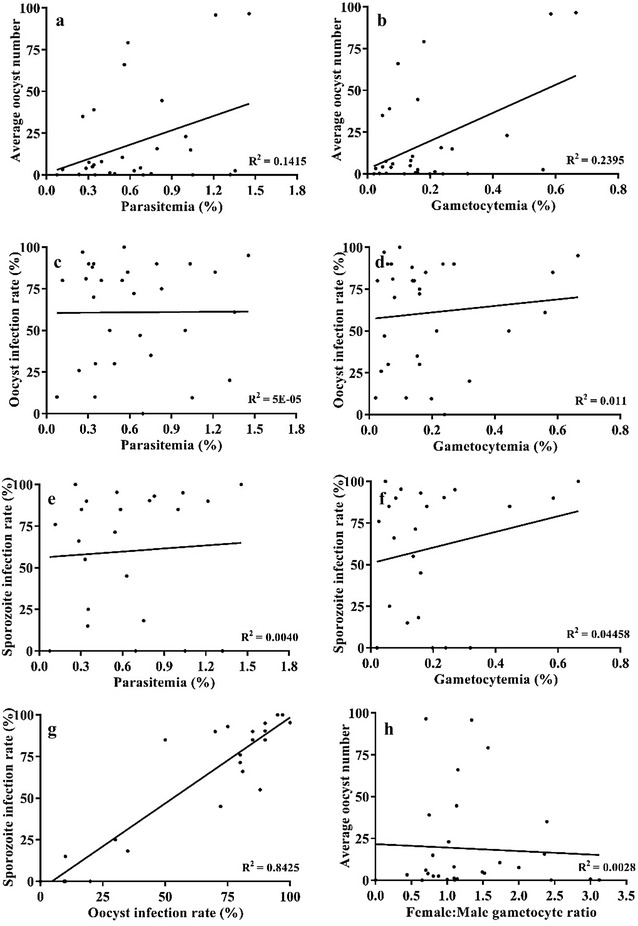
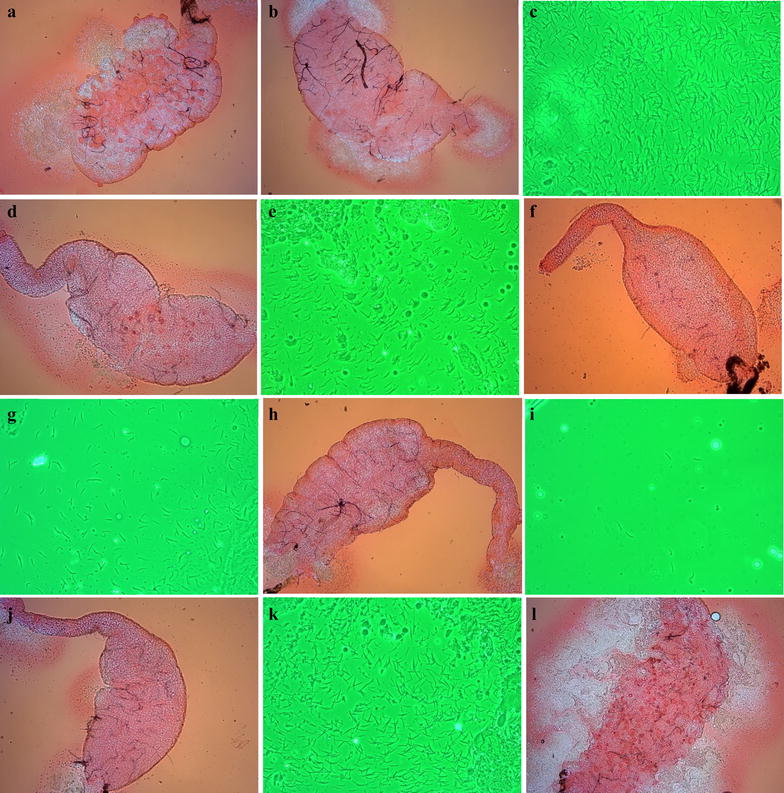
A weak but significant correlation was found between patient blood gametocytaemia/parasitaemia and mosquito oocyst load. No correlation was observed between gametocytaemia/parasitaemia and oocyst infection rates, and between gametocyte sex ratio and oocyst load. When it came to development of the parasite in the mosquito, a strong positive correlation was observed between oocyst midgut levels and sporozoite infection rates, and between oocyst levels and salivary gland sporozoite loads. Kinetic studies showed that sporozoites appeared in the salivary gland as early as day 7, post-infection.
This is the first study in India to carry out membrane-feeding experiments with wild An. stephensi and P. vivax. A wide range of mosquito infection loads and infection rates were observed, pointing to a strong interplay between parasite, vector and human factors. Most of the present observations are in agreement with feeding experiments conducted with P. vivax elsewhere in the world.
在全球追踪蚊子感染性和消除寄生虫的工作中,可控的蚊子喂食实验有助于了解寄生虫在媒介中的发育动态。斯氏按蚊通常被认为是在果阿及南亚其他地区传播疟原虫的主要城市疟疾媒介。然而,关于间日疟原虫与斯氏按蚊的相互作用仍有许多需要了解的地方。作为美国国立卫生研究院南亚疟疾进化国际卓越中心(ICEMR)(南亚疟疾进化研究组,MESA)的一部分,开展了一系列用野生斯氏按蚊和间日疟原虫进行的膜饲实验,以更好地了解这种媒介-寄生虫相互作用。
从印度果阿邦蓬达市建筑工地的积水处收集野生斯氏按蚊幼虫和蛹。这些幼虫和蛹在位于果阿的国立疟疾研究所(NIMR)野外单位的MESA ICEMR昆虫饲养室中饲养,直至羽化为成年蚊子。膜饲实验所用的血液取自当地果阿医学院和医院自愿参与研究的疟疾患者。通过米勒血细胞计数板技术对寄生虫进行计数,并研究配子体血症/寄生虫血症与蚊子成功感染之间的相关性。
在患者血液配子体血症/寄生虫血症与蚊子卵囊负荷之间发现了微弱但显著的相关性。在配子体血症/寄生虫血症与卵囊感染率之间,以及配子体性别比与卵囊负荷之间未观察到相关性。在蚊子体内寄生虫的发育方面,观察到卵囊在中肠的水平与子孢子感染率之间,以及卵囊水平与唾液腺子孢子负荷之间存在强正相关。动力学研究表明,感染后最早在第7天唾液腺中出现子孢子。
这是印度首次用野生斯氏按蚊和间日疟原虫进行膜饲实验的研究。观察到了广泛的蚊子感染负荷和感染率,表明寄生虫、媒介和人为因素之间存在强烈的相互作用。目前的大多数观察结果与世界其他地方用间日疟原虫进行的喂食实验一致。