Zhao Ming, Zhou Lixin, Sun Li, Song Yan, Guo Yunquan, Zhang Xun, Zhao Feng, Wang Peng, Yue Junqiu, Niu Dongfeng, Li Zhongwu, Huang Xiaozheng, Kang Qiang, Jia Lin, Lai Jinping, Cao Dengfeng
Department of Pathology, Zhejiang Provincial People's Hospital, Hangzhou, China.
Department of Pathology, Key Laboratory of Carcinogenesis and Translational Research (Ministry of Education), Peking University Cancer Hospital (Beijing Cancer Hospital), Beijing, China.
Diagn Pathol. 2017 Jul 10;12(1):51. doi: 10.1186/s13000-017-0638-z.
GATA-binding protein 3 (GATA3) has been identified as a sensitive marker for breast carcinoma but its sensitivity in primary genital extramammary Paget diseases (EMPDs) has not been well studied.
Here we investigated immunohistochemical expression of GATA3 in 72 primary genital EMPDs (35 from female, 37 from male; 45 with intraepithelial disease only, 26 with both intraepithelial disease and invasive adenocarcinoma including 14 also metastasis, 1 with metastatic adenocarcinoma only for study). We also compared GATA3 to gross cystic disease fluid protein 15 (GCDFP15) for their sensitivity.
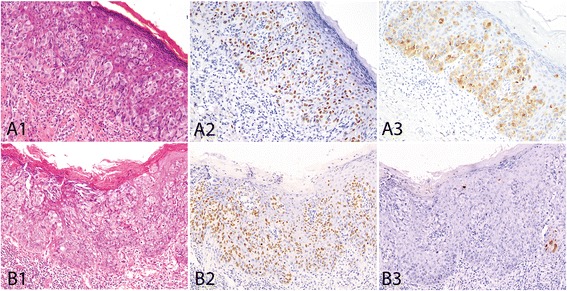
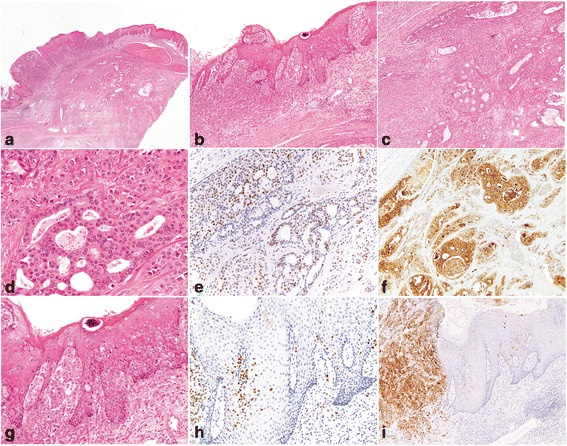
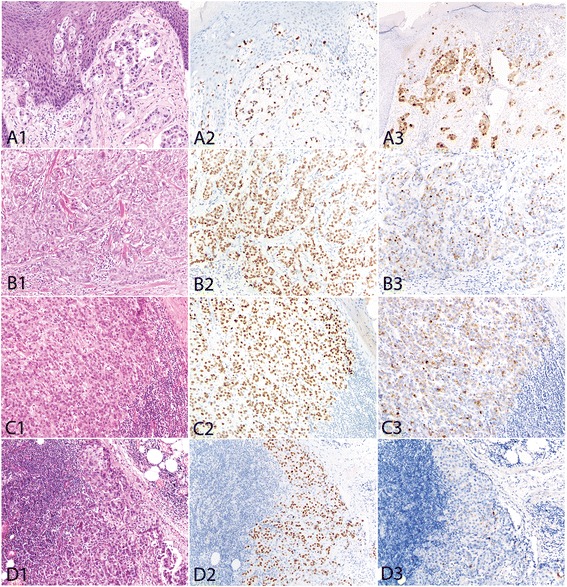
Positive GATA3 staining was seen in all 71 (100%) intraepithelial diseases, 25/26 (96%; female 10/10, male 15/16) invasive adenocarcinomas and 14/15 (93%; female 3/3, male 11/12) metastatic adenocarcinomas, respectively. Positive GCDFP15 staining was seen in 46/71 (65%; female 28/34 or 82%, male 18/37 or 49%) intraepithelial diseases, 20/26 (77%; female 9/10, male 11/16) invasive adenocarcinomas, and 12/15 (80%; female 2/3, male 10/12) metastatic adenocarcinomas, respectively (GATA3 versus GCDFP15: p < 0.01 for both intraepithelial disease and invasive adenocarcinoma, p = 0.28 for metastatic adenocarcinoma). In positive-stained cases, GATA3 stained more tumor cells than GCDFP15 (79% versus 25% for intraepithelial disease, 71% vs 34% for invasive adenocarcinoma, 73% vs 50% for metastatic adenocarcinoma, p < 0.01 for all 3 components).
Our findings indicate that GATA3 is a very sensitive marker for primary genital EMPDs and is more sensitive than GCDFP15.
GATA结合蛋白3(GATA3)已被确定为乳腺癌的敏感标志物,但其在原发性生殖器外Paget病(EMPD)中的敏感性尚未得到充分研究。
我们研究了72例原发性生殖器EMPD中GATA3的免疫组化表达情况(女性35例,男性37例;仅上皮内病变45例,上皮内病变合并浸润性腺癌26例,其中14例有转移,仅1例转移性腺癌用于研究)。我们还比较了GATA3和大囊性病液蛋白15(GCDFP15)的敏感性。
在所有71例(100%)上皮内病变、25/26例(96%;女性10/10,男性15/16)浸润性腺癌和14/15例(93%;女性3/3,男性11/12)转移性腺癌中均可见GATA3阳性染色。在46/71例(65%;女性28/34或82%,男性18/37或49%)上皮内病变、20/26例(77%;女性9/10,男性11/16)浸润性腺癌和12/15例(80%;女性2/3,男性10/12)转移性腺癌中分别可见GCDFP15阳性染色(GATA3与GCDFP15比较:上皮内病变和浸润性腺癌的p均<0.01,转移性腺癌的p = 0.28)。在阳性染色病例中,GATA3染色的肿瘤细胞比GCDFP15多(上皮内病变为79%对25%,浸润性腺癌为71%对34%,转移性腺癌为73%对50%,所有3个组分的p均<0.01)。
我们的研究结果表明,GATA3是原发性生殖器EMPD的非常敏感的标志物,且比GCDFP15更敏感。