Beltrán Leopoldo R, Dawid Corinna, Beltrán Madeline, Levermann Janina, Titt Sascha, Thomas Sini, Pürschel Viktoria, Satalik Miriam, Gisselmann Günter, Hofmann Thomas, Hatt Hanns
Department of Cell Physiology, Ruhr-University-BochumBochum, Germany.
Chair of Food Chemistry and Molecular Sensory Science, Technische Universität MünchenFreising, Germany.
Front Pharmacol. 2017 Jun 26;8:408. doi: 10.3389/fphar.2017.00408. eCollection 2017.
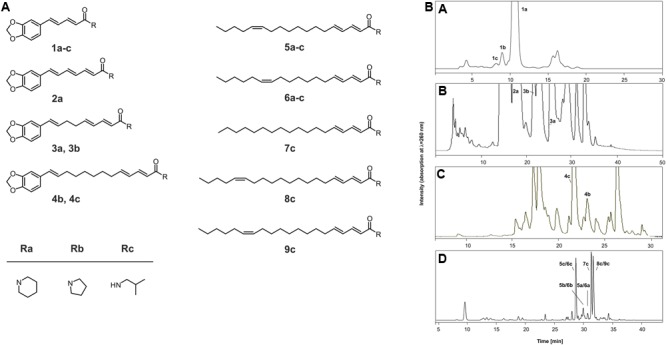
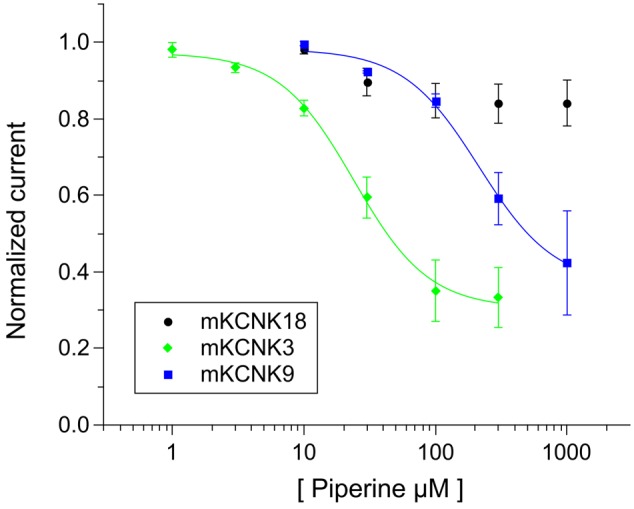
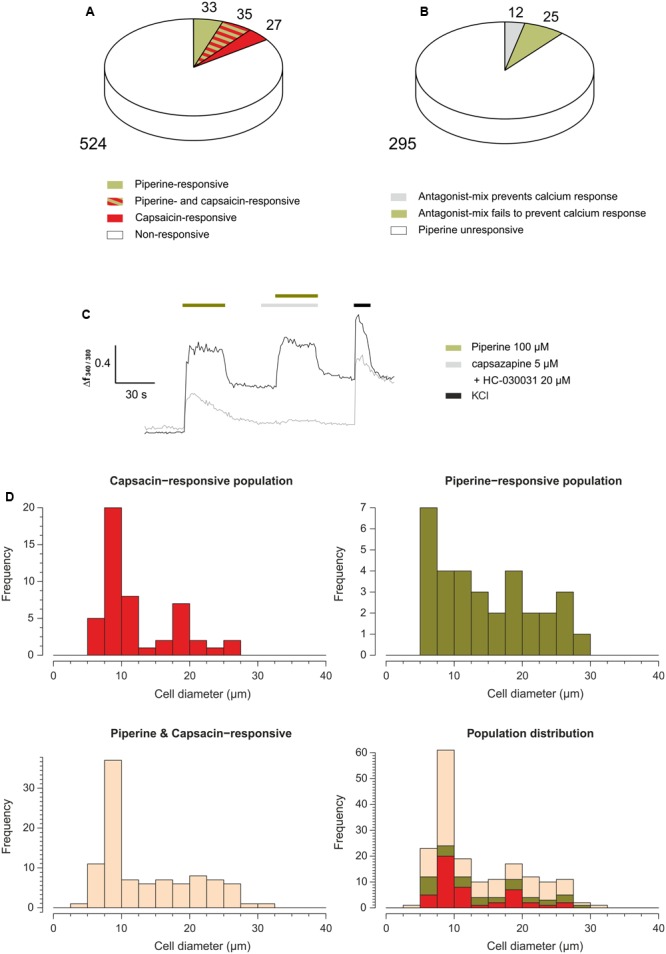
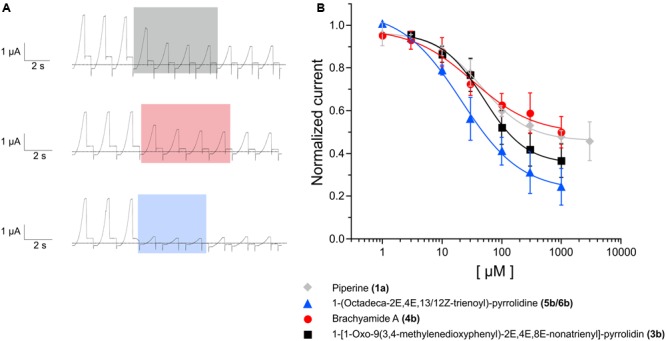
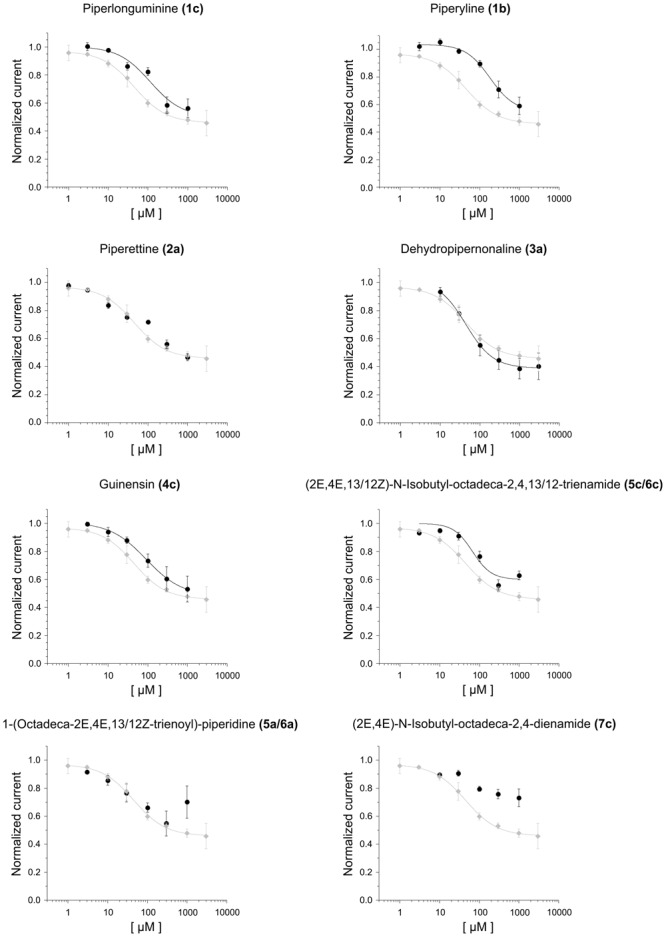
Black peppercorns ( L.) elicit a pungent and tingling oral impression. Their pungency is partially explained by the agonist activity of some of their active principles, especially piperine, on TRP channels. However, we recently showed that piperine, as well as other pungent compounds, also possess a marked effect on two-pore domain (KCNK, K) K channels. Members of this family play a key role in maintaining the resting membrane potential of excitable cells. Interestingly, tingling compounds have been shown to induce neuronal excitation by inhibiting KCNK channels. We addressed the question of whether it was plausible that KCNK channels could constitute a physiologically relevant target for the sensory active compounds present in black peppercorns. Because previous studies have demonstrated that mouse trigeminal neurons respond to several pungent compounds, to which humans are also sensitive, we used a primary culture of mouse trigeminal neurons to investigate whether the effect of piperine on these cell types could also be mediated by KCNK channels. We observed that even in the presence of classical TRP-antagonists, piperine was still able to activate a fraction of trigeminal neurons. Furthermore, our results showed that piperine is capable of inducing neuronal depolarization by a mechanism that does not require extracellular Na or Ca. This depolarization was mediated by the inhibition of a background K conductance, most likely corresponding to the KCNK channels of the TASK subfamily. We then performed a screening with 12 other pungent and/or tingling chemosensates isolated from black peppercorns. These compounds were evaluated on oocytes expressing the human orthologues of KCNK3, KNCK9 and KCNK18, which we previously showed to be inhibited by piperine. Remarkably, almost all of the isolated chemosensates inhibited the basal activity of hKCNK3, with 1-(octadeca-2,4,13/12-trienoyl)pyrrolidine acting as one of the most potent natural blockers for hKCNK3 found to date. Our results suggest that KCNK channels, especially KCNK3, are likely to play a complementary role to TRP channels in the complex orosensory impression elicited by black peppercorns, while they also help to expand the pharmacological knowledge of KCNK channels.
黑胡椒(L.)会引起一种辛辣且刺痛的口腔感觉。其辛辣感部分归因于某些活性成分,尤其是胡椒碱,对瞬时受体电位(TRP)通道的激动剂活性。然而,我们最近发现,胡椒碱以及其他辛辣化合物,对双孔结构域(KCNK,K)钾通道也有显著影响。该家族成员在维持可兴奋细胞的静息膜电位方面起着关键作用。有趣的是,已表明刺痛化合物通过抑制KCNK通道来诱导神经元兴奋。我们探讨了KCNK通道是否可能是黑胡椒中存在的感觉活性化合物的生理相关靶点这一问题。由于先前的研究表明小鼠三叉神经元对几种辛辣化合物有反应,而人类对这些化合物也敏感,我们使用小鼠三叉神经元的原代培养物来研究胡椒碱对这些细胞类型的作用是否也可由KCNK通道介导。我们观察到,即使存在经典的TRP拮抗剂,胡椒碱仍能够激活一部分三叉神经元。此外,我们的结果表明,胡椒碱能够通过一种不需要细胞外钠或钙的机制诱导神经元去极化。这种去极化是由背景钾电导的抑制介导的,很可能对应于TASK亚家族的KCNK通道。然后,我们用从黑胡椒中分离出的其他12种辛辣和/或刺痛化学感受剂进行了筛选。这些化合物在表达我们先前表明会被胡椒碱抑制的KCNK3、KNCK9和KCNK18人类同源物的卵母细胞上进行了评估。值得注意的是,几乎所有分离出的化学感受剂都抑制了hKCNK3的基础活性,1 -(十八碳 - 2,4,13/12 - 三烯酰)吡咯烷是迄今为止发现的对hKCNK3最有效的天然阻滞剂之一。我们的结果表明,KCNK通道,尤其是KCNK3,可能在黑胡椒引发的复杂口腔感觉印象中对TRP通道起到互补作用,同时它们也有助于扩展对KCNK通道的药理学认识。