Ji Wei, Wang Yue, Tanabe Ichiro, Han Xiaoxia, Zhao Bing, Ozaki Yukihiro
Department of Chemistry , School of Science and Technology , Kwansei Gakuin University , Sanda , Hyogo 669-1337 , Japan . Email:
State Key Laboratory of Supramolecular Structure and Materials , Jilin University , Changchun 130012 , P. R. China . Email:
Chem Sci. 2015 Jan 1;6(1):342-348. doi: 10.1039/c4sc02618g. Epub 2014 Sep 29.
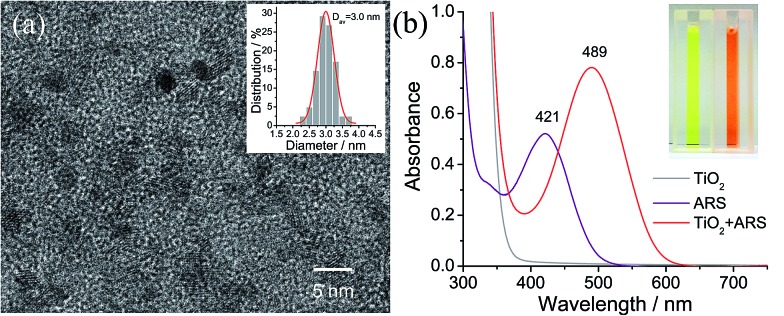
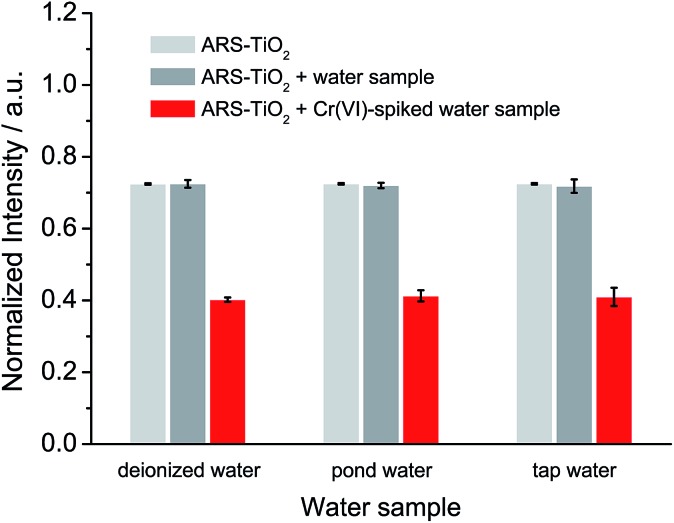
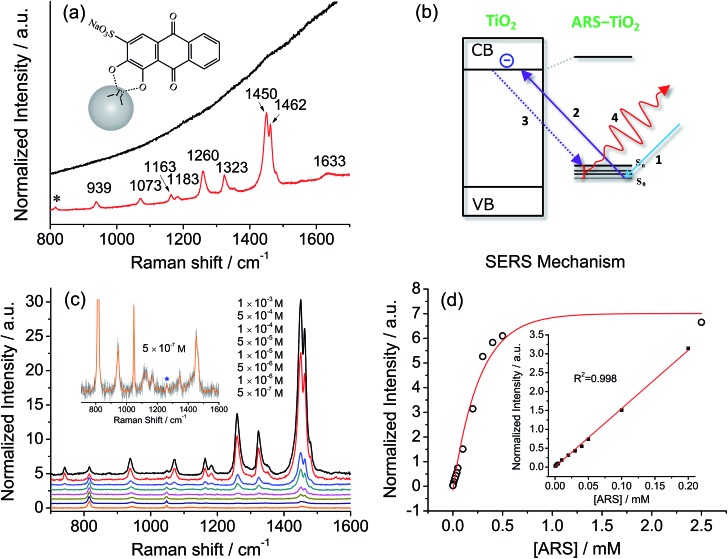
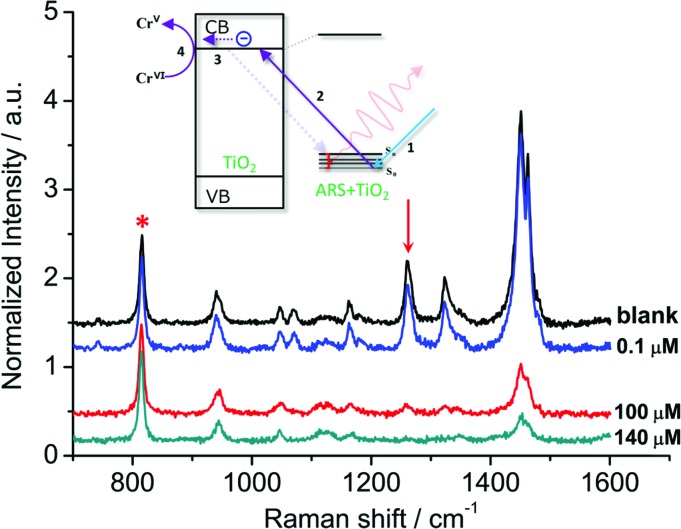
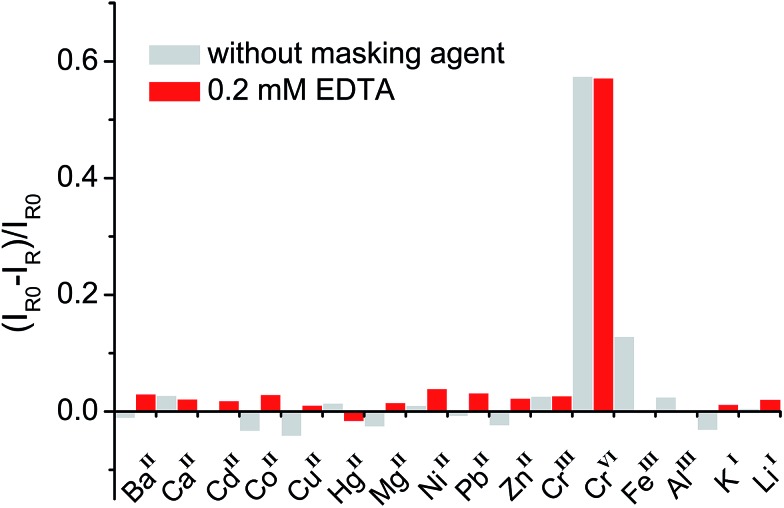
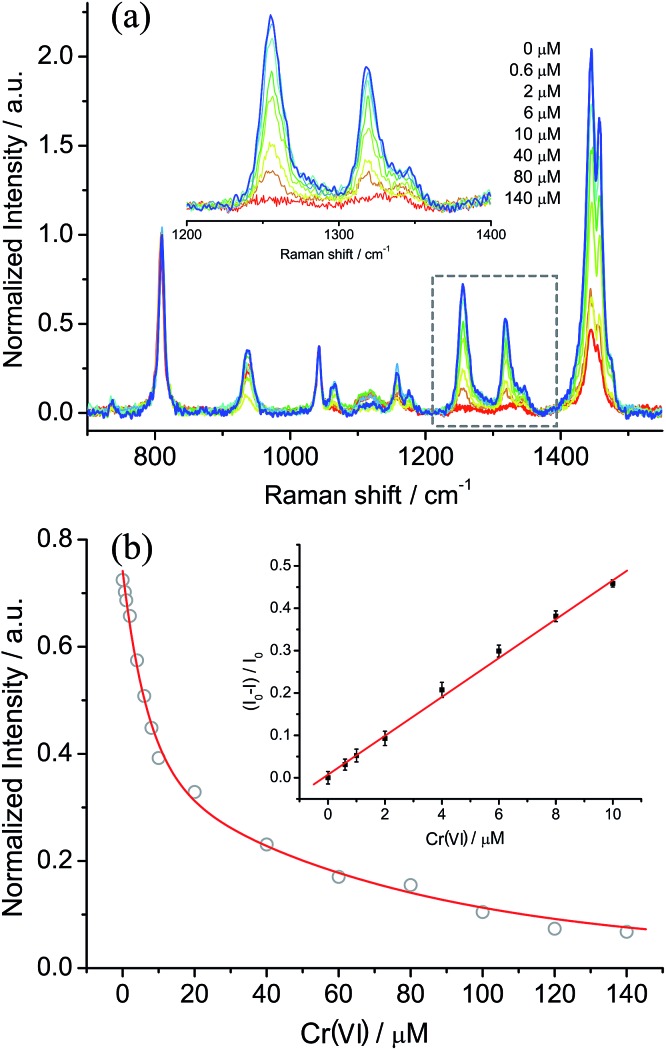
Semiconductor materials have been successfully used as surface-enhanced Raman scattering (SERS)-active substrates, providing SERS technology with a high flexibility for application in a diverse range of fields. Here, we employ a dye-sensitized semiconductor system combined with semiconductor-enhanced Raman spectroscopy to detect metal ions, using an approach based on the "turn-off" SERS strategy that takes advantage of the intrinsic capacity of the semiconductor to catalyze the degradation of a Raman probe. Alizarin red S (ARS)-sensitized colloidal TiO nanoparticles (NPs) were selected as an example to show how semiconductor-enhanced Raman spectroscopy enables the determination of Cr(vi) in water. Firstly, we explored the SERS mechanism of ARS-TiO complexes and found that the strong electronic coupling between ARS and colloidal TiO NPs gives rise to the formation of a ligand-to-metal charge-transfer (LMCT) transition, providing a new electronic transition pathway for the Raman process. Secondly, colloidal TiO nanoparticles were used as active sites to induce the self-degradation of the Raman probe adsorbed on their surfaces in the presence of Cr(vi). Our data demonstrate the potential of ARS-TiO complexes as a SERS-active sensing platform for Cr(vi) in an aqueous solution. Remarkably, the method proposed in this contribution is relatively simple, without requiring complex pretreatment and complicated instruments, but provides high sensitivity and excellent selectivity in a high-throughput fashion. Finally, the ARS-TiO complexes are successfully applied to the detection of Cr(vi) in environmental samples. Thus, the present work provides a facile method for the detection of Cr(vi) in aqueous solutions and a viable application for semiconductor-enhanced Raman spectroscopy based on the chemical enhancement they contribute.
半导体材料已成功用作表面增强拉曼散射(SERS)活性基底,为SERS技术在各种领域的应用提供了高度的灵活性。在此,我们采用染料敏化半导体系统结合半导体增强拉曼光谱来检测金属离子,采用基于“关断”SERS策略的方法,该方法利用半导体催化拉曼探针降解的内在能力。以茜素红S(ARS)敏化的胶体TiO纳米颗粒(NPs)为例,展示了半导体增强拉曼光谱如何能够测定水中的Cr(Ⅵ)。首先,我们探究了ARS-TiO复合物的SERS机制,发现ARS与胶体TiO NPs之间的强电子耦合导致形成配体到金属的电荷转移(LMCT)跃迁,为拉曼过程提供了新的电子跃迁途径。其次,在Cr(Ⅵ)存在下,胶体TiO纳米颗粒被用作活性位点,诱导吸附在其表面的拉曼探针自降解。我们的数据证明了ARS-TiO复合物作为水溶液中Cr(Ⅵ)的SERS活性传感平台的潜力。值得注意的是,本研究中提出的方法相对简单,无需复杂的预处理和复杂的仪器,但以高通量方式提供了高灵敏度和优异的选择性。最后,ARS-TiO复合物成功应用于环境样品中Cr(Ⅵ)的检测。因此,本工作为水溶液中Cr(Ⅵ)的检测提供了一种简便方法,并基于它们所贡献的化学增强作用,为半导体增强拉曼光谱提供了可行的应用。