Kemp Joanne, Moore Kate, Fransen Marlene, Russell Trevor, Freke Matthew, Crossley Kay M
La Trobe Sport and Exercise Medicine Research Centre, School of Allied Health, College of Science, Health and Engineering, La Trobe University, Melbourne, VIC Australia.
Australian Collaboration for Research into Injury in Sport and its Prevention, Faculty of Health, Federation University Australia, Ballarat, VIC Australia.
Pilot Feasibility Stud. 2017 Jul 7;4:16. doi: 10.1186/s40814-017-0157-4. eCollection 2018.
Despite the increasing use of hip arthroscopy for hip pain, there is no level 1 evidence to support physiotherapy rehabilitation programs following this procedure. The aims of this study were to determine (i) what is the feasibility of a randomised controlled trial (RCT) investigating a targeted physiotherapy intervention for early-onset hip osteoarthritis (OA) post-hip arthroscopy? and (ii) what are the within-group treatment effects of the physiotherapy intervention and a health-education control group?
This study was a pilot single-blind RCT conducted in a private physiotherapy clinic in Hobart, Australia. Patients included 17 volunteers (nine women; age 32 ± 8 years; body mass index = 25.6 ± 5.1 kg/m) who were recruited 4-14 months post-hip arthroscopy, with chondropathy and/or labral pathology at the time of surgery. Interventions included a physiotherapy treatment program that was semi-standardised and consisted of (i) manual therapy; (ii) hip strengthening and functional retraining; and (iii) health education. Control treatment encompassed individualised health education sessions. The primary outcome measure was feasibility, which was reported as percentage of eligible participants enrolled, adherence with the intervention, and losses to follow-up. The research process was evaluated using interviews, and an estimated sample size for a definitive study is offered. Secondary outcomes included the Hip disability and Osteoarthritis Outcome Score (HOOS) and the International Hip Outcome Tool (IHOT-33) patient-reported outcomes.
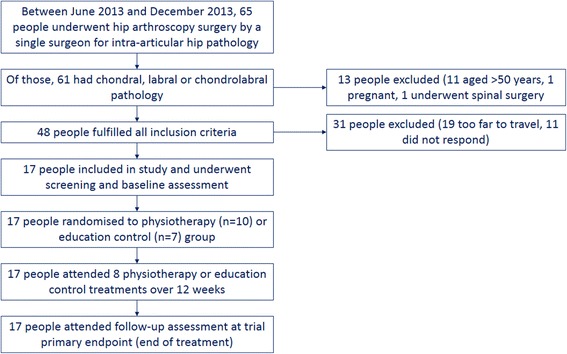
Seventeen out of 48 eligible patients (35%) were randomised. Adherence to the intervention was 100%, with no losses to follow-up. The estimated sample size for a full-scale RCT was 142 patients. The within-group (95% confidence intervals) change scores for the physiotherapy group were HOOS-Symptoms 6 points (-4 to 16); HOOS-Pain 10 points (-2 to 22); HOOS-Activity of Daily Living 8 points (0 to 16); HOOS-Sport 3 points (-12 to 19); HOOS-Quality of Life 3 points (-7 to 13); and IHOT-33 7 points (-10 to 25). The within-group (95% confidence intervals) change scores for the control group were HOOS-Symptoms -4 points (-17 to 9); HOOS-Pain -2 points (-18 to 13); HOOS-Activity of Daily Living -7 points (-17 to 4); HOOS-Sport 4 points (-16 to 23); HOOS-Quality of Life -5 points (-18 to 9); and IHOT-33 -4 points (-27 to 19). Suggestions to improve study design included greater supervision of exercises and increased access to physiotherapy appointments.
Results support the feasibility of a full-scale RCT, and recommendations for an adequately powered and improved study to determine the efficacy of this physiotherapy intervention post-hip arthroscopy to reduce pain and improve function are provided.
Australian Clinical Trials Registry, ACTRN12614000426684.
尽管髋关节镜检查在治疗髋关节疼痛方面的应用日益增多,但目前尚无一级证据支持该手术后的物理治疗康复方案。本研究的目的是确定:(i)针对髋关节镜检查后早期髋关节骨关节炎(OA)开展一项随机对照试验(RCT),研究针对性物理治疗干预措施的可行性如何?(ii)物理治疗干预组和健康教育对照组的组内治疗效果如何?
本研究是在澳大利亚霍巴特一家私立物理治疗诊所进行的一项单盲RCT试点研究。患者包括17名志愿者(9名女性;年龄32±8岁;体重指数=25.6±5.1kg/m²),这些志愿者在髋关节镜检查后4 - 14个月招募,手术时患有软骨病和/或盂唇病变。干预措施包括一个半标准化的物理治疗方案,该方案包括:(i)手法治疗;(ii)髋关节强化和功能再训练;(iii)健康教育。对照治疗包括个体化的健康教育课程。主要结局指标是可行性,以入选的合格参与者百分比、干预措施的依从性以及失访情况来报告。通过访谈对研究过程进行评估,并给出了确定性研究的估计样本量。次要结局包括髋关节残疾和骨关节炎结局评分(HOOS)以及国际髋关节结局工具(IHOT - 33)患者报告结局。
48名合格患者中有17名(35%)被随机分组。干预措施的依从性为100%,无失访情况。一项全面RCT的估计样本量为142名患者。物理治疗组的组内(95%置信区间)变化分数为:HOOS - 症状6分(-4至16);HOOS - 疼痛10分(-2至22);HOOS - 日常生活活动8分(0至16);HOOS - 运动3分(-12至19);HOOS - 生活质量3分(-7至13);IHOT - 33 7分(-10至25)。对照组的组内(95%置信区间)变化分数为:HOOS - 症状 -4分(-17至9);HOOS - 疼痛 -2分(-18至13);HOOS - 日常生活活动 -7分(-17至4);HOOS - 运动4分(-16至23);HOOS - 生活质量 -5分(-18至9);IHOT - 33 -4分(-27至19)。关于改进研究设计的建议包括加强对锻炼的监督以及增加物理治疗预约的机会。
结果支持开展一项全面RCT的可行性,并为进行一项有足够效力且改进后的研究提供了建议,以确定这种髋关节镜检查后物理治疗干预措施减轻疼痛和改善功能的疗效。
澳大利亚临床试验注册中心,ACTRN12614000426684。
