Austermann Jacqueline, Mitrovica Jerry X, Huybers Peter, Rovere Alessio
Department of Earth Sciences, University of Cambridge, Cambridge, UK.
Department of Earth and Planetary Sciences, Harvard University, Cambridge, MA 02138, USA.
Sci Adv. 2017 Jul 7;3(7):e1700457. doi: 10.1126/sciadv.1700457. eCollection 2017 Jul.
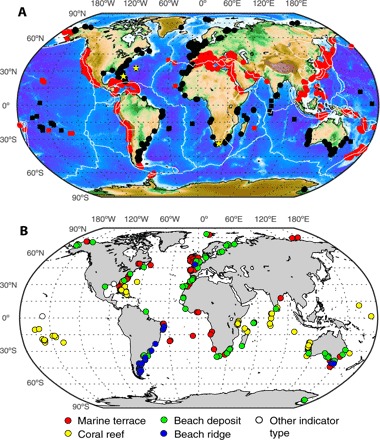
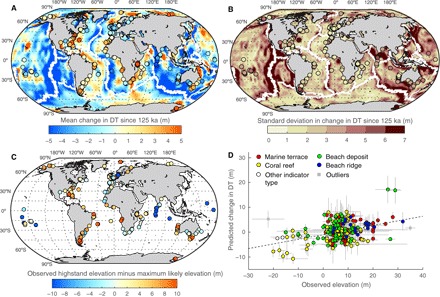
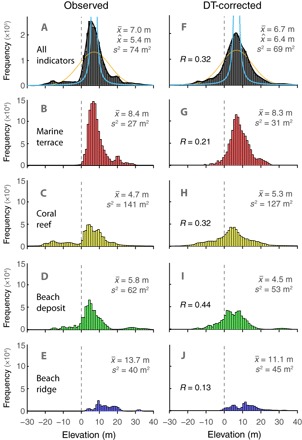
Estimating minimum ice volume during the last interglacial based on local sea-level indicators requires that these indicators are corrected for processes that alter local sea level relative to the global average. Although glacial isostatic adjustment is generally accounted for, global scale dynamic changes in topography driven by convective mantle flow are generally not considered. We use numerical models of mantle flow to quantify vertical deflections caused by dynamic topography and compare predictions at passive margins to a globally distributed set of last interglacial sea-level markers. The deflections predicted as a result of dynamic topography are significantly correlated with marker elevations (>95% probability) and are consistent with construction and preservation attributes across marker types. We conclude that a dynamic topography signal is present in the elevation of last interglacial sea-level records and that the signal must be accounted for in any effort to determine peak global mean sea level during the last interglacial to within an accuracy of several meters.
基于当地海平面指标估算末次间冰期的最小冰量,需要针对那些相对于全球平均值改变当地海平面的过程对这些指标进行校正。尽管一般会考虑冰川均衡调整,但通常不考虑由地幔对流引起的全球尺度地形动态变化。我们使用地幔流数值模型来量化由动态地形引起的垂直挠度,并将被动大陆边缘的预测结果与一组全球分布的末次间冰期海平面标志物进行比较。由动态地形预测的挠度与标志物海拔高度显著相关(概率大于95%),并且与各标志物类型的构造和保存属性一致。我们得出结论,末次间冰期海平面记录的海拔中存在动态地形信号,并且在任何旨在将末次间冰期全球平均海平面峰值确定在几米精度范围内的工作中,都必须考虑该信号。