Janus Joanna M, O'Shaughnessy Ryan F L, Harwood Catherine A, Maffucci Tania
Centre for Cell Biology and Cutaneous Research, Blizard Institute, Barts and The London School of Medicine and Dentistry, Queen Mary University of London, London E1 2AT, UK.
Cancers (Basel). 2017 Jul 11;9(7):86. doi: 10.3390/cancers9070086.
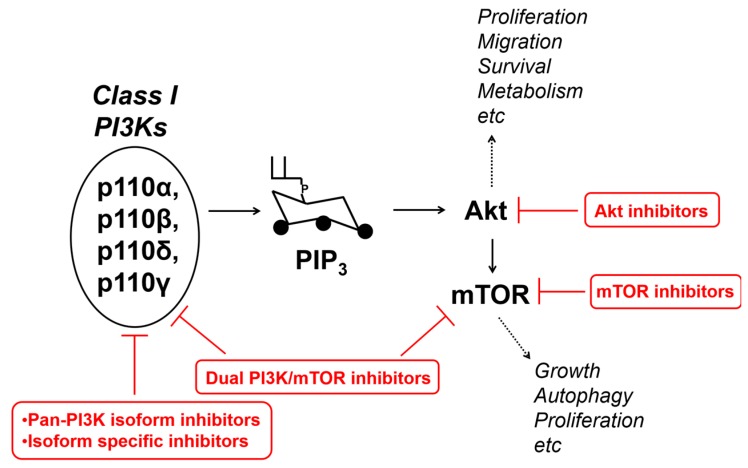
Cutaneous squamous cell carcinoma (cSCC) derives from keratinocytes in the epidermis and accounts for 15-20% of all cutaneous malignancies. Although it is usually curable by surgery, 5% of these tumours metastasise leading to poor prognosis mostly because of a lack of therapies and validated biomarkers. As the incidence rate is rising worldwide it has become increasingly important to better understand the mechanisms involved in cSCC development and progression in order to develop therapeutic strategies. Here we discuss some of the evidence indicating that activation of phosphoinositide 3-kinases (PI3Ks)-dependent signalling pathways (in particular the PI3Ks targets Akt and mTOR) has a key role in cSCC. We further discuss available data suggesting that inhibition of these pathways can be beneficial to counteract the disease. With the growing number of different inhibitors currently available, it would be important to further investigate the specific contribution of distinct components of the PI3Ks/Akt/mTOR pathways in order to identify the most promising molecular targets and the best strategy to inhibit cSCC.
皮肤鳞状细胞癌(cSCC)起源于表皮中的角质形成细胞,占所有皮肤恶性肿瘤的15% - 20%。尽管它通常可通过手术治愈,但这些肿瘤中有5%会发生转移,导致预后不良,主要原因是缺乏治疗方法和经过验证的生物标志物。由于全球发病率不断上升,为了制定治疗策略,更好地了解cSCC发生和发展的机制变得越来越重要。在这里,我们讨论一些证据,这些证据表明磷酸肌醇3激酶(PI3Ks)依赖性信号通路(特别是PI3Ks的靶点Akt和mTOR)的激活在cSCC中起关键作用。我们进一步讨论现有数据,这些数据表明抑制这些通路可能有助于对抗该疾病。随着目前可用的不同抑制剂数量不断增加,进一步研究PI3Ks/Akt/mTOR通路不同组分的具体作用,以确定最有前景的分子靶点和抑制cSCC的最佳策略将非常重要。