Ramírez-Vélez Robinson, Moreno-Jiménez Javier, Correa-Bautista Jorge Enrique, Martínez-Torres Javier, González-Ruiz Katherine, González-Jiménez Emilio, Schmidt-RioValle Jacqueline, Lobelo Felipe, Garcia-Hermoso Antonio
Centro de Estudios para la Medición de la Actividad Física (CEMA). Escuela de Medicina y Ciencias de la Salud, Universidad del Rosario, Cra. 24 No. 63C - 69, Bogotá D.C, Colombia.
Grupo de Ejercicio Físico y Deportes, Facultad de Salud, Vicerrectoría de Investigaciones, Universidad Manuela Beltrán, Bogotá D.C, Colombia.
BMC Pediatr. 2017 Jul 11;17(1):162. doi: 10.1186/s12887-017-0919-4.
Waist circumference (WC) and waist-to-height ratio (WHtR) are often used as indices predictive of central obesity. The aims of this study were: 1) to obtain smoothed centile charts and LMS tables for WC and WHtR among Colombian children and adolescents; 2) to evaluate the utility of these parameters as predictors of overweight and obesity.
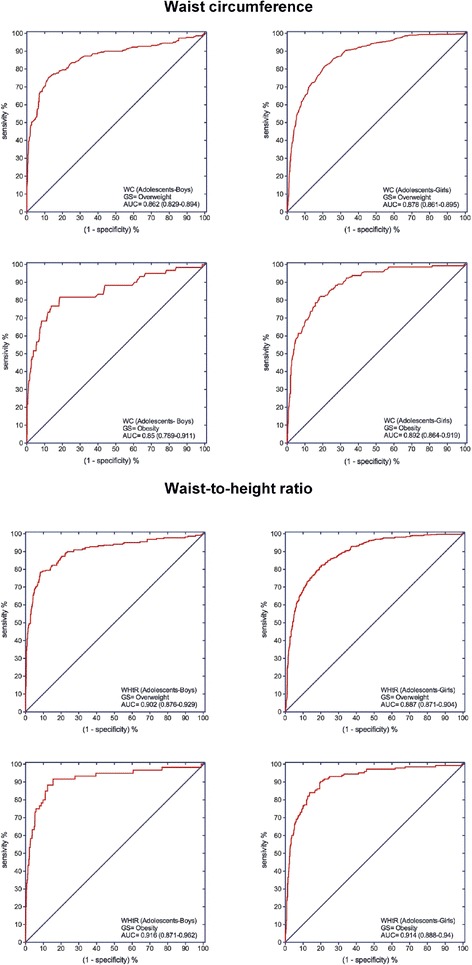
A cross-sectional study was conducted of a sample population of 7954 healthy Colombian schoolchildren [3460 boys and 4494 girls, mean age 12.8 (±2.3) years]. Weight, height, body mass index (BMI), WC and WHtR were measured, and percentiles were calculated using the LMS method (Box-Cox, median and coefficient of variation). Appropriate cut-off points of WC and WHtR for overweight and obesity, according to International Obesity Task Force definitions, were selected using receiver operating characteristic (ROC) analysis. The discriminating power of WC and WHtR is expressed as area under the curve (AUC).
Reference values for WC and WHtR are presented. Mean WC increased and WHtR decreased with age for both genders. A moderate positive correlation was observed between WC and BMI (r = 0.756, P < 0.01) and between WHtR and BMI (r = 0.604, P < 0.01). ROC analysis revealed strong discrimination power in the identification of overweight and obesity for both measures in our sample population. Overall, WHtR was a slightly better predictor of overweight/obesity (AUC 95% CI 0.868-0.916) than WC (AUC 95% CI 0.862-0.904).
This paper presents the first sex and age-specific WC and WHtR percentiles for Colombian children and adolescents aged 9.0-17.9 years. The LMS tables obtained, based on Colombian reference data, can be used as quantitative tools for the study of obesity and its comorbidities.
腰围(WC)和腰高比(WHtR)常被用作预测中心性肥胖的指标。本研究的目的是:1)获取哥伦比亚儿童和青少年WC和WHtR的平滑百分位数图表和LMS表;2)评估这些参数作为超重和肥胖预测指标的效用。
对7954名健康的哥伦比亚学童样本群体进行了横断面研究[3460名男孩和4494名女孩,平均年龄12.8(±2.3)岁]。测量了体重、身高、体重指数(BMI)、WC和WHtR,并使用LMS方法(Box-Cox、中位数和变异系数)计算百分位数。根据国际肥胖特别工作组的定义,使用受试者工作特征(ROC)分析选择WC和WHtR用于超重和肥胖的合适切点。WC和WHtR的鉴别能力用曲线下面积(AUC)表示。
给出了WC和WHtR的参考值。男女的平均WC随年龄增加,而WHtR随年龄降低。WC与BMI之间(r = 0.756,P < 0.01)以及WHtR与BMI之间(r = 0.604,P < 0.01)观察到中度正相关。ROC分析显示,在我们的样本群体中,这两种测量方法在识别超重和肥胖方面具有很强的鉴别能力。总体而言,WHtR作为超重/肥胖的预测指标(AUC 95% CI 0.868 - 0.916)比WC(AUC 95% CI 0.862 - 0.904)稍好。
本文给出了9.0 - 17.9岁哥伦比亚儿童和青少年首个按性别和年龄划分的WC和WHtR百分位数。基于哥伦比亚参考数据获得的LMS表可作为研究肥胖及其合并症的定量工具。