Critical Care Center and Cardiovascular Medical Center, Kaohsiung Veterans General Hospital, Kaohsiung, Taiwan.
School of Medicine, National Yang-Ming University, Taipei, Taiwan.
Cardiovasc Diabetol. 2017 Jul 11;16(1):89. doi: 10.1186/s12933-017-0572-0.
Previous studies regarding the cardioprotective effects of dipeptidyl peptidase 4 (DPP-4) inhibitors have not provided sufficient evidence of a relationship between DPP-4 inhibition and actual cardiovascular outcomes. This study aimed to evaluate the impact of DPP-4 inhibitors on the survival of diabetic patients after first acute myocardial infarction (AMI).
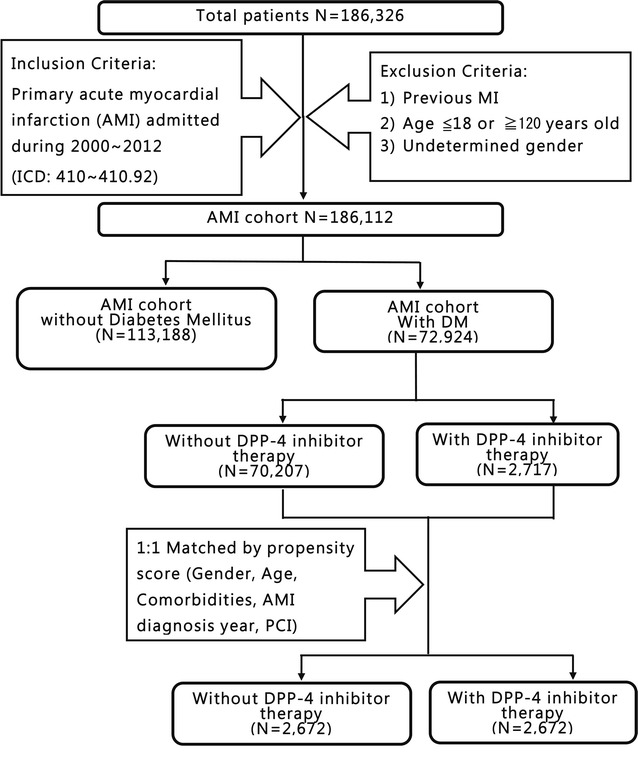
This was a nationwide, propensity score-matched, case-control study of 186,112 first AMI patients, 72,924 of whom had diabetes. A propensity score, one-to-one matching technique was used to match 2672 controls to 2672 patients in the DPP-4 inhibitor group for analysis. Controls were matched based on gender, age, and a history of hypertension, dyslipidemia, diabetes, peripheral vascular disease, heart failure, cerebrovascular accident, end-stage renal disease, chronic obstructive pulmonary disease, and percutaneous coronary intervention.
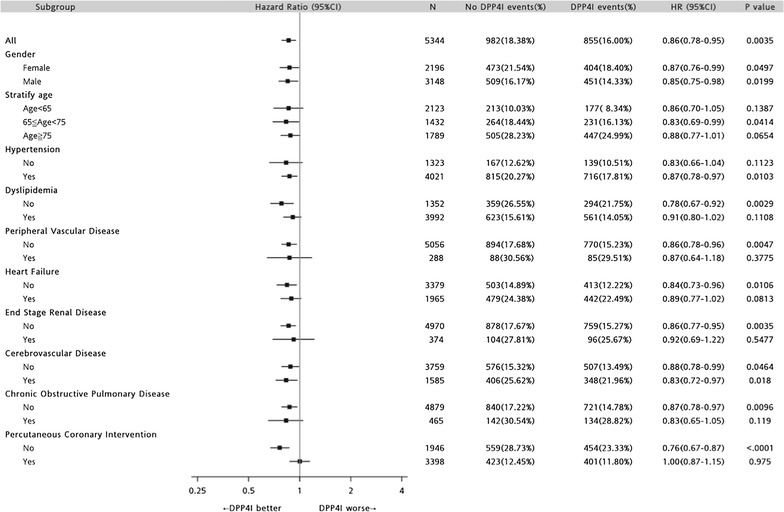
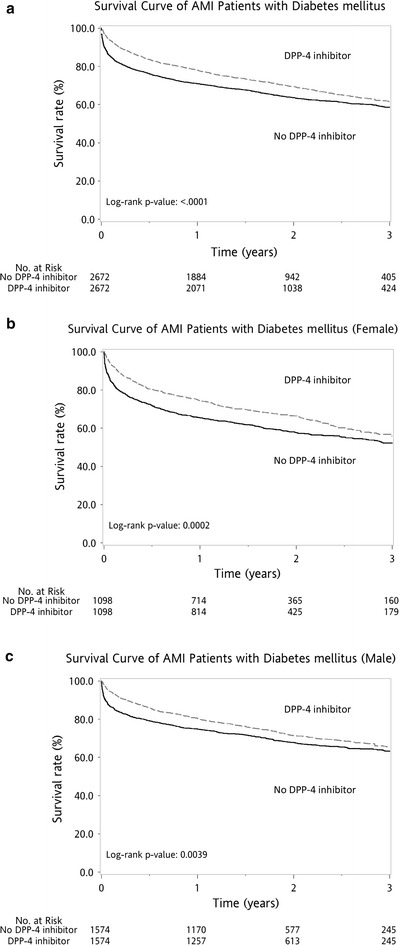
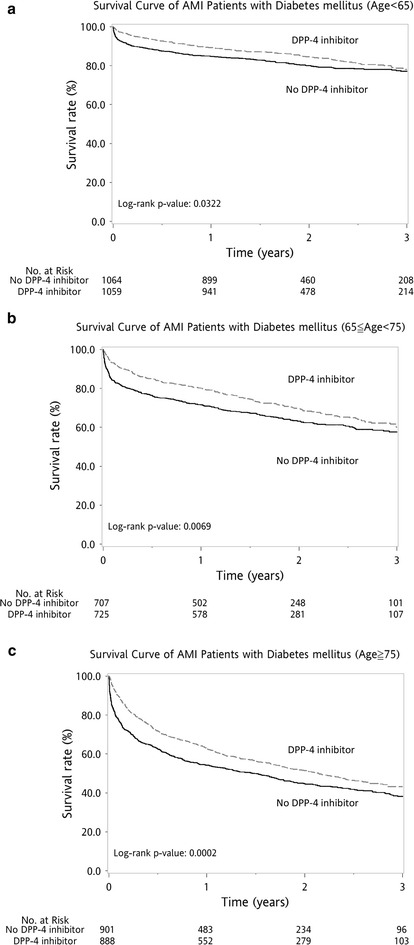
DPP-4 inhibitors improve the overall 3-year survival rate (log rank P < 0.0001), whether male or female. Cox proportional hazard regression showed DPP-4 inhibitor is beneficial in diabetes patients after AMI (HR = 0.86; 95% CI 0.78-0.95), especially in those patients with hypertension (HR = 0.87; 95% CI 0.78-0.97; P = 0.0103) and cerebrovascular disease (HR = 0.83; 95% CI 0.72-0.97; P = 0.018), but without dyslipidemia (HR = 0.78; 95% CI 0.67-0.92; P = 0.0029), without peripheral vascular disease (HR = 0.86; 95% CI 0.78-0.96; P = 0.0047), without heart failure (HR = 0.84; 95% CI 0.73-0.96; P = 0.0106), without end stage renal disease (HR = 0.86; 95% CI 0.77-0.95; P = 0.0035), and without chronic obstructive pulmonary disease (HR = 0.87; 95% CI 0.78-0.97; P = 0.0096).
DPP-4 inhibitor therapy improved long-term survival in diabetic patients after first AMI, regardless of gender.
先前关于二肽基肽酶 4(DPP-4)抑制剂的心脏保护作用的研究并未提供 DPP-4 抑制与实际心血管结局之间关系的充分证据。本研究旨在评估 DPP-4 抑制剂对首次急性心肌梗死(AMI)后糖尿病患者生存的影响。
这是一项全国性的、基于倾向评分匹配的病例对照研究,共纳入 186112 例首次 AMI 患者,其中 72924 例患有糖尿病。采用倾向评分、一对一匹配技术,将 2672 例 DPP-4 抑制剂组的患者与 2672 例患者进行匹配,用于分析。对照组基于性别、年龄以及高血压、血脂异常、糖尿病、外周血管疾病、心力衰竭、脑血管意外、终末期肾病、慢性阻塞性肺疾病和经皮冠状动脉介入治疗史进行匹配。
DPP-4 抑制剂改善了所有 3 年的总体生存率(对数秩 P<0.0001),无论患者为男性还是女性。Cox 比例风险回归显示,DPP-4 抑制剂对 AMI 后糖尿病患者有益(HR=0.86;95%CI 0.78-0.95),尤其是高血压(HR=0.87;95%CI 0.78-0.97;P=0.0103)和脑血管疾病(HR=0.83;95%CI 0.72-0.97;P=0.018)患者,而对血脂异常(HR=0.78;95%CI 0.67-0.92;P=0.0029)、外周血管疾病(HR=0.86;95%CI 0.78-0.96;P=0.0047)、心力衰竭(HR=0.84;95%CI 0.73-0.96;P=0.0106)、终末期肾病(HR=0.86;95%CI 0.77-0.95;P=0.0035)、慢性阻塞性肺疾病(HR=0.87;95%CI 0.78-0.97;P=0.0096)患者无益。
无论性别如何,DPP-4 抑制剂治疗均可改善首次 AMI 后糖尿病患者的长期生存。