Mak Catherine, Whittingham Koa, Cunnington Ross, Boyd Roslyn N
Queensland Cerebral Palsy and Rehabilitation Research Centre (QCPRRC), The University of Queensland Child Health Research Centre (UQ-CHRC), Faculty of Medicine, The University of Queensland, Brisbane, Queensland, Australia.
School of Psychology, The University of Queensland, Brisbane, Queensland, Australia.
BMJ Open. 2017 Jul 10;7(7):e015191. doi: 10.1136/bmjopen-2016-015191.
Cerebral palsy (CP) is the most common childhood physical disability, with life-long impacts for 1.77 in 1000 children. Although CP is primarily a physical disability, children with CP have an increased risk of experiencing cognitive difficulties, particularly attention and executive function deficits. Impairment in cognitive abilities can lead to subsequent impairment in independent functioning, education, employment and interpersonal relationships. This paper reports the protocol of a randomised controlled trial of a novel family-centred lifestyle intervention based on mindfulness and hatha yoga principles (MiYoga). MiYoga aims to enhance child and parent outcomes for children with CP.
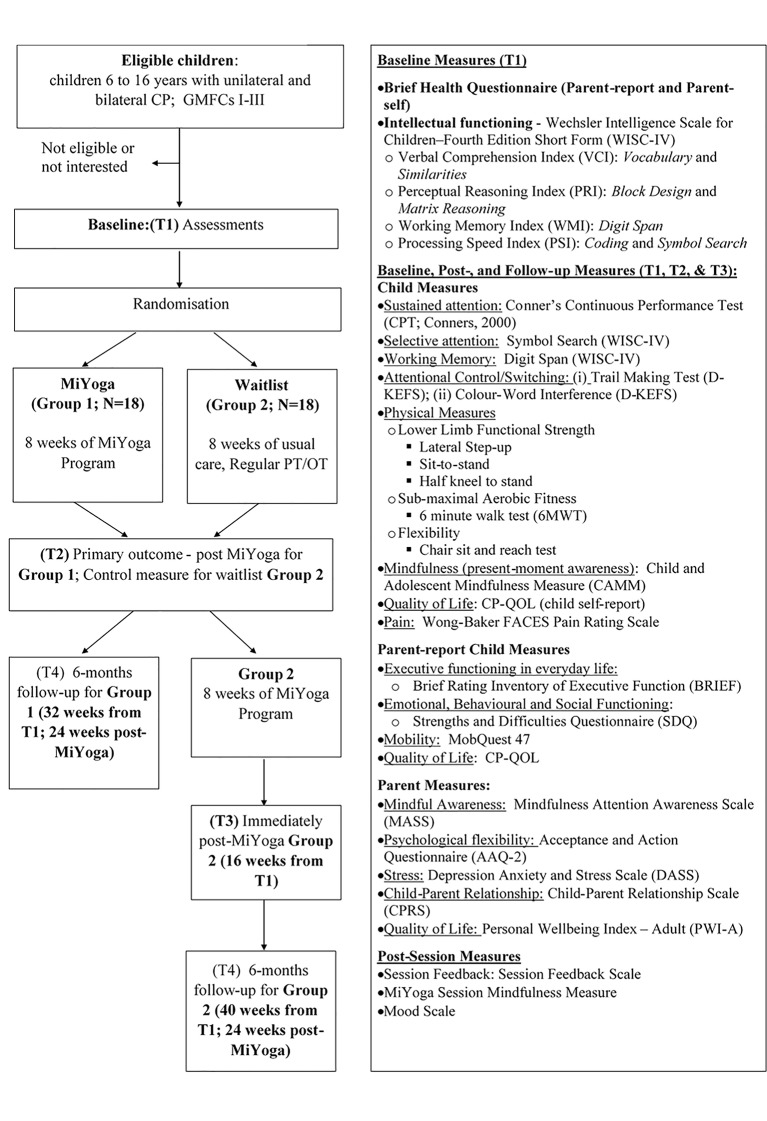
The aim is to recruit 36 child-parent dyads (children aged 6-16 years; bilateral or unilateral CP; Gross Motor Function Classification System I-III), who will be randomly assigned to two groups: MiYoga andwaitlistt control. The MiYoga programme will be facilitated in a group format for 8 weeks. Assessments will be administered at baseline, prior to MiYoga, following completion of MiYoga, and at 6-month follow-up (retention). The primary outcome will be the child's sustained attentional ability as measured by the Conner's Continuous Performance Test II. Other outcomes of interest for children with CP consists of attentional control, physical functioning, behavioural and well-being. For parents, the outcomes of interest are mindfulness, psychological flexibility and well-being. Data will be analysed using general linear models, specifically analysis of covariance and analysis of variance.
Full ethical approval for this study has been obtained by the Children's Health Queensland Hospital and Health Service Research Ethics Committee (HREC/12/QRCH/120) and The University of Queensland (2012000993). If MiYoga is proven effective, its dissemination would assist children with CP and complement their ongoing therapy by improving the ability of the child to pay attention at school and in therapy, and alleviating environmentalstressorss for both the child and his/her parents.
ACTRN12613000729729; Pre-results.http://www.ANZCTR.org.au/ACTRN12613000729729.aspx DATE OF TRIAL REGISTRATION: Prospectively registered on 2 July 2013-present (ongoing).
Recruitment is complete. Data are still being collected at present. We aim to complete data collection by February 2017.
脑瘫(CP)是儿童期最常见的身体残疾,每1000名儿童中有1.77人受其终身影响。尽管脑瘫主要是一种身体残疾,但脑瘫儿童出现认知困难的风险增加,尤其是注意力和执行功能缺陷。认知能力受损会导致独立功能、教育、就业和人际关系方面的后续损害。本文报告了一项基于正念和哈他瑜伽原则(MiYoga)的新型以家庭为中心的生活方式干预随机对照试验的方案。MiYoga旨在改善脑瘫儿童及其家长的相关结果。
目标是招募36对儿童-家长组合(儿童年龄在6至16岁;双侧或单侧脑瘫;粗大运动功能分类系统I-III级),他们将被随机分为两组:MiYoga组和等待名单对照组。MiYoga项目将以小组形式开展8周。评估将在基线、MiYoga之前、MiYoga完成后以及6个月随访(留存)时进行。主要结果将是通过康纳斯连续操作测验II测量的儿童持续注意力能力。脑瘫儿童的其他感兴趣结果包括注意力控制、身体功能、行为和幸福感。对于家长,感兴趣的结果是正念、心理灵活性和幸福感。数据将使用一般线性模型进行分析,具体为协方差分析和方差分析。
本研究已获得昆士兰儿童健康医院和卫生服务研究伦理委员会(HREC/12/QRCH/120)以及昆士兰大学(2012000993)的全面伦理批准。如果MiYoga被证明有效,其传播将有助于脑瘫儿童,并通过提高儿童在学校和治疗中的注意力以及减轻儿童及其父母的环境压力来补充他们正在进行的治疗。
ACTRN12613000729729;预结果。http://www.ANZCTR.org.au/ACTRN12613000729729.aspx 试验注册日期:前瞻性注册于2013年7月2日至今(正在进行)。
招募工作已完成。目前仍在收集数据。我们的目标是在2017年2月前完成数据收集。