Jordanić Mislav, Rojas-Martínez Mónica, Mañanas Miguel Angel, Alonso Joan Francesc, Marateb Hamid Reza
Department of Automatic Control (ESAII), Biomedical Engineering Research Centre (CREB), Universitat Politècnica de Catalunya (UPC), Barcelona 08028, Spain.
Biomedical Research Networking Center in Bioengineering, Biomaterials and Nanomedicine (CIBER-BBN), Madrid 28029, Spain.
Sensors (Basel). 2017 Jul 8;17(7):1597. doi: 10.3390/s17071597.
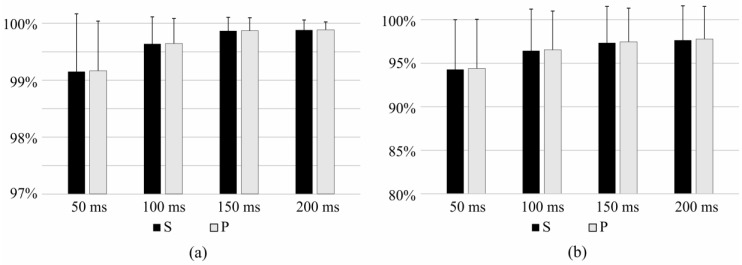
Estimation of neuromuscular intention using electromyography (EMG) and pattern recognition is still an open problem. One of the reasons is that the pattern-recognition approach is greatly influenced by temporal changes in electromyograms caused by the variations in the conductivity of the skin and/or electrodes, or physiological changes such as muscle fatigue. This paper proposes novel features for task identification extracted from the high-density electromyographic signal (HD-EMG) by applying the mean shift channel selection algorithm evaluated using a simple and fast classifier-linear discriminant analysis. HD-EMG was recorded from eight subjects during four upper-limb isometric motor tasks (flexion/extension, supination/pronation of the forearm) at three different levels of effort. Task and effort level identification showed very high classification rates in all cases. This new feature performed remarkably well particularly in the identification at very low effort levels. This could be a step towards the natural control in everyday applications where a subject could use low levels of effort to achieve motor tasks. Furthermore, it ensures reliable identification even in the presence of myoelectric fatigue and showed robustness to temporal changes in EMG, which could make it suitable in long-term applications.
利用肌电图(EMG)和模式识别来估计神经肌肉意图仍然是一个未解决的问题。原因之一是,模式识别方法会受到因皮肤和/或电极电导率变化或肌肉疲劳等生理变化而导致的肌电图时间变化的极大影响。本文提出了一种通过应用均值漂移通道选择算法从高密度肌电信号(HD-EMG)中提取的用于任务识别的新特征,该算法使用简单快速的分类器——线性判别分析进行评估。在三个不同用力水平下,对八名受试者在四种上肢等长运动任务(前臂屈伸、旋前/旋后)期间记录HD-EMG。任务和用力水平识别在所有情况下都显示出非常高的分类率。这种新特征尤其在极低用力水平的识别中表现出色。这可能是朝着日常应用中的自然控制迈出的一步,在这些应用中,受试者可以使用低水平的用力来完成运动任务。此外,即使在存在肌电疲劳的情况下,它也能确保可靠的识别,并且对肌电图的时间变化表现出鲁棒性,这使其适用于长期应用。