Vandenplas Yvan
Kidz Health Castle, UZ Brussel, Vrije Universiteit Brussel, Laarbeeklaan 101, 1090 Brussels, Belgium.
Nutrients. 2017 Jul 10;9(7):731. doi: 10.3390/nu9070731.
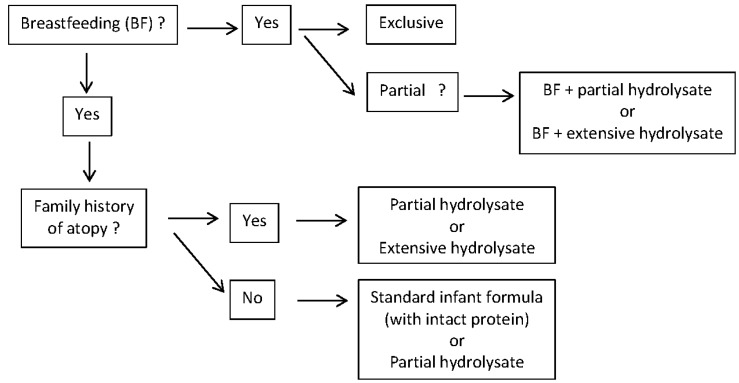
The prevention and management of cow milk allergy (CMA) is still debated. Since CMA is much less frequent in breastfed infants, breastfeeding should be stimulated. Literature was searched using databases to find original papers and reviews on this topic. Hydrolysates with a clinical proof of efficacy are recommended in the prevention and treatment of CMA. However, not all meta-analyses conclude that hydrolysates do prevent CMA or other atopic manifestations such as atopic dermatitis. There are pros and cons to consider partially hydrolysed protein as an option for starter infant formula for each non-exclusively breastfed infant. A challenge test is still recommended as the most specific and sensitive diagnostic test, although a positive challenge test does not proof that the immune system is involved. The Cow Milk Symptom Score (CoMiSS™) is an awareness tool that enables healthcare professionals to better recognize symptoms related to the ingestion of cow milk, but it still needs validation as diagnostic tool. The current recommended elimination diet is a cow milk based extensive hydrolysate, although rice hydrolysates or soy infant formula can be considered in some cases. About 10 to 15% of infants allergic to cow milk will also react to soy. Mainly because of the higher cost, amino acid based formula is reserved for severe cases. There is no place for infant formula with intact protein from other animals as cross-over allergenicity is high. During recent years, attention focused also on the bifidogenic effect of prebiotics and more recently also on human milk oligosaccharides. A bifidogenic gastrointestinal microbiome may decrease the risk to develop allergic disease. The addition of probiotics and prebiotics to the elimination diet in treatment may enhance the development of tolerance development. Breastfeeding is the best way to feed infants. Cow milk based extensive hydrolysates remain the first option for the treatment of CMA for the majority of patients, while amino acid formulas are reserved for the most severe cases. Rice hydrolysates and soy infant formula are second choice options. Partial hydrolysates with clinical proof of efficacy are recommended in some guidelines in the prevention of CMA and allergic disease in at risk infants, and may be considered as an option as protein source in starter infant formula.
牛奶过敏(CMA)的预防和管理仍存在争议。由于母乳喂养的婴儿中CMA的发生率要低得多,因此应鼓励母乳喂养。通过检索数据库查找关于该主题的原始论文和综述。在CMA的预防和治疗中,推荐使用具有临床疗效证据的水解配方奶粉。然而,并非所有的荟萃分析都得出水解配方奶粉能预防CMA或其他特应性表现(如特应性皮炎)的结论。对于每一个非纯母乳喂养的婴儿,将部分水解蛋白作为起始婴儿配方奶粉的选择都有其利弊。激发试验仍然是最具特异性和敏感性的诊断试验,尽管激发试验呈阳性并不能证明免疫系统参与其中。牛奶症状评分(CoMiSS™)是一种认知工具,可使医护人员更好地识别与摄入牛奶相关的症状,但它作为诊断工具仍需验证。目前推荐的排除饮食是以牛奶为基础的深度水解配方奶粉,不过在某些情况下也可考虑大米水解配方奶粉或大豆婴儿配方奶粉。约10%至15%对牛奶过敏的婴儿也会对大豆产生反应。主要由于成本较高,氨基酸配方奶粉仅用于重症病例。由于交叉过敏风险高,其他动物的完整蛋白婴儿配方奶粉没有应用空间。近年来,人们也关注到益生元的双歧杆菌生成作用,最近还关注到人乳寡糖。具有双歧杆菌生成作用的胃肠道微生物群可能会降低患过敏性疾病的风险。在治疗中,将益生菌和益生元添加到排除饮食中可能会促进耐受性的发展。母乳喂养是喂养婴儿的最佳方式。对于大多数患者,以牛奶为基础的深度水解配方奶粉仍然是治疗CMA的首选,而氨基酸配方奶粉仅用于最严重的病例。大米水解配方奶粉和大豆婴儿配方奶粉是第二选择。一些指南推荐在预防高危婴儿的CMA和过敏性疾病时使用具有临床疗效证据的部分水解配方奶粉,并且可以将其作为起始婴儿配方奶粉的蛋白质来源选项。