Institute of Epidemiology and Preventive Medicine, College of Public Health, National Taiwan University, Taipei, Taiwan.
Research Center for Genes, Environment and Human Health, College of Public Health, National Taiwan University, Taipei, Taiwan.
Sci Rep. 2017 Jul 11;7(1):5131. doi: 10.1038/s41598-017-05301-4.
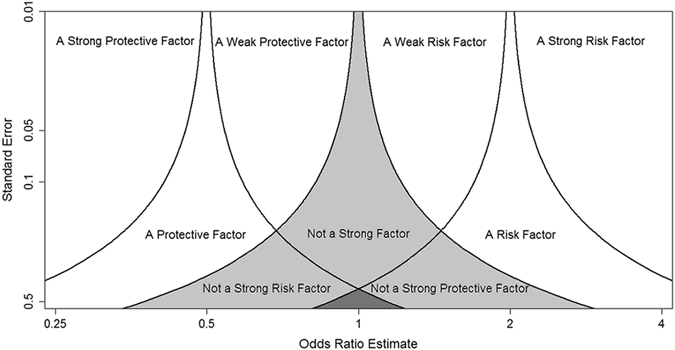
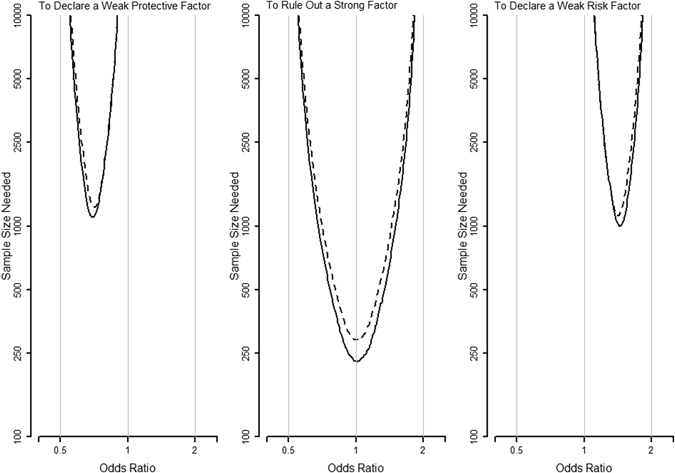
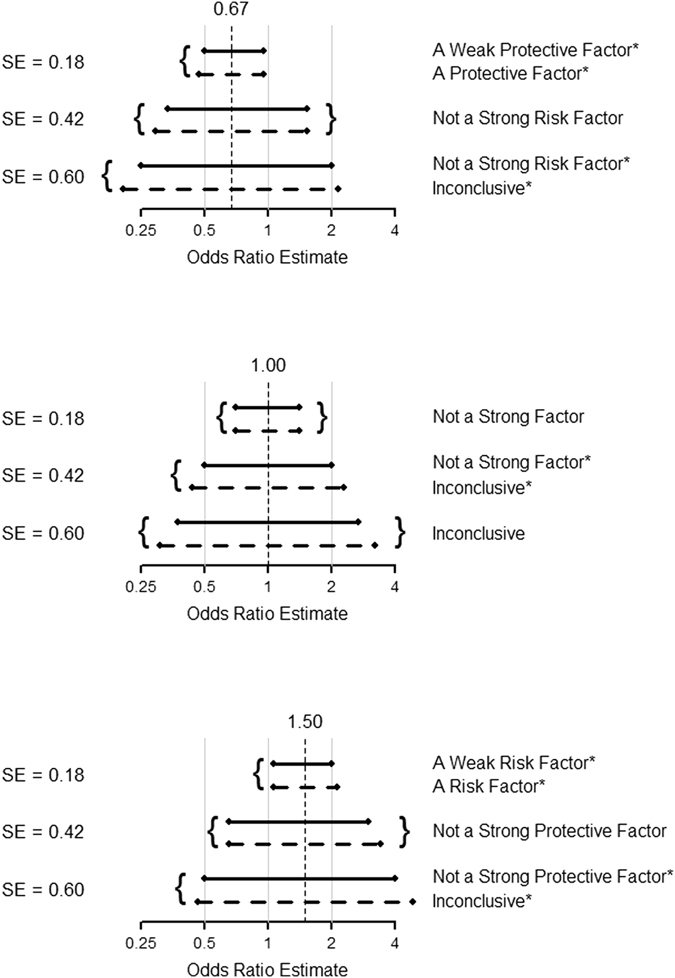
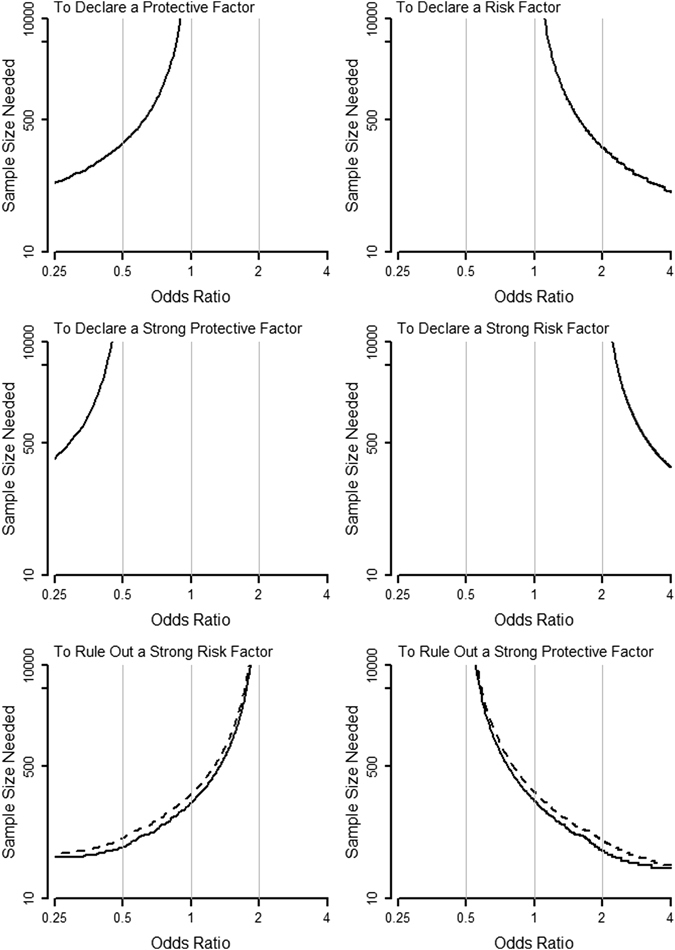
Characterizing exposure-disease associations is a central issue in epidemiology, one which epidemiologists often approach by adopting the index of the odds ratio and presenting its point estimate, p-value and confidence interval. In this study, the parameter space of the odds ratio is partitioned into five mutually exclusive regions corresponding to 'strong protective factor', 'weak protective factor', 'no association', 'weak risk factor', and 'strong risk factor', respectively. The authors presented a suite of statistical methods tailored to such a five-region demarcation, including methods for hypothesis testing, confidence interval estimation and calculation of the sample size needed to obtain the desired level of statistical power. The authors show that the five-region methods can efficiently and informatively describe a putative exposure-disease association, including its presence or absence, as well as its direction and strength (if any association exists). Three published results were re-analyzed to demonstrate the methods. R code is provided for convenience as well. The five-region methods are recommended for routine use during the analysis of epidemiologic data.
描述暴露-疾病关联是流行病学中的一个核心问题,为此,流行病学家通常采用比值比指数,并给出其点估计值、p 值和置信区间。在本研究中,将比值比的参数空间划分为五个相互排斥的区域,分别对应“强保护因素”、“弱保护因素”、“无关联”、“弱风险因素”和“强风险因素”。作者提出了一整套针对这种五区域划分的统计方法,包括用于假设检验、置信区间估计和计算获得所需统计功效所需样本量的方法。作者表明,五区域方法可以有效地、有信息量地描述一个假定的暴露-疾病关联,包括其存在与否,以及其方向和强度(如果存在任何关联)。还重新分析了三个已发表的结果以演示这些方法。此外还提供了 R 代码以便于使用。建议在分析流行病学数据时常规使用五区域方法。