Department of stomatology, Sichuan Cancer Hospital, Sichuan Cancer Center, School of Medicine, University of Electronic Science and Technology of China, Sichuan, China.
Department of Head and Neck Surgery, Sichuan Cancer Hospital, Sichuan Cancer Center, School of Medicine, University of Electronic Science and Technology of China, Sichuan, China.
Sci Rep. 2017 Jul 11;7(1):5148. doi: 10.1038/s41598-017-05479-7.
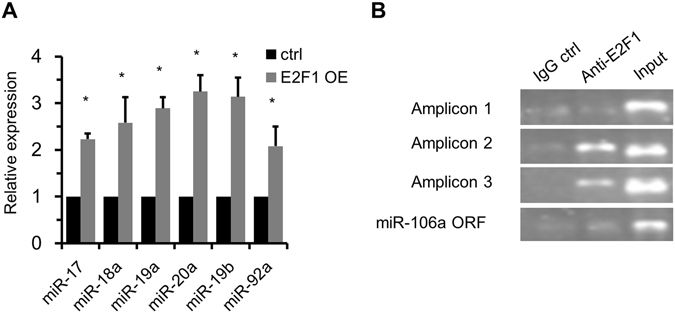
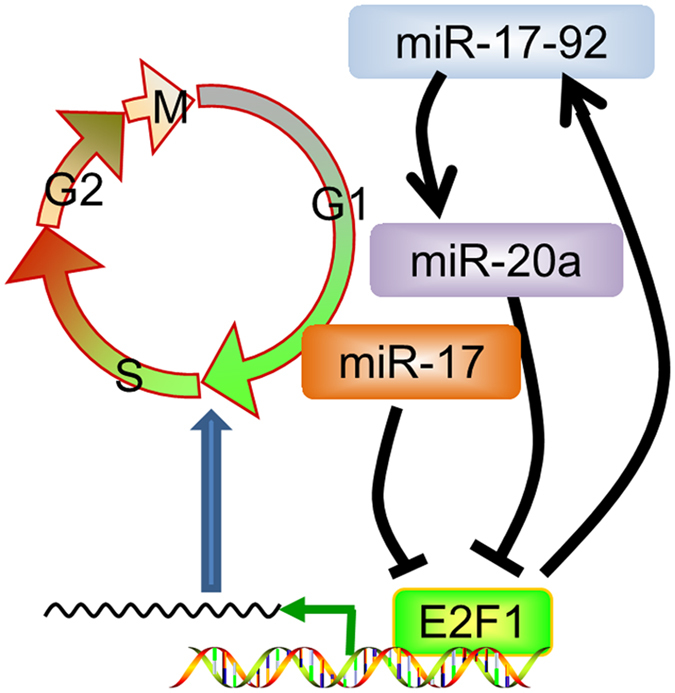
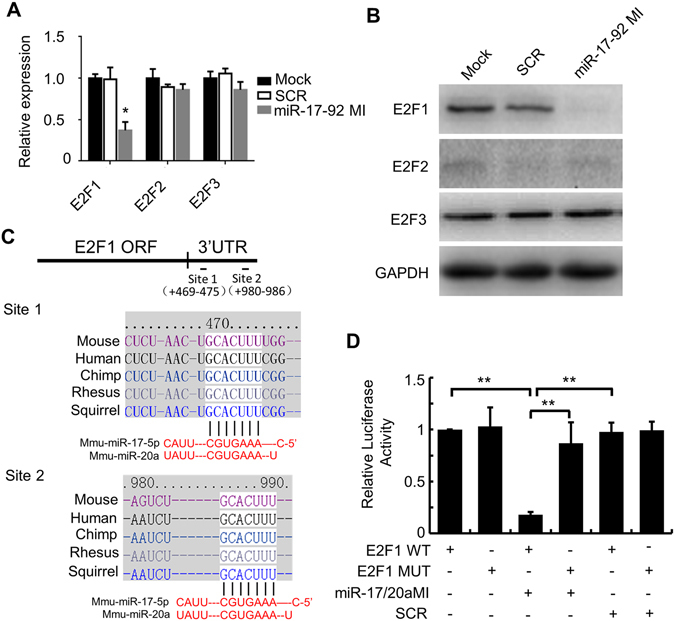
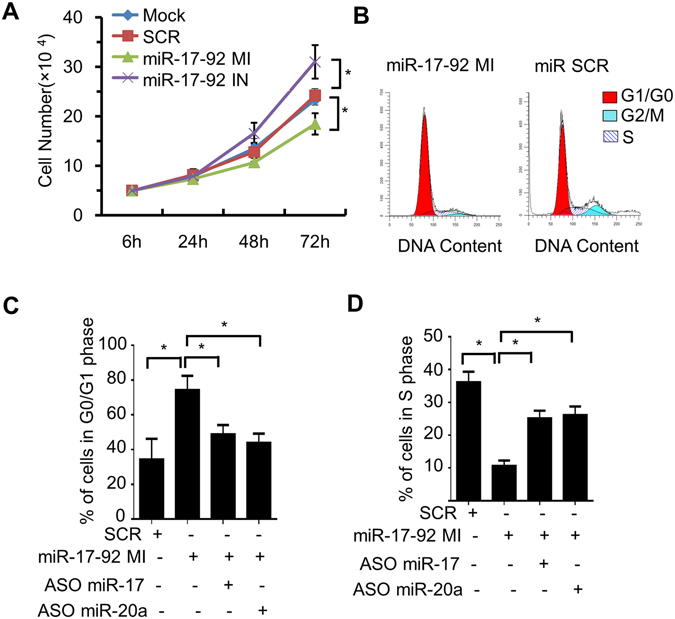
Normal cell cycle progression and proliferation of palatal mesenchymal cells are important for palatal development. As targets of miR-17-92, E2F transcription factors family has been suggested to induce the transcription of miR-17-92 in several cell types. In the present study, we sought to investigate whether this negative feedback loop exists in mouse PMCs and what the function of this negative feedback loop would be in palatal mesenchymal cells. Using GeneMANIA, we revealed that the most important function of experimentally verified targets of miR-17-92 is cell cycle regulation. E2F1 and E2F3, but not E2F2, were extensively expressed in mouse palate. Over-expression of E2F1 significantly increased the expression of all the members of miR-17-92. After increased by E2F1, miR-17 and miR-20a may negatively target E2F1, and thereby prevent the cells from excessive proliferation. We suggest that the negative feedback loop between E2F1 and miR-17-92 may contribute to palatal development by regulating the proliferation and cell cycle of palatal mesenchymal cells.
正常的细胞周期进程和腭中胚层细胞的增殖对于腭的发育是重要的。作为 miR-17-92 的靶标,E2F 转录因子家族已被认为在几种细胞类型中诱导 miR-17-92 的转录。在本研究中,我们试图研究这种负反馈回路是否存在于小鼠 PMCs 中,以及这种负反馈回路在腭中胚层细胞中的功能是什么。使用 GeneMANIA,我们揭示了 miR-17-92 的实验验证靶标的最重要功能是细胞周期调控。E2F1 和 E2F3,但不是 E2F2,在小鼠腭中广泛表达。E2F1 的过表达显著增加了 miR-17-92 的所有成员的表达。E2F1 增加后,miR-17 和 miR-20a 可能负向靶向 E2F1,从而防止细胞过度增殖。我们认为,E2F1 和 miR-17-92 之间的负反馈回路可能通过调节腭中胚层细胞的增殖和细胞周期来促进腭的发育。